Tropical Cyclones and Acute Coronary Syndromes: Unraveling the Cardiovascular Burden in Mainland China
Highlight
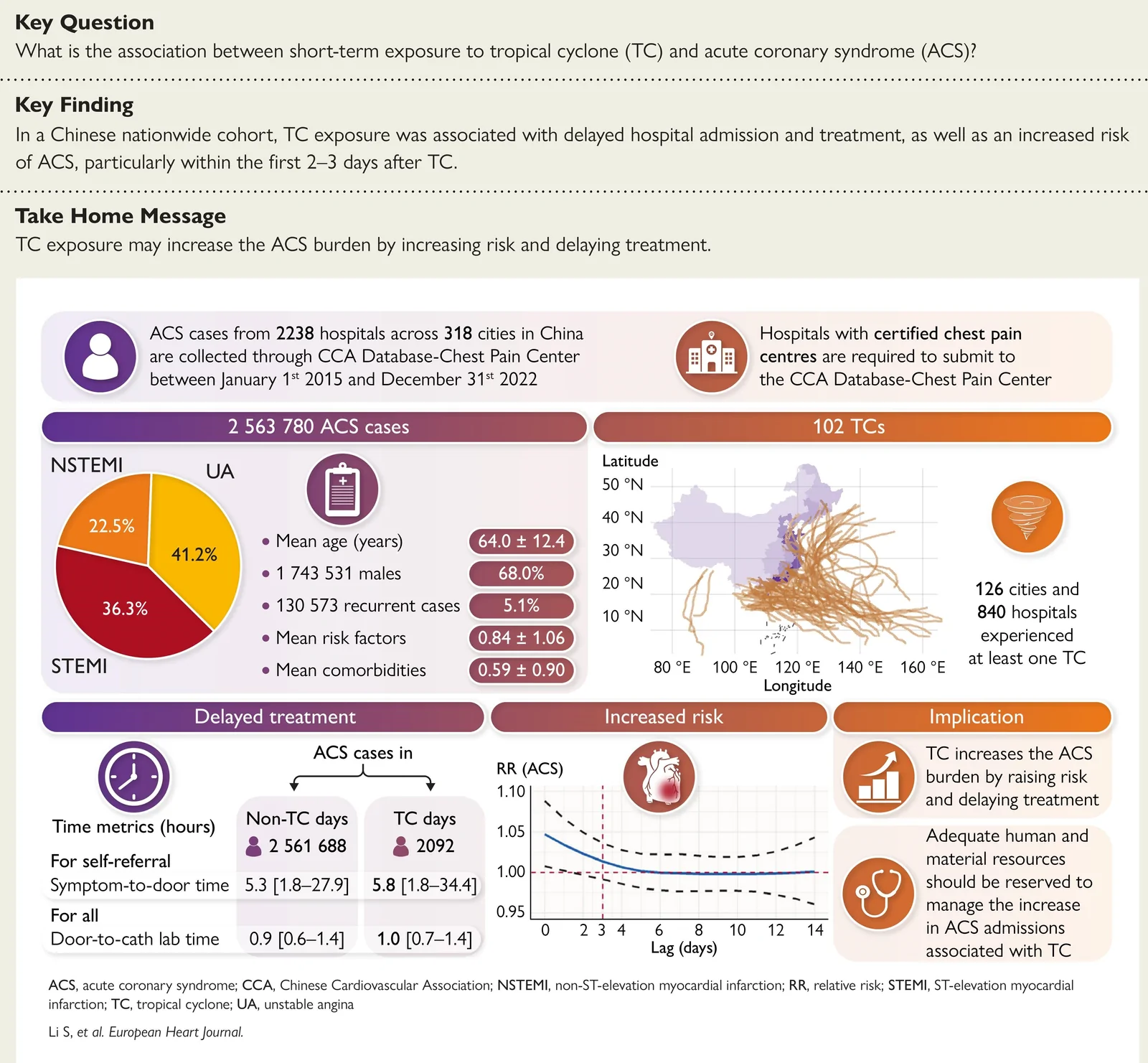
Tropical cyclone (TC) exposure in mainland China significantly raises acute coronary syndrome (ACS) incidence by 14% within three days post-exposure. TC days are linked to delays in hospital self-referral and longer times to catheterization treatment. Men, those with lower education levels, and individuals harboring multiple ACS risk factors demonstrate heightened vulnerability. These findings underscore the pressing need for multidisciplinary approaches to reduce TC-associated cardiovascular morbidity.
Study Background
Acute coronary syndrome (ACS), encompassing ST-elevation myocardial infarction (STEMI), non-ST-elevation myocardial infarction (NSTEMI), and unstable angina, remains a leading cause of morbidity and mortality worldwide. Environmental stressors such as extreme weather events have been increasingly recognized as triggers for cardiovascular events. Tropical cyclones, characterized by strong winds and heavy precipitation, pose not only direct physical hazards but also indirect health risks through psychological stress, disruptions in healthcare access, and physiological stress responses.
Existing evidence on the impact of tropical cyclones on ACS risk, particularly in developing countries where healthcare infrastructure may be limited, remains scarce. China experiences frequent tropical cyclones with substantial population exposure, making it an important setting to investigate these associations.
Study Design
This time-stratified case-crossover study analyzed 2,563,780 ACS patient records from a nationwide registry across mainland China collected between 2015 and 2022. Inclusion criteria focused on patients diagnosed with ACS and its subtypes: STEMI, NSTEMI, and unstable angina.
To define tropical cyclone exposure, the study employed the Willoughby wind field model to estimate daily maximum sustained wind speeds, classifying TC-exposed days as those with wind speeds ≥17.5 m/s. The primary outcome was ACS incidence in relation to TC exposure.
Statistical modeling used conditional quasi-Poisson regression combined with distributed lag non-linear models to evaluate both immediate and delayed associations over a 0–3-day lag period following TC exposure.
Subgroup analyses explored effect modification by sex, education level, and cardiovascular risk factor burden to identify populations at increased risk.
Key Findings
The study cohort had a mean age of 64.0 ± 12.4 years and was predominantly male (68%). On tropical cyclone days, patients exhibited significant delays in reaching hospital care, with an average self-referral delay of 5.8 hours compared to 5.3 hours on non-TC days. Furthermore, the time from hospital admission to catheterization prolonged to 1.0 hour on TC days versus 0.9 hours otherwise.
Importantly, TC exposure was associated with a 14% increase in ACS risk within 0–3 days after exposure (95% CI: 2% to 27%). The risk elevation was consistent across ACS subtypes, suggesting a broad impact of tropical cyclones on cardiac events.
Subgroup analyses revealed stronger associations among male patients, those with lower education levels, and individuals with multiple cardiovascular risk factors, highlighting social and biological vulnerability factors influencing outcomes.
Expert Commentary
This large-scale, methodologically rigorous study provides valuable epidemiological evidence linking extreme weather exposure to acute cardiovascular events in a high-burden, resource-diverse setting. The use of precise wind speed modeling and advanced time-series analytical approaches strengthens the validity of the findings.
The biological plausibility centers on the multifactorial mechanisms whereby tropical cyclones elicit acute physiologic stress responses, including inflammation, heightened sympathetic activity, and coagulation changes, potentiating plaque rupture and thrombosis. Concomitantly, logistical obstacles during TCs delay care delivery, compounding risk.
Limitations include potential residual confounding by unmeasured environmental or socioeconomic variables and the challenge of capturing all TC-related stressors beyond wind speed. Generalizability may vary depending on healthcare infrastructure and population demographics elsewhere.
Clinically, these results stress the urgency of integrating disaster preparedness into cardiovascular care protocols, prioritizing vulnerable groups for preventive interventions and ensuring rapid treatment access despite adverse weather. Public health policies should reinforce infrastructure resilience to reduce TC-associated morbidity.
Conclusion
This nationwide Chinese study substantially advances understanding of the intersection between environmental disasters and cardiovascular health by demonstrating that tropical cyclone exposure not only elevates ACS incidence but also compromises timely treatment. These findings call for collaborative efforts by governments, healthcare providers, and communities to implement targeted strategies that mitigate both the direct and indirect cardiovascular impacts of tropical cyclones.
Future research should explore mechanistic pathways in greater depth, evaluate intervention effectiveness, and extend surveillance to other disaster-prone regions globally to inform international guidelines on cardiovascular risk management during extreme weather events.
Funding and ClinicalTrials.gov
Details on funding sources and clinical trial registration were not specified in the original publication abstract.
References
Li S, Wang W, Zhou H, Zhang Y, Chen L, Lin J, Nawsherwan, Huo Y, Ge J, Wang B, Wang Y. Tropical cyclones and acute coronary syndromes: a Chinese nationwide study. Eur Heart J. 2026 Sep 8;47(34):4826-4838. PMID: 41705661.
Brook RD, Rajagopalan S, Pope CA 3rd, et al. Particulate Matter Air Pollution and Cardiovascular Disease: An Update to the Scientific Statement From the American Heart Association. Circulation. 2010 Jun 1;121(21):2331-78.
Bauer ME, Verrinder G, Brodie DA. Psychosocial and physiological stress responses of volunteer firefighters during wildfire suppression. Int J Wildland Fire. 2019;28(11):777-787.
Leiva A, Baeza C, Klug E, et al. Weather and Cardiovascular Disease: A Review. Open Cardiovasc Med J. 2014;8:58-68.
This article was created using several editorial tools, including AI, as part of the process. Human editors reviewed this content before publication.