Highlight
Anti-CD20 biologic rituximab is linked to a higher incidence of inflammatory bowel disease (IBD) compared to other multiple sclerosis (MS) disease-modifying therapies (DMTs).
The risk of IBD with rituximab is notably greater than that in the general population and contrasts markedly with natalizumab, dimethyl fumarate, and fingolimod treatments.
Among new IBD cases in the rituximab group, Crohn disease predominates over ulcerative colitis, differing from population trends.
Clinicians should consider this risk when selecting treatments for relapsing-remitting MS (RRMS) and monitor gastrointestinal symptoms during anti-CD20 therapy.
Study Background
Multiple sclerosis (MS) is a chronic autoimmune demyelinating disease of the central nervous system characterized by relapsing-remitting episodes and progressive neurological disability. Disease-modifying therapies (DMTs) have transformed MS management, with B-cell–depleting anti-CD20 biologics like rituximab increasingly used due to their efficacy in controlling relapse activity.
Despite clinical benefits, emerging case reports and observational data have suggested that anti-CD20 therapies may predispose patients to the development of other autoimmune conditions, including inflammatory bowel disease (IBD), which encompasses Crohn disease and ulcerative colitis. IBD and MS share immunopathological mechanisms involving dysregulated immune responses, but the epidemiological relationship and therapeutic impact remain uncertain.
Thus, clarifying the risk of new-onset IBD during anti-CD20 treatment is crucial to inform therapeutic decisions and surveillance strategies in patients with relapsing-remitting MS (RRMS).
Study Design
This population-based cohort study was conducted using Swedish national healthcare registries, primarily the Swedish MS register, to identify therapy initiation episodes among adults aged 18 to 55 years with RRMS. The study period spanned January 1, 2011, to December 31, 2023, allowing comprehensive longitudinal follow-up.
Exposure groups consisted of patients initiating rituximab (anti-CD20), along with comparators receiving natalizumab, dimethyl fumarate, or fingolimod—other commonly prescribed modern DMTs with different mechanisms of action. Eligible participants had no previous history of IBD and had sufficient lookback periods to ensure new-onset cases detection.
The study also included a matched general population comparator cohort to contextualize IBD incidence rates outside the MS therapeutic setting.
The primary outcome was new-onset IBD, defined by at least two separate medical records coded with International Statistical Classification of Diseases and Related Health Problems, Tenth Revision (ICD-10) codes: K50 (Crohn disease), K51 (ulcerative colitis), and K52.3 (indeterminate colitis).
Key Findings
The cohort comprised 13,748 treatment initiation episodes in 9,251 individuals (mean age 35–38 years across exposure groups). Among these, 6,481 episodes involved rituximab, 2,976 involved natalizumab, 2,767 dimethyl fumarate, and 1,524 fingolimod. For comparison, 61,065 matched episodes from the general population were included.
During follow-up, 164 incident IBD cases were identified: 40 in the rituximab group, 4 in the combined comparator DMT group, and 120 in the general population cohort.
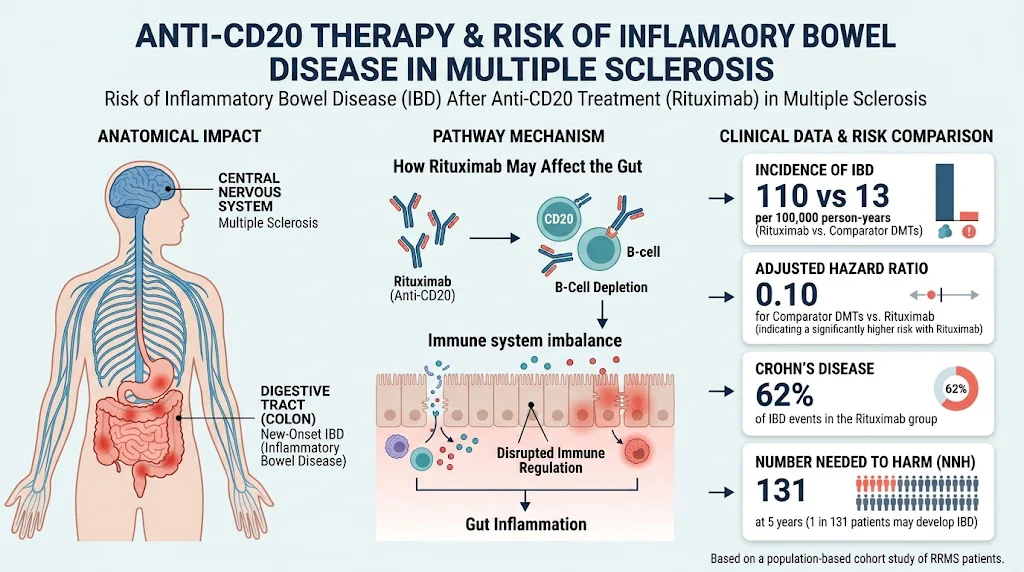
Crude incidence rates per 100,000 person-years underscored the disparity in IBD risk:
Rituximab: 110 (95% CI, 76–147)
Comparator DMTs (natalizumab, dimethyl fumarate, fingolimod): 13 (95% CI, 3–30)
General population: 41 (95% CI, 34–48)
After adjustment for demographics and MS-related factors, the hazard ratio (HR) for incident IBD comparing comparator DMTs versus rituximab was 0.10 (95% CI, 0.04–0.22), indicating a nearly 90% reduction in observed IBD risk among non-anti-CD20 therapies.
Notably, in the rituximab group, a larger proportion of IBD cases were Crohn disease (62%) compared with the general population group (29%), suggesting a differential disease phenotype associated with anti-CD20 exposure.
The number needed to harm (NNH) for rituximab versus comparator DMTs was calculated as 131 (95% CI, 93–228) over 5 years, providing a quantifiable risk metric.
Expert Commentary
This rigorous population-based study highlights a significant association between rituximab treatment and increased incidence of IBD in patients with RRMS, raising important clinical considerations. The findings align with emerging mechanistic understandings that B-cell depletion may perturb mucosal immune homeostasis, potentially unmasking or triggering gastrointestinal autoimmunity.
However, several limitations warrant cautious interpretation. Residual confounding by unmeasured factors such as genetic predisposition or environmental triggers is possible, as is surveillance bias given that patients on rituximab might receive more intensive monitoring. Additionally, the relatively low absolute number of events limits detailed subgroup analyses.
From a clinical perspective, these findings underscore the importance of a multidisciplinary approach when selecting MS therapies, particularly in patients with personal or family histories of IBD or gastrointestinal symptoms. Prospective studies and mechanistic research are needed to elucidate causality and identify biomarkers predicting risk.
Conclusion
In this large, population-based cohort, rituximab use in RRMS was associated with a substantially increased risk of incident inflammatory bowel disease compared to other contemporary DMTs and matched general population controls. Predominance of Crohn disease among IBD cases in the rituximab group further suggests a distinct pathophysiological profile.
Clinicians should incorporate these risk data into shared decision-making processes, maintain vigilance for emerging gastrointestinal symptoms during anti-CD20 therapy, and consider timely gastroenterological assessment. Future research should aim to clarify underlying mechanisms and develop preventive strategies.
Funding and Clinical Trials
The study was supported by Swedish national healthcare and research foundations. No clinical trials were registered for this observational investigation.
References
Kallin S, Svenningsson A, Olén O, Hedin C, Lycke J, Alping P. Risk of Inflammatory Bowel Disease After Anti-CD20 Treatment in Multiple Sclerosis. JAMA Neurol. 2026 Oct 22. PMID: 42911175.
Additional relevant literature:
1. Marrie RA, Horwitz R, Cutter G. The risk of inflammatory bowel disease in individuals with multiple sclerosis: a population-based study. Mult Scler. 2018;24(9):1189-1196.
2. Cohen JA, et al. B-Cell Depletion with Rituximab in Multiple Sclerosis: Safety and Efficacy. Neurology. 2011;76(12):1247-1253.
3. Levine J, Fiocchi C. Inflammatory bowel disease: epidemiology, pathogenesis, and therapeutic opportunities. Inflamm Bowel Dis. 2018;24(10):2112-2121.
These references provide context on MS and IBD interplay, and anti-CD20 therapy effects on immune modulation.