Highlight
This large international cohort study involving 1,095 patients with cervical artery dissection (CeAD) identifies that 57.9% achieved complete vessel recanalization at 6 months. Risk factors negatively impacting recanalization include older age, diabetes mellitus, active smoking, and complete vessel occlusion at presentation. Notably, antithrombotic therapy type (antiplatelet vs anticoagulation) showed no effect on recanalization rates. Incomplete recanalization was associated with a trend towards higher recurrent ischemic stroke risk.
Study Background and Disease Burden
Cervical artery dissection, a tear in the arterial wall of extracranial carotid or vertebral arteries, is a major cause of ischemic stroke in young and middle-aged adults. The resulting arterial stenosis or occlusion predisposes patients to ischemic events due to embolism or hemodynamic compromise. Understanding the natural history of vascular healing, specifically vessel recanalization, is crucial for optimizing secondary stroke prevention strategies and monitoring. Yet data on the rates and predictors of complete recanalization, and their impact on clinical outcomes, remain limited and inconsistent.
Study Design
This analysis is a planned sub-study from the Antithrombotic Treatment for Stroke Prevention in Cervical Artery Dissection (TREAT-CeAD) study, a large retrospective multicenter cohort drawn from 63 international sites between January 2015 and June 2022. Inclusion criteria for this subanalysis were patients diagnosed with imaging-confirmed CeAD involving a single vessel causing stenosis, who had vascular imaging available at 6 months post-dissection. In total, 1,095 patients were evaluated. The primary endpoint was complete vessel recanalization at 6 months, defined by follow-up vascular imaging assessment. Secondary endpoints included recurrent ischemic stroke rates and time to recanalization. Clinical characteristics, vascular imaging features at baseline, and follow-up were collected. Multivariable logistic regression was used to identify independent predictors of recanalization, and an accelerated failure time Weibull model evaluated time to recanalization.
Key Findings
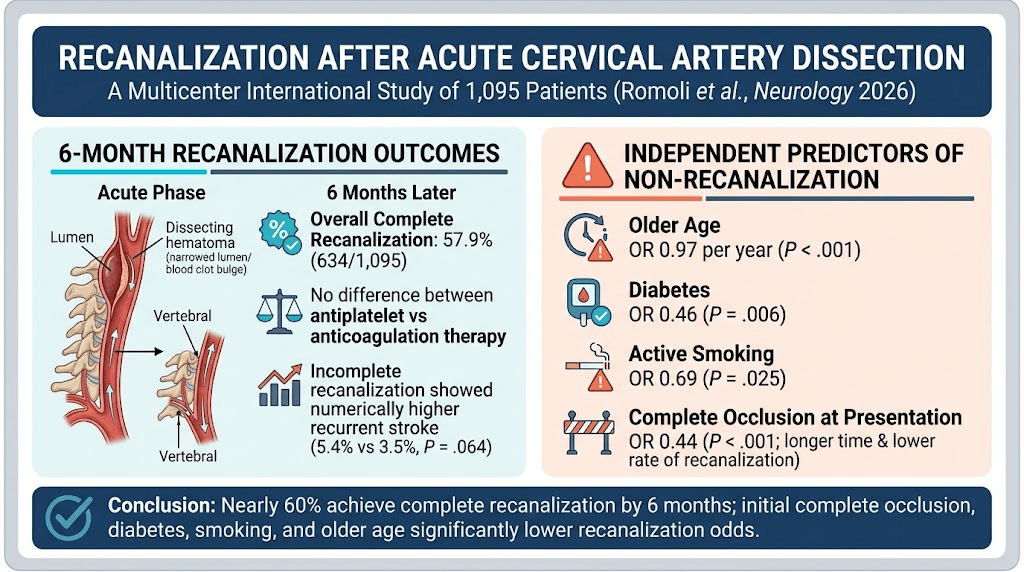
Among 1,095 patients (median age 45 years, 46.7% female), 634 (57.9%) achieved complete recanalization by 6 months. Independent factors associated with reduced likelihood of complete recanalization included:
Older age: Each additional year of age decreased odds of recanalization (OR 0.97; 95% CI 0.96–0.98; p <0.001)
Diabetes mellitus: halved odds of recanalization (OR 0.46; 95% CI 0.27–0.81; p=0.006)
Active smoking: 31% lower odds (OR 0.69; 95% CI 0.50–0.95; p=0.025)
Complete occlusion at presentation: 56% lower odds (OR 0.44; 95% CI 0.32–0.59; p<0.001)
Complete occlusions were associated with longer times to recanalization, confirmed by modeling. Most importantly, the type of antithrombotic therapy (antiplatelet vs anticoagulation) showed no impact on recanalization rates, addressing a key clinical question regarding medical management.
Incomplete recanalization patients had a numerically higher, though not statistically significant, recurrent ischemic stroke rate compared with those with complete recanalization (5.4% vs 3.5%; p=0.064). This suggests a clinically relevant trend warranting further investigation.
Expert Commentary
These findings substantially advance understanding of CeAD recovery dynamics. The interplay between modifiable risk factors—smoking and diabetes—and vascular healing highlights important targets for risk factor modification in this population. The finding that complete occlusion portends poorer recanalization and delayed vessel healing underlines the importance of initial imaging stratification for risk assessment and individualized surveillance protocols.
The lack of difference in recanalization between antiplatelet and anticoagulant therapies aligns with prior trials suggesting comparable efficacy for preventing stroke recurrence. This supports current guidelines favoring tailored antithrombotic treatment based on patient risk profiles rather than a one-size-fits-all approach.
Limitations include the retrospective design with inherent potential biases and variability in imaging modalities used across centers. Additionally, the relative infrequency of recurrent stroke events requires cautious interpretation of clinical outcome correlations. Prospective, randomized studies would further fortify evidence on management strategies affecting vascular remodeling and patient outcomes.
Conclusion
In this largest international cohort to date, nearly 60% of patients with acute cervical artery dissection achieved complete vessel recanalization at 6 months. Older age, diabetes, smoking, and initial complete occlusion of the vessel independently predicted incomplete recanalization. These insights emphasize the necessity of integrating clinical risk factors and baseline vascular imaging features to personalize follow-up imaging protocols and prevention strategies. Further prospective research is needed to determine if intensified intervention in high-risk groups can improve vascular healing and reduce recurrent stroke risk.
Funding and ClinicalTrials.gov
This study was supported by international collaborative institutional funding as part of the TREAT-CeAD initiative. No specific clinical trial registration was indicated for this retrospective analysis.
References
Romoli M, Muppa J, Lee EM, et al. Recanalization After Acute Cervical Artery Dissection: A Multicenter International Study. Neurology. 2026 Oct 20;107(9):e218566. PMID: 42900873.