Highlight
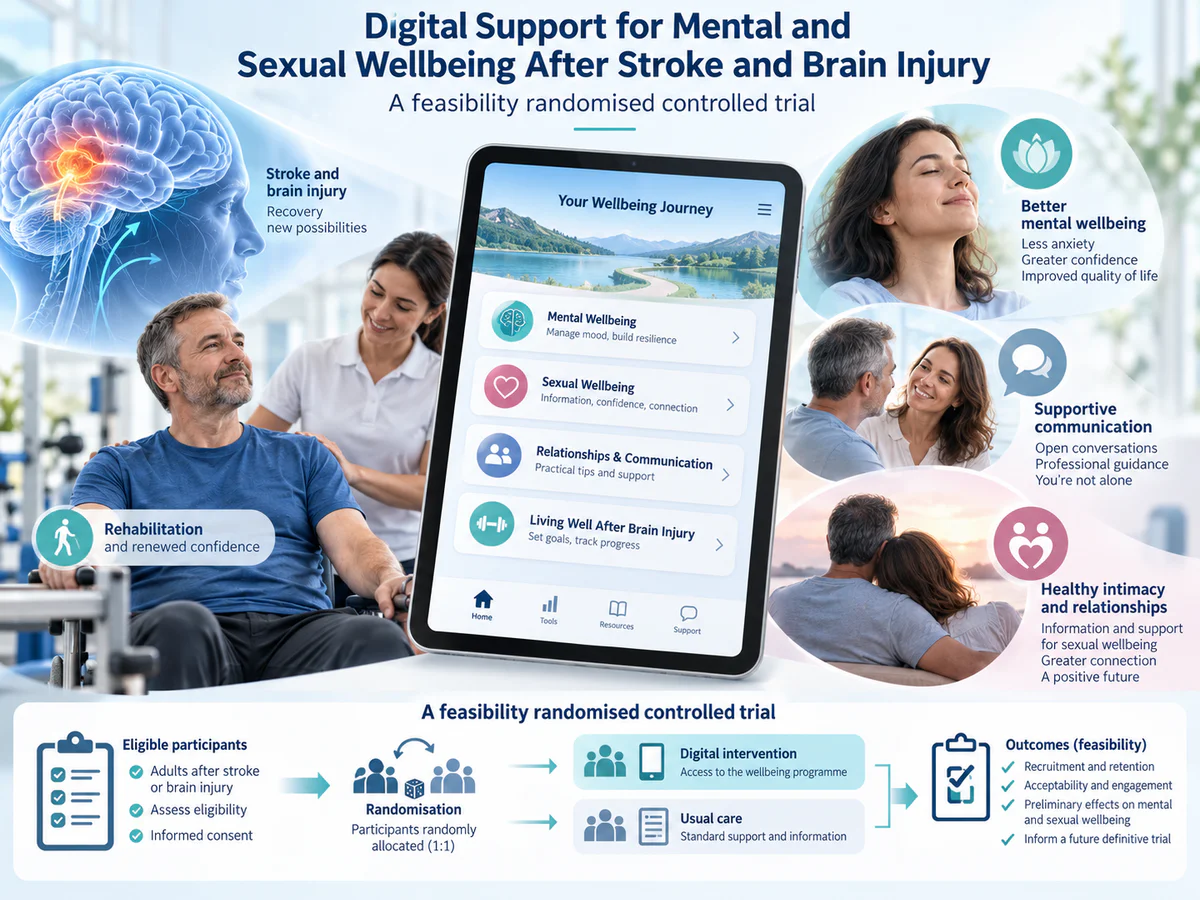
This feasibility randomized controlled trial evaluated HOPE4ABI, an innovative eight-week digital self-management program designed to support mental and sexual wellbeing in adults living with stroke or acquired brain injury (ABI). The study demonstrated acceptable recruitment and retention rates, revealing potential improvements in mental wellbeing, sexual wellbeing, and quality of life at six months post-intervention. Although engagement and acceptability targets were not fully met, participant feedback enabled refinement of the intervention. These findings support proceeding to a larger definitive trial to test efficacy and cost-effectiveness.
Study Background
Stroke and acquired brain injury (ABI) survivors frequently experience long-term challenges extending beyond physical disability, notably mental health difficulties such as depression and anxiety, and impairments in sexual wellbeing. Psychological sequelae and sexual dysfunction post-brain injury have profound impacts on quality of life but remain underrecognized and undertreated in clinical practice. Traditional rehabilitation often overlooks these domains, and survivors face barriers accessing specialized support. Digital interventions offer scalable, accessible solutions potentially filling this gap by delivering tailored educational content and self-management strategies remotely. However, evidence assessing their feasibility and impact in this population is limited, necessitating rigorous evaluation of novel approaches like HOPE4ABI.
Study Design
This was a pragmatic, parallel, two-arm feasibility randomized controlled trial conducted entirely online. The trial enrolled 53 adults residing in the U.K. with any type of acquired brain injury sustained at least three months before enrollment, reflecting a representative sample of chronic survivors. Participants were randomized 1:1 to receive either a self-guided or group-facilitated mode of the HOPE4ABI program, an eight-week digital self-management intervention targeting mental and sexual wellbeing post-brain injury.
Both arms received identical informational content via an online platform, covering psychological coping, sexual health education, and strategies to improve wellbeing. The group-facilitated arm additionally featured peer-to-peer interaction and professional facilitation via videoconferences, hypothesized to enhance engagement and support. Primary feasibility outcomes included recruitment rate, retention at six months, participant engagement (measured by module completion rates), and acceptability (participant satisfaction). Secondary outcomes comprised validated measures of mental wellbeing, sexual wellbeing, and overall quality of life, assessed at baseline, eight weeks, and six months.
Key Findings
The study successfully recruited 53 of 73 screened participants, achieving a recruitment rate of 72.6%, indicating good demand and accessibility for a digital platform in this population. At six months, follow-up data were retained from 45 participants (84.9%), exceeding the a priori progression criteria for retention and supporting trial feasibility.
Despite robust recruitment and retention, engagement with the intervention—defined by completion of program modules—was 52.3%, falling short of the predefined target. Similarly, acceptability, measured by participant satisfaction questionnaires, was 75.7%, just below the criterion. Post-intervention qualitative interviews explored barriers including digital literacy challenges, motivational fluctuations, and perceived relevance, guiding subsequent intervention refinement.
Encouragingly, analysis of six-month follow-up data revealed consistent improvements across all secondary outcome domains compared to baseline. Participants reported better mental wellbeing, reflected by enhanced mood and reduced distress scores. Sexual wellbeing measures indicated improvements in sexual satisfaction and intimacy confidence. Moreover, global quality of life assessments showed meaningful positive change. While the study was not powered to detect statistically significant efficacy, these signals provide preliminary evidence supporting the intervention’s potential clinical benefit.
No adverse events related to the digital intervention were reported, underscoring its safety and tolerability. Both delivery modes—self-guided and group-facilitated—were feasible, though interactive facilitation may enhance engagement, warranting further investigation.
Expert Commentary
The authors appropriately conducted this feasibility study as a critical precursor to a definitive efficacy trial. The inclusion of both self-guided and group-facilitated arms offers valuable insight into optimal digital delivery modalities post-ABI, balancing autonomy and social support. Notably, sexual health is a neglected domain in neurorehabilitation; thus, HOPE4ABI addresses an important unmet need. The recruitment and retention successes highlight the acceptability of digital platforms among a traditionally hard-to-reach population.
Limitations include the modest sample size limiting efficacy interpretation, potential selection bias toward digitally literate participants, and incomplete engagement that may attenuate effect sizes. The modest acceptability and engagement emphasize the importance of iterative adaptations to improve usability, content relevance, and motivational support. Further mechanistic work elucidating how changes in mental wellbeing interact with sexual health outcomes post-stroke could enhance intervention targeting.
Current clinical guidelines emphasize holistic rehabilitation addressing psychosocial and sexual wellbeing after brain injury but lack clear evidence-based digital interventions. HOPE4ABI could become a scalable adjunct to enhance multidisciplinary rehabilitation if efficacy is confirmed.
Conclusion
This feasibility randomized controlled trial demonstrates that the HOPE4ABI digital intervention is a promising tool to support mental and sexual wellbeing in stroke and brain injury survivors. Key feasibility metrics—particularly recruitment and retention—were met, and emerging efficacy signals suggest beneficial impacts on wellbeing and quality of life at six months. Challenges around engagement and acceptability are surmountable through iterative user feedback and program refinement.
The findings justify progression to a larger definitive trial to robustly evaluate HOPE4ABI’s clinical effectiveness and cost-effectiveness. If successful, this intervention could fill a critical gap in holistic brain injury rehabilitation, empowering survivors to better manage mental and sexual health concerns digitally, thereby improving long-term quality of life.
Funding and Clinical Trials Registration
The study was registered with ISRCTN (Registration number ISRCTN46988394). Details regarding funding were not specified in the abstract and should be reviewed in the full publication for transparency.
References
1. Wright H, Walker-Clarke A, Drummond A, Kidd L, Yeates G, Williams D, McWilliams D, Kimani PK, Matouskova G, Turner A. A novel digital intervention to support mental and sexual wellbeing after stroke and brain injury: A feasibility randomised controlled trial. Clinical Rehabilitation. 2026 Oct 22;2692155261498396. doi: 10.1177/02692155261498396. PMID: 42910834.
2. Ownsworth T, Strong J, Hollon SD. Psychosocial adjustment after acquired brain injury: A systematic review of intervention studies. Journal of Clinical Psychology in Medical Settings. 2008;15(2):140-153.
3. Graziadio S, Gamble C, Bhave S, Rodgers H. Sexual dysfunction in stroke survivors: a systematic review of qualitative evidence. Disability and Rehabilitation. 2013;35(20):1709-1717.
4. Bateman A, et al. eHealth interventions for patients with stroke and aphasia: A systematic review. Topics in Stroke Rehabilitation. 2018;25(7):455-460.
5. National Institute for Health and Care Excellence (NICE). Stroke rehabilitation in adults. NICE guideline [NG128]. 2019.