We use cookies

Our website uses essential cookies and, with your consent, additional cookies to measure performance and improve our services. Cookie Policy.

You can change your choice at any time.

MMedXYNews
HomeVideos
MedXY AI/MedXY News/Tag: multiple sclerosis
MedXY News
EnglishTag

multiple sclerosis

Ask MedXY AI
type 2 diabetesclinical trialheart failureimmunotherapyobesitycardiovascular riskatrial fibrillationbiomarkerscritical careclinical trialsHypertensionartificial intelligenceCardiologyoncologypublic healthtype 1 diabetesdiabetesMortalityAlzheimer's diseasecardiovascular diseasebreast cancerepidemiology

Latest news

Tag

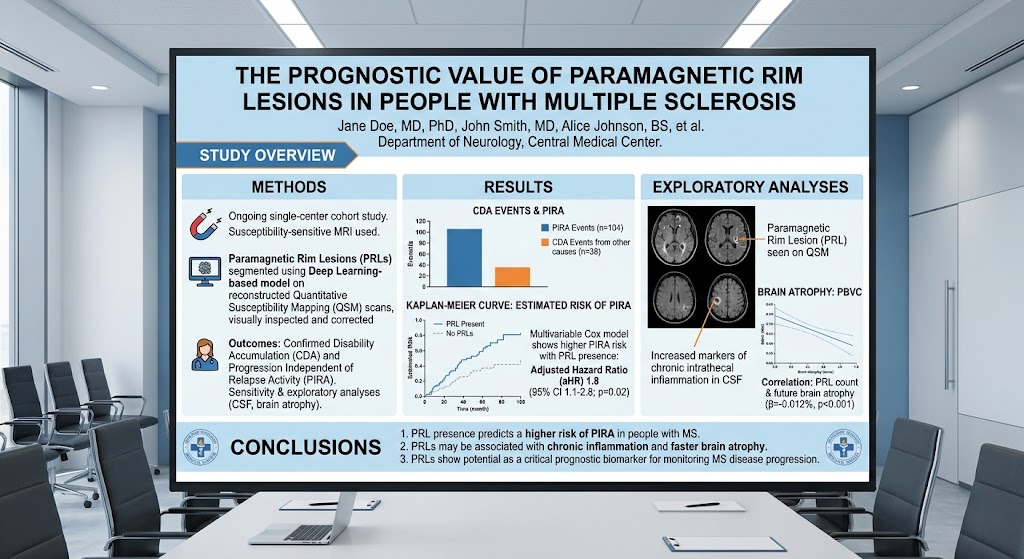
Paramagnetic Rim Lesions as Predictors of Progression in Multiple Sclerosis: Insights from a 5-Year Longitudinal Study
NeurologyParamagnetic Rim LesionsBrain Atrophy

Paramagnetic Rim Lesions as Predictors of Progression in Multiple Sclerosis: Insights from a 5-Year Longitudinal Study

By MedXY|Aug 22, 2026

Paramagnetic rim lesions detected via MRI are associated with increased risk of disability progression independent of relapse activity and accelerated brain atrophy in multiple sclerosis, highlighting their role as prognostic biomarkers for
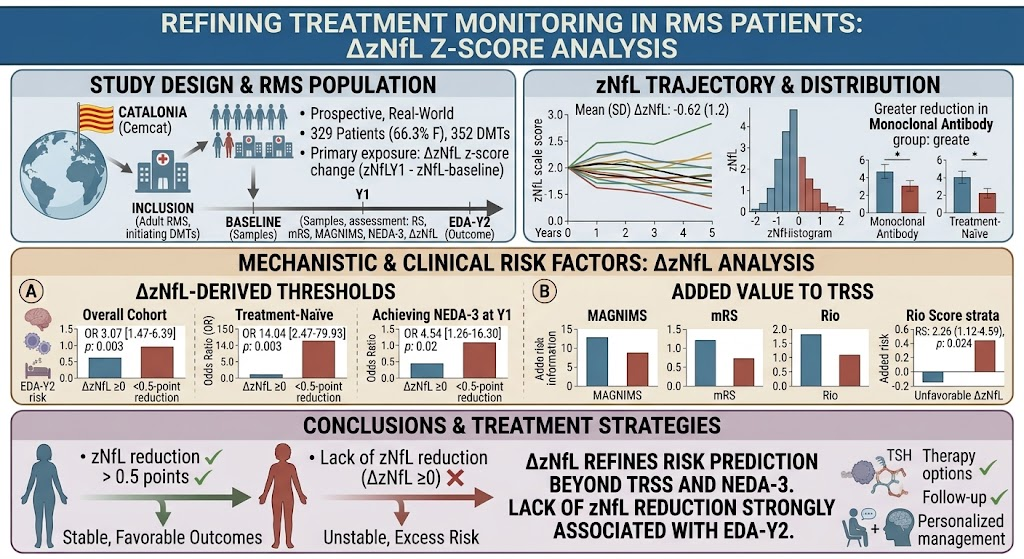
Refining Treatment Monitoring in Patients With Relapsing Multiple Sclerosis Based on Changes on Neurofilament Light Chain Z-Scores
Clinical Updatesmultiple sclerosis
© 2026 MedXY
Contact usAbout usPrivacy PolicyMedXY story
Treatment monitoring

Refining Treatment Monitoring in Patients With Relapsing Multiple Sclerosis Based on Changes on Neurofilament Light Chain Z-Scores

By MedXY|Aug 21, 2026

Serum neurofilament light chain (sNfL) z-score dynamics enhance monitoring of treatment response in relapsing multiple sclerosis (RMS), providing complementary predictive value for disease activity beyond conventional clinical and MRI asses

Serum Glial Fibrillary Acidic Protein Dynamics in Multiple Sclerosis: Biomarker Insights into Disease Progression and Therapeutic Response
Clinical Updatesmultiple sclerosisGFAP

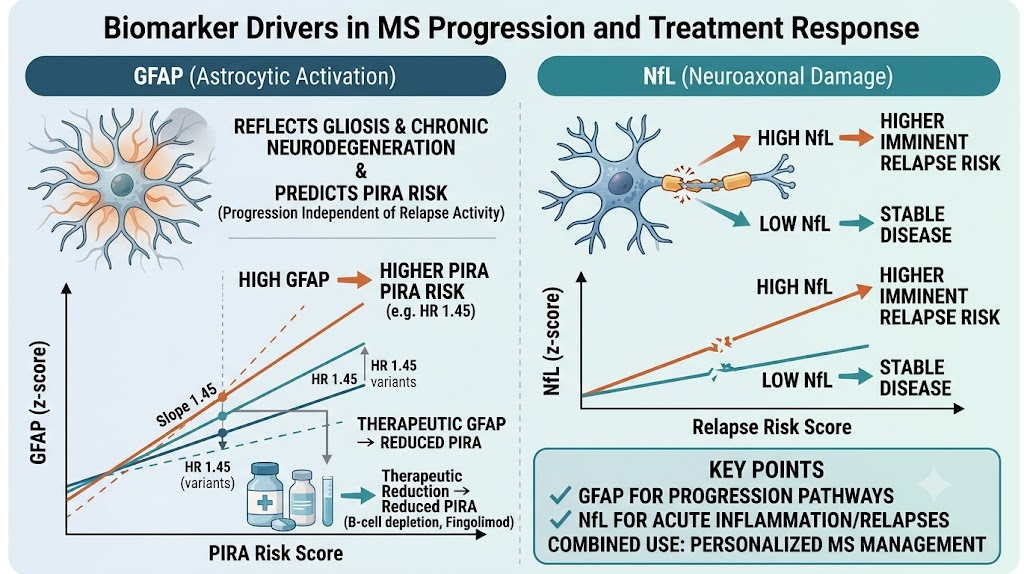
Serum Glial Fibrillary Acidic Protein Dynamics in Multiple Sclerosis: Biomarker Insights into Disease Progression and Therapeutic Response

By MedXY|Aug 4, 2026

Serum GFAP elevation predicts progression independent of relapse in MS; therapy-induced GFAP reduction associates with decreased progression risk, supporting GFAP as a biomarker for progression risk stratification and treatment monitoring.

Multiple Sclerosis Does Not Appear to Worsen In-Hospital Outcomes After Cardiovascular Surgery, but Routine Home Discharge Is Less Common
Cardiologycardiovascular surgerydischarge disposition

Multiple Sclerosis Does Not Appear to Worsen In-Hospital Outcomes After Cardiovascular Surgery, but Routine Home Discharge Is Less Common

By MedXY|Jun 11, 2026

A large US inpatient analysis found similar in-hospital mortality and complication rates after cardiovascular surgery in patients with and without multiple sclerosis, but patients with MS were less often discharged routinely home.

Why Prevalence Is Rising Differently in Parkinson Disease, Multiple Sclerosis, and Motor Neuron Diseases
Neurologymultiple sclerosisParkinson disease

Why Prevalence Is Rising Differently in Parkinson Disease, Multiple Sclerosis, and Motor Neuron Diseases

By MedXY|Jun 9, 2026

A large Sweden-France analysis suggests rising MS prevalence is mainly survival-driven, increasing MND prevalence reflects growing incidence, and PD prevalence rises modestly through mixed demographic and survival effects.

Subclinical Peripheral Vascular Leakage in Demyelinating Disease-Associated Uveitis: What Ultra-Widefield Angiography Adds Beyond Clinical Quiescence
Clinical Updatesfluorescein angiographymultiple sclerosis

Subclinical Peripheral Vascular Leakage in Demyelinating Disease-Associated Uveitis: What Ultra-Widefield Angiography Adds Beyond Clinical Quiescence

By MedXY|Jun 9, 2026

A new cohort study suggests ultra-widefield fluorescein angiography frequently detects persistent peripheral leakage in clinically inactive demyelinating disease-associated uveitis, highlighting a potential gap between examination-based rem

Multiple Sclerosis End-of-Life Care Remains Hospital-Centered Despite Comparable Palliative Care Use
Neurologyhealth services researchhospital death

Multiple Sclerosis End-of-Life Care Remains Hospital-Centered Despite Comparable Palliative Care Use

By MedXY|May 10, 2026

A large Ontario population study found that people with multiple sclerosis received palliative care at rates similar to other decedents, yet rural inequities and frequent hospital death persisted, highlighting the need for earlier neuropall

Five-Year Ublituximab Treatment Shows Sustained Benefits in Relapsing Multiple Sclerosis: ULTIMATE Extension Study
Allergy & Immunologyclinical trialDisease-Modifying Therapy

Five-Year Ublituximab Treatment Shows Sustained Benefits in Relapsing Multiple Sclerosis: ULTIMATE Extension Study

By MedXY|Apr 22, 2026

Long-term data from the ULTIMATE open-label extension study demonstrates sustained efficacy and safety of ublituximab in relapsing multiple sclerosis over five years, with significant reductions in relapse rates and disability progression c

Money Talks: How Pharmaceutical Industry Payments Influence MS Doctors to Prescribe Costlier Brand-Name Drugs Over Generics
NeurologyGeneric DrugsIndustry Payments

Money Talks: How Pharmaceutical Industry Payments Influence MS Doctors to Prescribe Costlier Brand-Name Drugs Over Generics

By MedXY|Apr 7, 2026

A new study reveals that neurologists receiving $1,000 or more from drug manufacturers were over 4 times more likely to prescribe expensive brand-name MS medications when generics were available, driving up costs for patients and the health

Why the New MS Diagnostic Criteria Require Caution: High Frequency of MOGAD and NMOSD in Optic Neuritis Patients
NeurologyMOGADmultiple sclerosis

Why the New MS Diagnostic Criteria Require Caution: High Frequency of MOGAD and NMOSD in Optic Neuritis Patients

By MedXY|Mar 30, 2026

A retrospective study reveals that 24% of patients meeting the latest MS criteria following optic neuritis actually have MOGAD or NMOSD, emphasizing the need for antibody testing to prevent misdiagnosis.

Navigating the Diagnostic Overlap: Why 24 Percent of Patients Meeting Minimal MS Criteria for Optic Neuritis Require Antibody Testing
NeurologyMOGADmultiple sclerosis

Navigating the Diagnostic Overlap: Why 24 Percent of Patients Meeting Minimal MS Criteria for Optic Neuritis Require Antibody Testing

By MedXY|Mar 18, 2026

A multicenter study reveals that nearly one-quarter of patients meeting the newest multiple sclerosis criteria for optic neuritis actually have MOGAD or NMOSD, emphasizing the critical role of antibody screening and detailed orbital MRI in

High-Level EBNA-1 Antibodies: A Precise Biomarker for Differentiating Multiple Sclerosis From MOGAD and NMOSD
NeurologybiomarkersEBNA-1

High-Level EBNA-1 Antibodies: A Precise Biomarker for Differentiating Multiple Sclerosis From MOGAD and NMOSD

By MedXY|Mar 11, 2026

A large-scale multicenter study reveals that persistent high-level Epstein-Barr nuclear antigen 1 (EBNA-1) peptide antibody titers serve as a highly specific biomarker, effectively distinguishing Multiple Sclerosis from other neuroinflammat

The Prognostic Significance of Paramagnetic Rim Lesions in Radiologically Isolated Syndrome: A New Paradigm for Early Multiple Sclerosis Diagnosis
Clinical UpdatesMRI biomarkersmultiple sclerosis

The Prognostic Significance of Paramagnetic Rim Lesions in Radiologically Isolated Syndrome: A New Paradigm for Early Multiple Sclerosis Diagnosis

By MedXY|Mar 11, 2026

This review explores how paramagnetic rim lesions (PRLs), as markers of chronic active demyelination, serve as powerful predictors for clinical Multiple Sclerosis conversion in individuals with radiologically isolated syndrome.

Beyond the Blood-Brain Barrier: Skull Bone Marrow TSPO Overexpression as a Novel Biomarker for Multiple Sclerosis Progression
Neurologybiomarkersmultiple sclerosis

Beyond the Blood-Brain Barrier: Skull Bone Marrow TSPO Overexpression as a Novel Biomarker for Multiple Sclerosis Progression

By MedXY|Mar 10, 2026

**Refining Content Structure** I’m now deeply immersed in the content. I’ve drafted the introduction, designed to capture attention and set the scene. I am expanding on the key findings, including correlations, and the clinical

Mapping the Genomic Landscape of Multiple Sclerosis Across Diverse Ancestries: Insights into Shared and Population-Specific Susceptibility
Clinical UpdatesGenetic Ancestrymultiple sclerosis

Mapping the Genomic Landscape of Multiple Sclerosis Across Diverse Ancestries: Insights into Shared and Population-Specific Susceptibility

By MedXY|Mar 8, 2026

This study demonstrates that while MS genetic risk factors are largely shared across ancestral groups, their predictive power and population-level impact vary significantly between European, South Asian, and African populations.

Long-Term Ublituximab Therapy in Multiple Sclerosis: Five-Year Results from the ULTIMATE I and II Extension Study Validate Early High-Efficacy Intervention
NeurologyB-cell Depletionmultiple sclerosis

Long-Term Ublituximab Therapy in Multiple Sclerosis: Five-Year Results from the ULTIMATE I and II Extension Study Validate Early High-Efficacy Intervention

By MedXY|Feb 20, 2026

Five-year data from the ULTIMATE I and II open-label extension demonstrate that ublituximab maintains exceptionally low relapse rates and slows disability progression in relapsing multiple sclerosis, emphasizing the clinical superiority of

Fenebrutinib Achieves 69% Reduction in New Brain Lesions for Relapsing Multiple Sclerosis: Insights from the FENopta Phase 2 Trial
NeurologyChất ức chế BTKfenebrutinib

Fenebrutinib Achieves 69% Reduction in New Brain Lesions for Relapsing Multiple Sclerosis: Insights from the FENopta Phase 2 Trial

By MedXY|Dec 23, 2025

The Phase 2 FENopta trial demonstrates that fenebrutinib, a highly selective, reversible BTK inhibitor, significantly reduces MRI disease activity by 69% in relapsing multiple sclerosis while maintaining a favorable safety profile over 48 w

Pregnancy DMT Management in Multiple Sclerosis Increases Relapse Risk — Anti‑CD20 Before Conception Is Most Protective
NeurologyDisease-Modifying Therapymultiple sclerosis

Pregnancy DMT Management in Multiple Sclerosis Increases Relapse Risk — Anti‑CD20 Before Conception Is Most Protective

By MedXY|Dec 11, 2025

A large French registry study shows that how disease-modifying therapies (DMTs) are managed during pregnancy meaningfully affects relapse rates in relapsing‑onset MS; prolonged natalizumab interruption and fingolimod use carry the highest r

Simvastatin Fails to Slow Disability Progression in Secondary Progressive Multiple Sclerosis: Insights from the Phase 3 MS-STAT2 Trial
Neurologyclinical trialmultiple sclerosis

Simvastatin Fails to Slow Disability Progression in Secondary Progressive Multiple Sclerosis: Insights from the Phase 3 MS-STAT2 Trial

By MedXY|Jan 15, 2026

In a large phase 3 trial, simvastatin 80 mg daily did not reduce disability progression in secondary progressive multiple sclerosis, challenging prior phase 2 results and underscoring the complexity of neurodegeneration in SPMS.

Menopause and Multiple Sclerosis: Evaluating the Impact on Disability Progression
Allergy & Immunologydisability progressionMenopause

Menopause and Multiple Sclerosis: Evaluating the Impact on Disability Progression

By MedXY|Oct 6, 2025

A comprehensive analysis reveals that menopause does not significantly alter the risk of disability progression in women with relapse-onset multiple sclerosis, underscoring the complexity of reproductive aging’s role in disease trajec

1 / 2
12
Next
Ask MedXY AI

Most popular

Intimate Health
Five Benefits for Women Continuing Sexual Activity After Menopause
Intimate Health
Why Some Women Have a Strong Sex Drive—And Why Men Shouldn't Worry About It
Nursing & care
How often should a couple have sex?
Intimate Health
Classic Intimacy Recommendations: How to Help Women Reach Orgasm and Enjoy Mutual Pleasure
Intimate Health
What Makes a Woman "Physiologically Addicted" Is Never Money, But These Two Relationship Qualities