Highlight
The study evaluated the long-term predictive accuracy of blood-based biomarkers for all-cause dementia in a large, community-dwelling cohort over 13 years. Phosphorylated tau 217 (p-tau217) emerged as the biomarker with the highest predictive accuracy, though all biomarkers individually demonstrated modest sensitivity but good specificity. Combining biomarkers with sociodemographic and health risk factors notably improved predictive performance.
Study Background and Disease Burden
Dementia represents a substantial and growing public health challenge globally, with complex etiologies and multifactorial risk factors. Biomarkers detectable in cerebrospinal fluid and imaging techniques have been pivotal in diagnosing Alzheimer’s disease pathology, but these methods are invasive, expensive, and less accessible for population screening. Blood-based biomarkers offer a promising, minimally invasive alternative for identifying individuals at risk, potentially facilitating earlier intervention and improved management. However, their predictive accuracy in diverse, community-based populations over long durations is inadequately characterized, limiting their implementation in routine clinical settings.
Study Design
This retrospective analysis utilized data from the well-characterized UK Whitehall II cohort, which originated in 1985 and includes British civil servants with repeated clinical assessments. Blood samples collected during the 2012-2013 wave were assayed in 2024 for amyloid-beta (Aβ) 42 and 40, glial fibrillary acidic protein (GFAP), neurofilament light (NfL), and phosphorylated tau protein 217 (p-tau217). Participants (n=5,225; 27.2% female) had a mean age of approximately 69.4 years at baseline, with a median follow-up duration of 12.2 years. Incident all-cause dementia diagnoses were ascertained through linkage to comprehensive medical records from 2012 to 2025. Statistical analyses centered on Cox proportional hazards models to assess biomarker-dementia associations and predictive performance metrics including the concordance index (C-index), sensitivity, specificity, and predictive values.
Key Findings
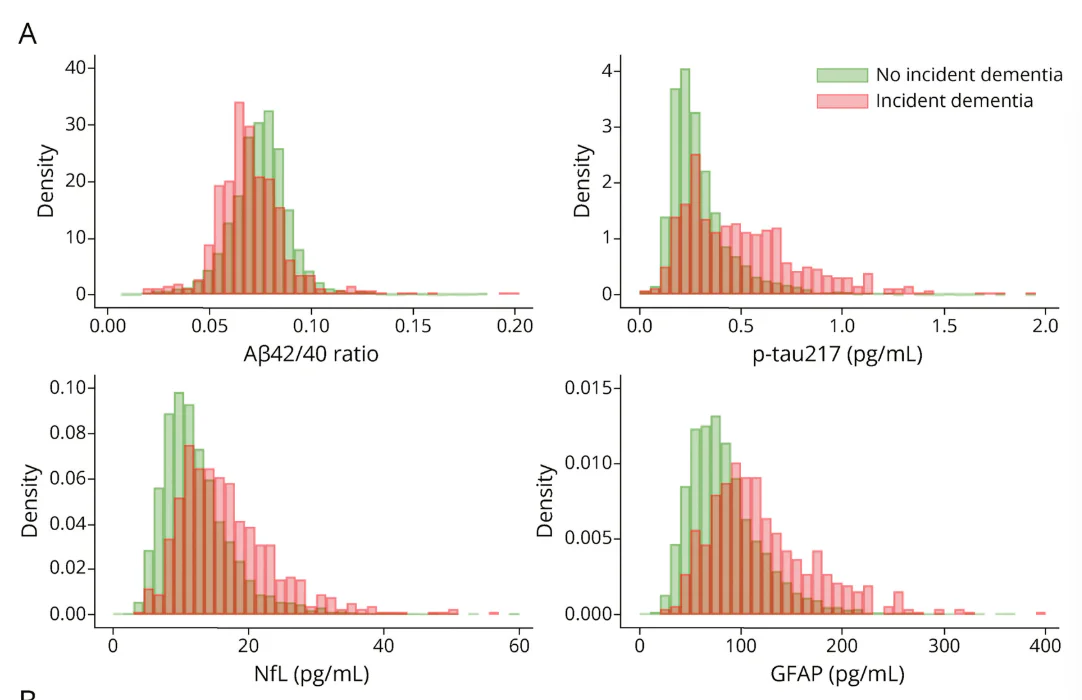
During follow-up, 516 participants (30.0% female) developed incident dementia. Participants in the worst quartile for each biomarker demonstrated significantly increased dementia risk: Aβ42/40 ratio (HR 1.88; 95% CI 1.57-2.24), p-tau217 (HR 3.74; 95% CI 3.12-4.50), NfL (HR 1.88; 95% CI 1.56-2.28), and GFAP (HR 2.25; 95% CI 1.87-2.72). Among the biomarkers, p-tau217 had the highest predictive discrimination with a C-index of 0.693 (95% CI 0.672-0.714), whereas the Aβ42/40 ratio had the lowest at 0.587 (95% CI 0.566-0.608). Incorporating all biomarkers collectively improved the C-index to 0.760 (95% CI 0.738-0.781). However, sensitivity for detecting future dementia ranged only from 41.7% to 59.5%, and positive predictive values were modest (16.4% to 23.5%), indicating limited ability to identify all individuals who would develop dementia. In contrast, specificity (76.8% to 78.8%) and negative predictive values (92.3% to 94.7%) were high, underscoring good ability to rule out dementia in those without elevated biomarker levels.
Importantly, a model built solely on sociodemographic, behavioral, and health-related risk factors achieved a comparable predictive accuracy (C-index 0.765; 95% CI 0.746-0.785). Combining these traditional risk factors with all biomarkers enhanced the predictive performance further, reaching a C-index of 0.813 (95% CI 0.795-0.830). This finding suggests that while biomarkers add meaningful value, their utility is maximized when integrated with clinical risk profiling.
Expert Commentary
This landmark assessment of blood-based biomarkers extends the evidence base by providing long-term outcome data in a well-defined, community cohort. The superior performance of p-tau217 aligns with its emerging role as a key marker of tau pathology, closely tied to cognitive decline in Alzheimer’s disease. However, the limited sensitivity and modest positive predictive values observed highlight intrinsic challenges in using single biomarkers as standalone screening tools for dementia prediction in heterogeneous populations. These results emphasize the importance of multimodal risk assessment strategies combining biochemical markers with established sociodemographic and clinical factors.
Limitations include the retrospective design and the cohort’s limited ethnic and socioeconomic diversity, potentially restricting generalizability. Additionally, dementia ascertainment relied on medical record linkage, which, while robust, may miss undiagnosed or subclinical cases. Despite these constraints, the findings support the clinical potential of blood-based biomarkers as components of dementia risk stratification but caution against their solitary use for definitive prognostication.
Conclusion
In a large longitudinal cohort, blood-based biomarkers demonstrated modest long-term dementia prediction accuracy, comparable to traditional risk factor models. Among the markers studied, p-tau217 showed the strongest associations with incident dementia. Integrating biomarker data with clinical and sociodemographic risk factors notably improved predictive capability, highlighting a complementary role for these assays rather than a standalone diagnostic approach. Continued research is needed to validate these biomarkers across diverse populations, refine assay thresholds, and explore their utility alongside emerging neuroimaging and genetic data to enhance early identification and intervention strategies for dementia.
Funding and ClinicalTrials.gov
The Whitehall II cohort study was supported by grants from the UK Medical Research Council and the British Heart Foundation, among others. Specific funding details and assay sponsorships were declared in the original publication. This retrospective cohort study is not registered on ClinicalTrials.gov.
References
Sabia S, Dumurgier J, Cavaillès C, et al. Blood-Based Biomarkers as Predictors of All-Cause Dementia: A 13-Year Follow-Up in the Whitehall II Cohort Study. Neurology. 2026 Oct 23;107(10):e218681. PMID: 42913444.
Jack CR Jr, Bennett DA, Blennow K, et al. NIA-AA Research Framework: Toward a biological definition of Alzheimer’s disease. Alzheimers Dement. 2018 Apr;14(4):535-562.
Mills KL, Donohue MC, Landau SM, et al. Longitudinal relationships between blood-based biomarkers and incident Alzheimer’s disease. Alzheimers Dement. 2022;18(7):1410-1421.