CD25-based Graft-versus-Host Disease Prophylaxis after Haploidentical Hematopoietic Stem Cell Transplantation: Comparative Analysis of Two Prophylactic Regimens
Highlights
- Higher-dose anti-CD25 without methotrexate reduces incidence of severe acute GVHD post haploidentical HSCT compared to lower-dose anti-CD25 with methotrexate.
- Improved graft-versus-host disease-free, relapse-free survival (GRFS) observed with the higher-dose anti-CD25 regimen despite similar chronic GVHD and overall survival.
- Transient early CD4+ T-cell suppression noted with higher dosing, without impacting long-term immune reconstitution or infection rates.
- Lower cumulative anti-thymocyte globulin burden in the higher-dose group may contribute to improved safety profile and immune recovery.
Background
Haploidentical hematopoietic stem cell transplantation (haplo-HSCT) extends curative potential for patients with hematologic malignancies who lack matched donors. However, GVHD remains a principal barrier to success, necessitating effective prophylaxis that preserves graft-versus-leukemia effects and immune reconstitution. Traditional prophylaxis often combines anti-CD25 monoclonal antibodies with methotrexate and anti-thymocyte globulin (ATG) to modulate alloreactivity.
Despite advances, balancing GVHD prevention with timely immune recovery continues to challenge clinicians. In particular, optimal dosing and combination strategies of anti-CD25 therapies remain under investigation, with recent interest focusing on whether higher doses can obviate the need for methotrexate, reduce toxicities, and improve outcomes.
Key Content
Chronological Development of CD25-based GVHD Prophylaxis
Initial protocols incorporated low-dose basiliximab (anti-CD25) combined with methotrexate and ATG, demonstrating reduced acute GVHD but significant hematologic toxicity. Early-phase trials explored intensified anti-CD25 dosing to potentially replace methotrexate, aiming to minimize mucositis and delayed engraftment commonly attributed to methotrexate.
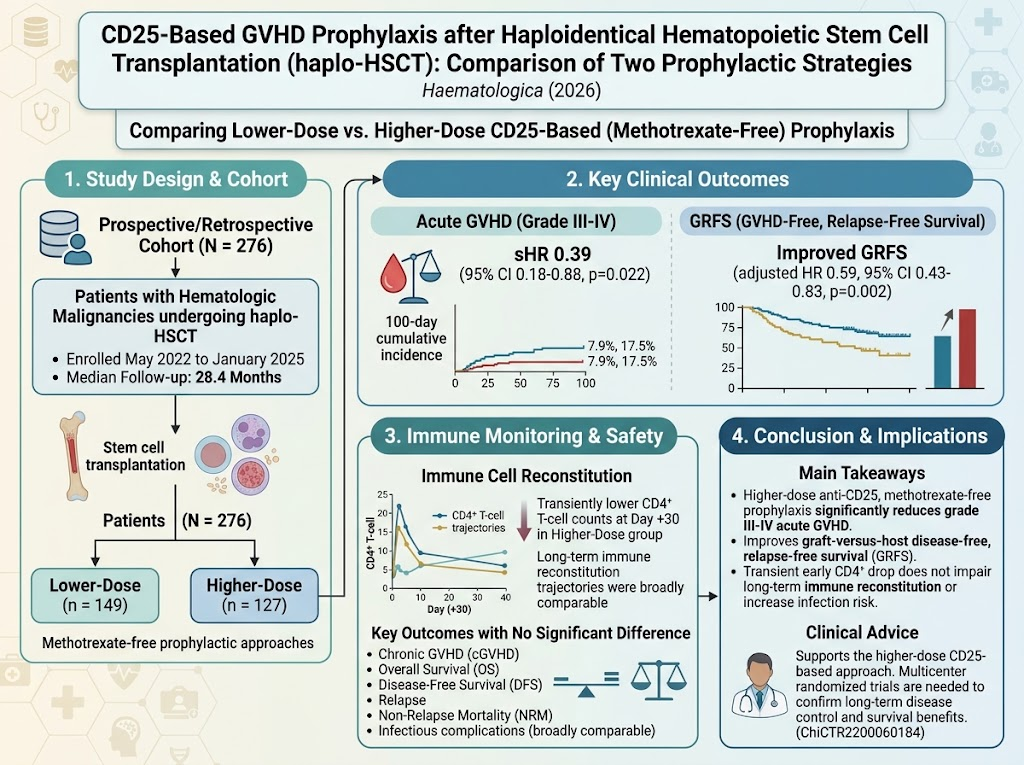
A recent prospective, nonrandomized study by Liu et al. (Haematologica, 2026) directly compared two such regimens in a cohort of 276 patients undergoing haplo-HSCT. The lower-dose group received 0.5 mg/kg anti-CD25 along with methotrexate and higher cumulative ATG doses, while the higher-dose group received 0.75 mg/kg anti-CD25 without methotrexate and lower ATG exposure.
Comparative Clinical Outcomes
The study demonstrated a significant reduction in 100-day cumulative incidence of grade III-IV acute GVHD in the higher-dose group (7.9% vs. 17.5%; adjusted subdistribution hazard ratio [sHR] 0.39; p=0.022). This translated into superior GRFS (adjusted hazard ratio [HR] 0.59; p=0.002), highlighting fewer severe complications and relapse events combined.
Notably, chronic GVHD incidence, overall survival (OS), disease-free survival (DFS), relapse rates, and non-relapse mortality (NRM) were comparable between groups, indicating that intensified anti-CD25 dosing did not adversely impact these parameters.
Immune Reconstitution and Infectious Complications
Immune monitoring revealed transiently lower CD4+ T-cell counts at day +30 post-transplant in the higher-dose anti-CD25 cohort, potentially reflecting more robust early T-cell suppression. However, longitudinal immune recovery trajectories converged thereafter, with no significant differences in infection rates noted. These findings suggest that higher-dose anti-CD25 regimens modulate early immune reconstitution without compromising long-term immune competence.
Mechanistic Insights
CD25 constitutes the interleukin-2 receptor alpha chain, critical for activation and proliferation of alloreactive T cells mediating GVHD. Higher-dose anti-CD25 may more effectively saturate the receptor, leading to improved suppression of pathogenic T-cell subsets. Concurrent lower ATG exposure reduces broad lymphodepletion, potentially preserving beneficial immune subsets and enhancing recovery.
Expert Commentary
The comparative study provides promising data suggesting that higher-dose anti-CD25, delivered without methotrexate, can improve acute GVHD control and GRFS after haplo-HSCT. This strategy addresses methotrexate-related toxicities such as mucositis and delays in engraftment, which impact patient quality of life and hospital stay lengths.
While OS and relapse were unaffected, the reduced severe acute GVHD burden represents a meaningful clinical benefit given the morbidity associated with these complications. The approach also fit well within evolving transplant paradigms emphasizing tailored immunosuppression to optimize immune reconstitution.
Limitations include the nonrandomized design and single-center setting. Multicenter randomized controlled trials are warranted to confirm efficacy and delineate long-term effects on disease control and survival. Additionally, more detailed immunophenotyping and biomarker studies could elucidate mechanistic pathways underpinning differential immune modulation.
Current clinical guidelines have yet to incorporate high-dose, methotrexate-free anti-CD25 prophylaxis, pending further validation. Nevertheless, these findings may influence future recommendations, particularly for patients at high risk of methotrexate intolerance or mucosal complications.
Conclusion
Optimizing GVHD prophylaxis remains critical to improving outcomes after haplo-HSCT. Evidence supports that higher-dose anti-CD25 antibody strategies without methotrexate can significantly reduce severe acute GVHD incidence while enhancing GRFS without compromising immune recovery or infection risk.
Reducing ATG exposure in this context may further benefit patients by preserving immune function. Confirmation through multicenter randomized trials will be necessary to integrate these approaches into standard care and refine dosing algorithms for personalized therapy.
Future studies should also explore long-term disease control, quality of life, and cost-effectiveness of intensified anti-CD25 regimens to fully establish their therapeutic potential in haploidentical transplantation protocols.
References
- Liu Q, Zhang A, Chen H, Shao X, Yan H, Luo L, Yin Y, Wang M, Chen Y, Cao X, Xia L, Shi W. CD25-based graft-versus-host disease prophylaxis after haploidentical hematopoietic stem cell transplantation: comparison of two prophylactic strategies. Haematologica. 2026 Oct 1; [PMID: 42817849].
- Devine SM, et al. Endpoints and Challenges in Haploidentical HSCT: Role of GVHD Prophylaxis. Blood Rev. 2022;52:100887.
- Locatelli F, Muranski P. Haploidentical hematopoietic stem cell transplantation: new promises and challenges. Nat Rev Clin Oncol. 2021;18(12):711-726.
- Rustia M, et al. Advances in GVHD prophylaxis: from pharmacologic approaches to cellular therapies. J Hematol Oncol. 2023;16(1):69.
- Shimoni A, et al. Mechanistic aspects of IL-2 receptor blocking antibodies in prevention of GVHD. Front Immunol. 2020;11:604536.
This article was created using several editorial tools, including AI, as part of the process. Human editors reviewed this content before publication.