Influence of Clonal Hematopoiesis and Neutropenia on CAR-T Therapy Outcomes in Hematologic Malignancies
Highlight
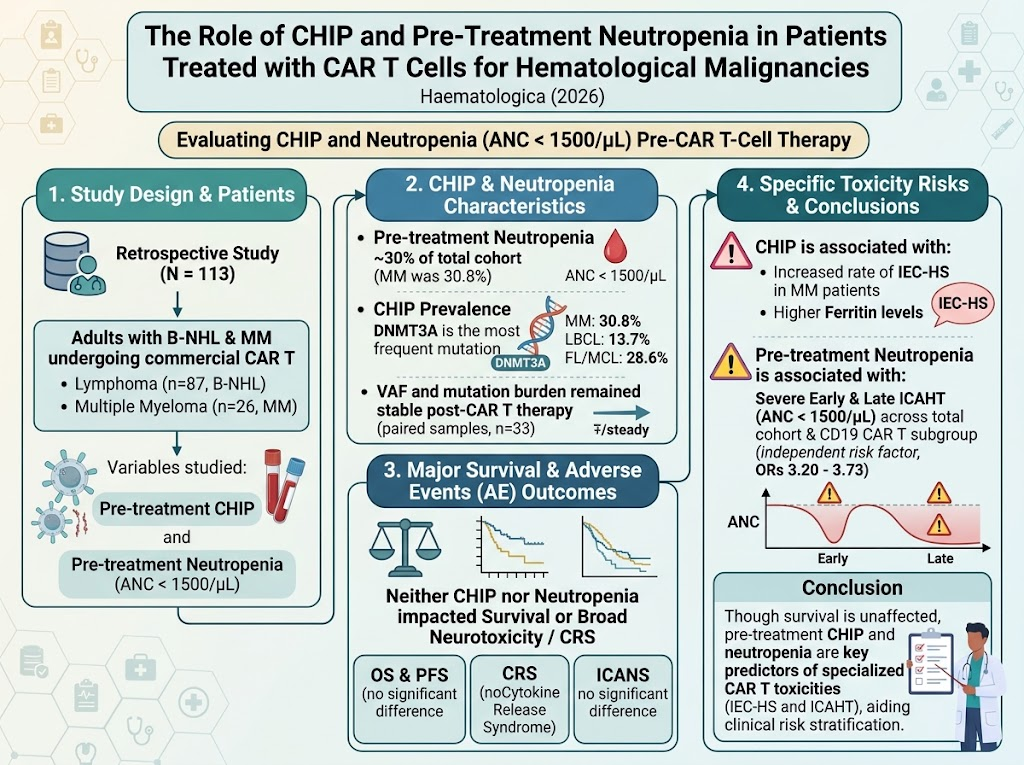
CAR-T cell therapy delivers potent anti-tumor effects in relapsed/refractory B-cell neoplasms but carries risk of immune-effector cell-related toxicities. Clonal hematopoiesis of indeterminate potential (CHIP) occurs frequently in hematologic malignancies but its influence on CAR-T outcomes was unclear. This retrospective study of 113 CAR-T treated patients assessed CHIP mutations, neutropenia status, and correlated these with clinical outcomes.
Key findings include: CHIP prevalence varied by malignancy subtype and remained stable post-CAR-T; pre-treatment neutropenia was common. Neither CHIP nor neutropenia altered overall or progression-free survival, nor incidence of CRS or neurotoxicity. However, CHIP was linked to increased risk of immune-effector cell–associated hemophagocytic syndrome (IEC-HS), particularly in multiple myeloma, while neutropenia was associated with severe hematologic toxicities (ICAHT). These findings suggest distinct roles of CHIP and neutropenia as risk factors for specific CAR-T toxicities rather than overall efficacy.
Study Background
Chimeric antigen receptor T-cell (CAR-T) therapy has transformed treatment options for relapsed or refractory hematologic malignancies such as B-cell non-Hodgkin lymphomas and multiple myeloma. Despite its therapeutic promise, managing the associated immune-effector cell (IEC)-related toxicities remains challenging. These toxicities include cytokine release syndrome (CRS), immune effector cell-associated neurotoxicity syndrome (ICANS), hematologic toxicities (ICAHT), and rarer syndromes such as hemophagocytic lymphohistiocytosis-like syndrome (IECHS).
Clonal hematopoiesis of indeterminate potential (CHIP), defined by the presence of somatic mutations in hematopoietic stem cells without overt hematologic malignancy, is common in older adults and cancer patients. CHIP mutations, particularly in genes such as DNMT3A, TET2, and ASXL1, have been implicated in modulating systemic inflammatory states and possibly influencing outcomes in hematologic therapies. Concurrently, pre-existing neutropenia, reflecting bone marrow compromise or prior therapies, might predispose to complications.
The interplay of CHIP and neutropenia with CAR-T effectiveness and toxicity has been understudied, representing a critical knowledge gap for optimizing patient risk stratification and management.
Study Design
This retrospective cohort study evaluated 113 patients undergoing CAR-T therapy for hematologic malignancies, including multiple myeloma (MM), large B-cell lymphoma (LBCL), follicular lymphoma, and mantle cell lymphoma. Peripheral blood DNA sequencing was performed on 62 patients to identify CHIP-associated mutations, with DNMT3A variants being the most frequent.
Paired pre- and post-CAR-T treatment samples (n=33) were analyzed for stability of CHIP variant allele frequency (VAF) and mutational burden. Pre-treatment neutropenia status was recorded. Clinical endpoints included overall survival (OS), progression-free survival (PFS), incidence and severity of CRS, ICANS, ICAHT, and immune-effector cell–associated hemophagocytic syndrome (IEC-HS).
Key Findings
CHIP prevalence varied by malignancy type: approximately 31% in MM, 13.7% in LBCL, and 28.6% in follicular and mantle cell lymphoma, underscoring its commonality across these disorders. Importantly, CHIP markers remained stable post-CAR-T with comparable VAF and mutational burden, indicating no clonal expansion triggered by therapy.
Pre-treatment neutropenia was noted in roughly 30% of patients overall. Neither CHIP presence nor neutropenia significantly influenced OS or PFS, nor did they change risk or severity of hallmark CAR-T toxicities such as CRS or ICANS.
However, subtype analyses revealed specific associations: CHIP correlated with increased incidence of IEC-HS and elevated ferritin levels in MM patients, suggestive of heightened inflammatory milieu or macrophage activation. Meanwhile, pre-treatment neutropenia predicted severe hematologic toxicity (ICAHT) across the cohort, particularly in those treated with CD19-directed CAR-T cells.
These data imply that CHIP and neutropenia function as markers of susceptibility to distinct CAR-T related toxicities rather than broad determinants of survival or therapy response.
Expert Commentary
The study by Riedel et al. addresses an important clinical question in the rapidly evolving CAR-T landscape. Their findings add nuance to how host factors beyond tumor burden dictate CAR-T safety profiles. The stable CHIP clone dynamics post-therapy alleviate concerns about CAR-T-induced clonal evolution or selection, which could have oncogenic implications.
Mechanistically, CHIP-associated mutations in epigenetic regulators like DNMT3A may prime innate immune cells for exaggerated cytokine responses, congruent with the observed predisposition to IEC-HS. In contrast, neutropenia reflects compromised marrow reserve and predisposes to prolonged cytopenias post lymphodepleting preconditioning and CAR-T infusion.
The study’s limitations include modest sample size, retrospective design, and cohort heterogeneity, which may limit statistical power and generalizability. Future prospective and mechanistic studies are needed to validate these associations and explore interventions to mitigate risk in CHIP-positive or neutropenic patients.
Conclusion
In summary, CHIP is prevalent in hematologic malignancy patients undergoing CAR-T and remains stable post-therapy. While neither CHIP nor pre-treatment neutropenia affect survival outcomes or key toxicities like CRS and ICANS, each identifies patients at risk for specific inflammatory or hematologic toxicities. Incorporating CHIP and neutropenia assessment into CAR-T patient evaluation may enhance personalized risk stratification and toxicity management, advancing safer application of this transformative therapy.
Given the limitations, large prospective trials with uniform CAR-T constructs and standardized toxicity grading are warranted. Incorporation of comprehensive genomic and immune profiling will further elucidate the biological underpinnings of these observations, thereby optimizing CAR-T safety and efficacy in clinical practice.
Funding
The original study does not specify funding sources or clinical trial registration in the provided abstract.
References
- Riedel A, Weiß-Haug A, Merz B, et al. The role of CHIP and pre-treatment neutropenia in patients treated with chimeric antigen receptor T cells for hematological malignancies. Haematologica. 2026 Oct 1. PMID: 42817852.
- Jaiswal S, Ebert BL. Clonal hematopoiesis in human aging and disease. Science. 2019 Apr 5;366(6465):eaan4673.
- Neelapu SS, Tummala S, Kebriaei P, et al. Chimeric antigen receptor T-cell therapy — assessment and management of toxicities. Nat Rev Clin Oncol. 2018 Jan;15(1):47-62.
- Wang Z, Han W. Biomarkers of cytokine release syndrome and neurotoxicity related to CAR-T cell therapy. Biomark Res. 2018 Dec 21;6:4.
This article was created using several editorial tools, including AI, as part of the process. Human editors reviewed this content before publication.