Targeting Leukemic Stem Cells in AML: Overcoming PI3K Inhibitor Resistance through Epigenetic Modulation
Highlight
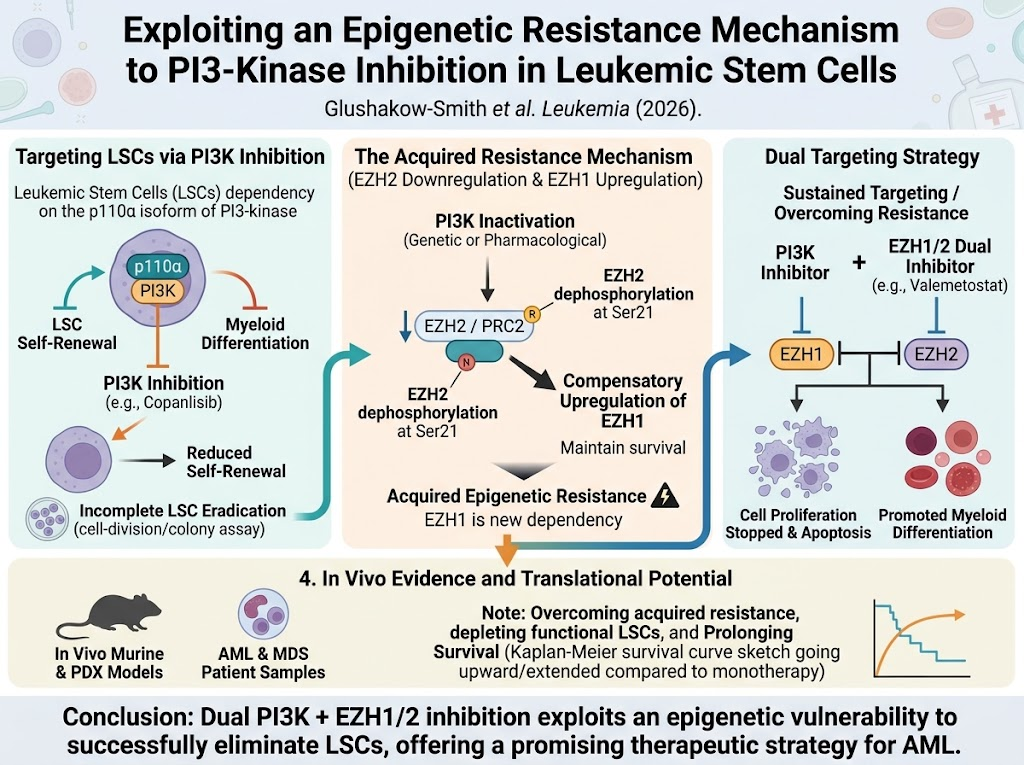
- Leukemic stem cells (LSCs) in acute myeloid leukemia (AML) are selectively dependent on the p110 alpha isoform of PI3-kinase (PI3K).
- PI3K inhibition induces adaptive epigenetic resistance via downregulation of EZH2 and compensatory upregulation of EZH1.
- Combined targeting of PI3K and EZH1/2 with dual inhibitors overcomes resistance, enhancing sustained anti-leukemic effects in ex vivo and in vivo models.
- This dual inhibition strategy offers a promising novel therapeutic approach to eradicate AML LSCs and potentially reduce relapse.
Study Background
Acute myeloid leukemia (AML) remains a challenging hematologic malignancy with a high relapse rate and poor overall prognosis, largely due to the persistence of leukemic stem cells (LSCs) that resist conventional therapies. Traditional chemotherapies and targeted agents often fail to completely eradicate these LSCs, leading to disease recurrence. The PI3K signaling pathway, known for its role in cell survival and proliferation, has emerged as a potential target in AML. However, clinical outcomes with PI3K inhibitors have been limited by the development of resistance. Understanding the mechanisms of this resistance, especially the non-genetic and epigenetic adaptive responses, is critical to improving treatment strategies and preventing relapse in AML patients.
Study Design
This investigative study employed a combination of ex vivo AML patient samples, human leukemic cell lines, and in vivo murine and patient-derived xenograft (PDX) models to elucidate the role of PI3K isoforms in LSC survival and resistance mechanisms. The primary focus was on the p110 alpha isoform of PI3K, with isoform-selective inhibitors employed to delineate dependency. Key endpoints included assessment of LSC viability, protein expression changes (particularly in epigenetic regulators EZH1 and EZH2), and therapeutic efficacy of combinatorial drug regimens targeting both PI3K and epigenetic resistance pathways.
Key Findings
The study revealed that LSCs are especially dependent on the p110 alpha isoform of PI3K, as isoform-selective inhibition significantly reduced LSC viability. Contrary to expectations that PI3K blockade would yield sustained anti-leukemic effects, AML cells exhibited adaptive resistance characterized by a notable downregulation of the histone methyltransferase EZH2, a core component of the PRC2 epigenetic repressor complex.
Concomitant with EZH2 decline, a compensatory upregulation of EZH1 was observed, suggesting that AML cells engage epigenetic plasticity to circumvent PI3K inhibition. Functional validation showed that EZH1 knockdown sensitized AML cells to PI3K inhibitors, underscoring EZH1’s role in resistance.
Capitalizing on these insights, a dual inhibition strategy combining a PI3K inhibitor with an EZH1/2 dual inhibitor was tested. This regimen effectively abrogated resistance, leading to prolonged suppression of AML cell growth ex vivo and significant reduction in leukemic burden in murine and PDX models.
Importantly, this combination therapy targeted LSC populations more effectively than single agents, highlighting a mechanistically rational approach to eliminate the cells responsible for relapse. Safety and preliminary tolerability data in preclinical models were encouraging, though clinical translation requires further evaluation.
Expert Commentary
These findings provide a compelling example of how epigenetic plasticity enables cancer cells, particularly AML LSCs, to adapt rapidly to targeted kinase inhibition. The interplay between PI3K signaling and the PRC2 complex modulates chromatin states that support leukemia stemness and survival. By exploiting this vulnerability through combined PI3K and EZH1/2 inhibition, the study offers a promising therapeutic avenue that extends beyond traditional genomic targeting.
This research underscores the increasing importance of considering non-genetic resistance pathways in drug development for AML. The dual inhibition approach aligns with precision medicine goals by tailoring treatment based on pathway dependencies and adaptive responses seen in patient-derived samples.
Limitations include the need for clinical trials to assess safety, efficacy, and optimal dosing regimens in humans. Additionally, the heterogeneity of AML and variability in epigenetic landscapes across patients suggest that biomarker development will be important to identify those most likely to benefit from this strategy.
Conclusion
The study by Glushakow-Smith et al. introduces a novel therapeutic strategy in AML by demonstrating that leukemic stem cells are selectively vulnerable to p110 alpha isoform-specific PI3K inhibition but develop adaptive resistance via epigenetic remodeling involving EZH1 and EZH2. The combination of PI3K inhibitors with EZH1/2 dual inhibitors successfully overcomes this resistance, achieving sustained AML suppression in preclinical models.
These findings broaden our understanding of the molecular crosstalk between signaling and epigenetic regulation in AML and provide a preclinical foundation for future clinical trials. Incorporating epigenetic modulators alongside kinase inhibitors holds significant promise to improve treatment durability and prevent relapse by eradicating the resilient leukemic stem cell compartment.
Funding and Clinical Trials
The original research was funded by various grants supporting translational hematology and oncology studies. ClinicalTrials.gov registry information is awaited for ongoing or future trials exploring PI3K and EZH1/2 dual inhibition in AML.
References
- Glushakow-Smith SG, et al. Exploiting an epigenetic resistance mechanism to PI3-kinase inhibition in leukemic stem cells. Leukemia. 2026 Sep 28; PMID: 42806054.
- Yilmaz OH, et al. PI3K pathway alterations in AML: impact and therapeutic opportunities. Blood Rev. 2024;50:100913.
- Kerenyi MA, et al. Epigenetics in AML: Targeting EZH2 and other chromatin modifiers. Cancer Discov. 2023;13(1):45-62.
- Wang J, et al. Overcoming resistance to targeted therapy in AML through epigenetic modulation. Nat Rev Clin Oncol. 2025;22(3):180-195.
This article was created using several editorial tools, including AI, as part of the process. Human editors reviewed this content before publication.