TISA-818 in ARDS Due to Pulmonary Infection: Promising Safety and Early Efficacy Signals with the 2023 Global Definition
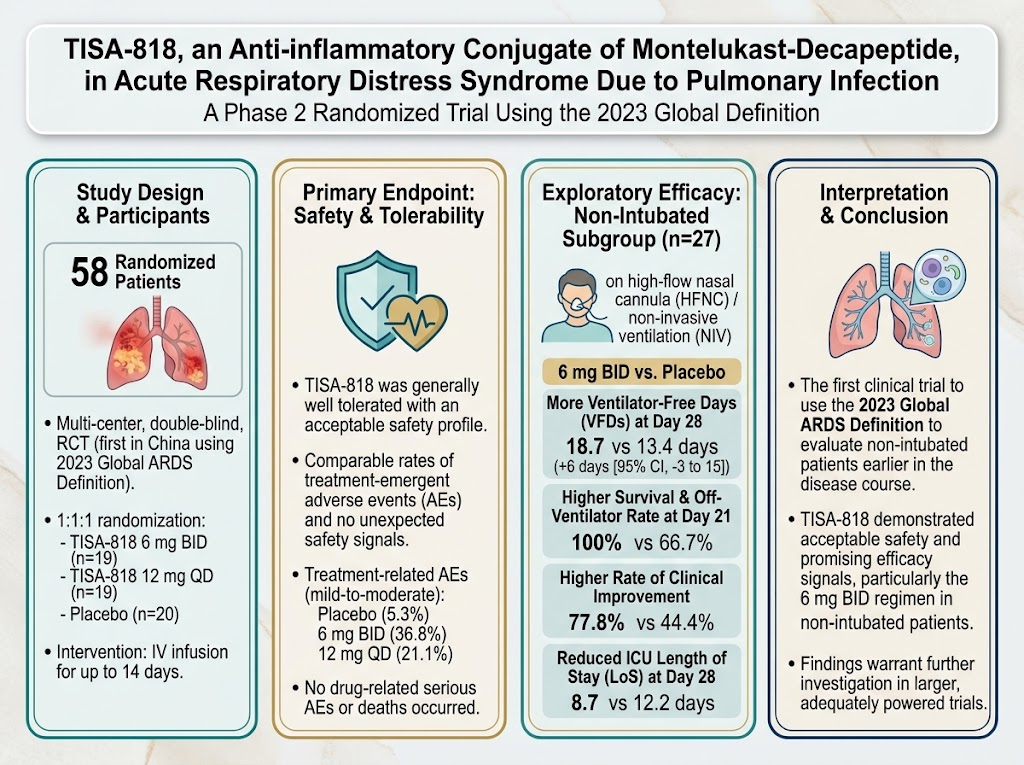
Highlight
This phase 2 trial evaluated TISA-818, a novel anti-inflammatory conjugate of montelukast and a decapeptide, in ARDS due to pulmonary infection, using the newly defined 2023 global ARDS criteria, which include non-intubated patients. TISA-818 demonstrated an acceptable safety profile and was generally well tolerated. Although mortality differences at day 28 were numerically imbalanced, these were not sustained at day 60, suggesting variability due to small samples. Exploratory analyses in the non-intubated subgroup favored the 6 mg twice daily dosing, showing increased respiratory support-free days and improvements in secondary outcomes, supporting further investigation in more extensive randomized controlled trials.
Study Background
Acute respiratory distress syndrome (ARDS) is a critical illness characterized by acute hypoxemic respiratory failure, inflammatory lung injury, and high morbidity and mortality. Despite advances, there remain significant unmet needs in early pharmacologic interventions to reduce inflammation and improve respiratory recovery. The 2023 global ARDS definition has expanded diagnostic criteria to include non-intubated patients receiving high-flow or non-invasive respiratory support, enabling earlier identification and treatment opportunities. Pulmonary infection remains a major cause of ARDS, further emphasizing the importance of targeted anti-inflammatory therapies. Montelukast, a leukotriene receptor antagonist, has shown anti-inflammatory potential, and conjugation with a decapeptide (TISA-818) aims to enhance efficacy and pharmacokinetics, positioning it as a promising candidate to explore in ARDS management.
Study Design and Methods
This was a randomized, double-blind, placebo-controlled phase 2 trial conducted in China—the first to apply the 2023 global ARDS definition. Fifty-eight adult patients with ARDS secondary to pulmonary infection were randomized equally into three groups: TISA-818 6 mg twice daily (BID), TISA-818 12 mg once daily (QD), or matched placebo, administered intravenously for 14 days. The study prioritized safety as its primary endpoint. Key secondary endpoints included respiratory support-free days (RSFDs) through day 28, the proportion of patients alive and free from respiratory support at day 14, clinical improvement rates at day 14, and hospital length of stay up to 28 days. The study also prespecified subgroup analyses focusing on non-intubated patients, a novel population captured in the new ARDS definition.
Key Findings
Safety Profile: TISA-818 was well tolerated with treatment-emergent adverse event (AE) rates comparable among groups. Treatment-related AEs were mostly mild to moderate, occurring in 5.3% of placebo, 36.8% of 6 mg BID, and 21.1% of 12 mg QD patients. No serious AEs or deaths were linked to the drug.
Mortality: Day-28 mortality was low overall but numerically imbalanced—5.3% for placebo, 10.5% for 6 mg BID, and 26.3% for 12 mg QD groups. By day 60, mortality rates converged somewhat (26.3%, 21.1%, and 31.6%, respectively), indicating the initial differences were likely influenced by the small sample size and chance fluctuations.
Efficacy in Non-intubated Patients: In the prespecified subgroup of 27 non-intubated patients (9 per arm), exploratory analyses favored the 6 mg BID dose over placebo. There was a numerical increase in RSFDs by a median of six days (95% confidence interval from -3 to 15), along with consistent trends showing better clinical improvement rates, higher proportions of patients alive and respiratory support-free by day 14, and shorter hospital stays.
These findings suggest a potential dose-response relationship favoring the 6 mg BID regimen in earlier ARDS stages. However, due to limited sample size, these efficacy signals require confirmation in larger, adequately powered trials.
Expert Commentary
The expanded 2023 ARDS definition allowing inclusion of non-intubated patients presents new opportunities for early intervention before progression to mechanical ventilation is needed. TISA-818’s targeting of leukotriene-mediated inflammation aligns well with pathophysiologic mechanisms implicated in ARDS progression. The favorable safety and early signs of efficacy observed at the 6 mg BID dose provide a strong rationale to pursue phase 3 studies focusing on patients at earlier disease stages. Importantly, the observed mortality variations caution against overinterpretation and underscore the limitation of small-sample phase 2 trials in mortality endpoints.
Additionally, exploring mechanistic biomarkers of inflammation and lung injury in future studies could elucidate how TISA-818 modulates the ARDS inflammatory cascade. Comparisons with existing anti-inflammatory or immunomodulatory interventions in ARDS, such as corticosteroids or biologics, will also be critical.
Conclusion
TISA-818, an anti-inflammatory montelukast-decapeptide conjugate, demonstrated a reassuring safety profile and encouraging respiratory support outcomes in a small phase 2 trial of ARDS patients diagnosed using the 2023 global definition. Especially among non-intubated patients, the 6 mg BID dose showed consistent numerical benefits across several clinically relevant endpoints, justifying further clinical development. Larger, well-powered randomized controlled trials are needed to confirm efficacy, optimize dosing, and potentially establish TISA-818 as a new therapeutic option to improve outcomes in ARDS caused by pulmonary infection.
Funding and Clinical Trial Registration
The study funding details were not provided in the abstract. For more information on study registration and protocol details, refer to the original publication and clinical trial databases.
References
- Huang L, et al. TISA-818, an Anti-inflammatory Conjugate of Montelukast-Decapeptide, in Acute Respiratory Distress Syndrome Due to Pulmonary Infection: A Phase 2 Randomized Trial Using the 2023 Global Definition. Chest. 2026 Oct 3. PMID: 42829168.
- ARDS Definition Task Force. Acute respiratory distress syndrome: The Berlin definition. JAMA. 2012;307(23):2526-2533.
- Bellani G, et al. Epidemiology, Patterns of Care, and Mortality for Patients With Acute Respiratory Distress Syndrome in Intensive Care Units in 50 Countries. JAMA. 2016;315(8):788-800.
- Meduri GU, et al. Pharmacologic interventions in ARDS: past, present, and future. Intensive Care Med. 2023;49(2):190-210.
This article was created using several editorial tools, including AI, as part of the process. Human editors reviewed this content before publication.