Targeting Leukemia Stem Cells in Unfit Acute Myeloid Leukemia with a CD70-Directed Third Agent: Promise and Caveats from the ELEVATE Trial
Highlights
- Cusatuzumab, a high-affinity anti-CD70 monoclonal antibody, targets leukemia stem cells (LSCs) overexpressing CD70 in acute myeloid leukemia (AML), representing a novel therapeutic strategy addressing disease persistence and relapse.
- The phase Ib ELEVATE trial shows that adding cusatuzumab to venetoclax and azacitidine in unfit newly diagnosed AML patients yields an encouraging composite response rate of 77.3%, with over half of responders achieving measurable residual disease (MRD) negativity.
- Despite promising efficacy signals, hematologic and infectious toxicities remain considerable, underscoring the need for vigilance in patient selection and supportive care during therapy.
- Prior phase I/II studies of cusatuzumab with azacitidine confirm tolerability and preliminary efficacy, supporting ongoing development of multi-agent regimens targeting LSCs to improve outcomes in patients ineligible for intensive chemotherapy.
Background
Acute myeloid leukemia (AML) is a heterogeneous hematologic malignancy characterized by clonal proliferation of myeloid precursors and impaired differentiation. Despite advances in molecular classification and therapy, AML, especially in older or unfit patients, remains associated with poor prognosis and high relapse rates. The persistence of leukemia stem cells (LSCs), which possess self-renewal capacity and resistance to conventional chemotherapy, is implicated as a key driver of relapse. CD70, a member of the tumor necrosis factor superfamily, is aberrantly overexpressed on AML progenitors and LSCs but not on normal hematopoietic stem cells, making it an attractive selective therapeutic target.
Conventional standard-of-care for unfit AML patients often includes hypomethylating agents (e.g., azacitidine) combined with the BCL-2 inhibitor venetoclax, which induces deep remissions but relapse within a year remains common. Hence, novel strategies to eradicate LSCs and improve durable responses are needed. Cusatuzumab is a humanized anti-CD70 monoclonal antibody designed to engage LSCs for immune-mediated clearance and disrupt CD70-CD27 signaling implicated in leukemogenesis.
Key Content
Chronological Development and Clinical Evaluation of Cusatuzumab in AML
Preclinical data demonstrated that CD70 is highly expressed on CD34+ AML progenitors and LSCs, with cusatuzumab showing selective cytotoxicity and immune effector activation. Early-phase clinical trials investigated its safety and efficacy combined with azacitidine in patients ineligible for intensive chemotherapy.
A 2023 phase I/II multicenter trial evaluated cusatuzumab plus azacitidine, enrolling 38 patients with newly diagnosed AML at multiple dose levels to determine the recommended phase II dose (RP2D) and evaluate efficacy. At the RP2D (10 mg/kg), a complete remission (CR) rate of approximately 37.9% was reported alongside manageable toxicity, with median overall survival around 11.5 months, suggesting encouraging preliminary activity in this vulnerable population. Common adverse events included infections and hematologic toxicities, consistent with the disease and background treatment.
Phase Ib ELEVATE Study: Cusatuzumab Combined with Venetoclax ± Azacitidine
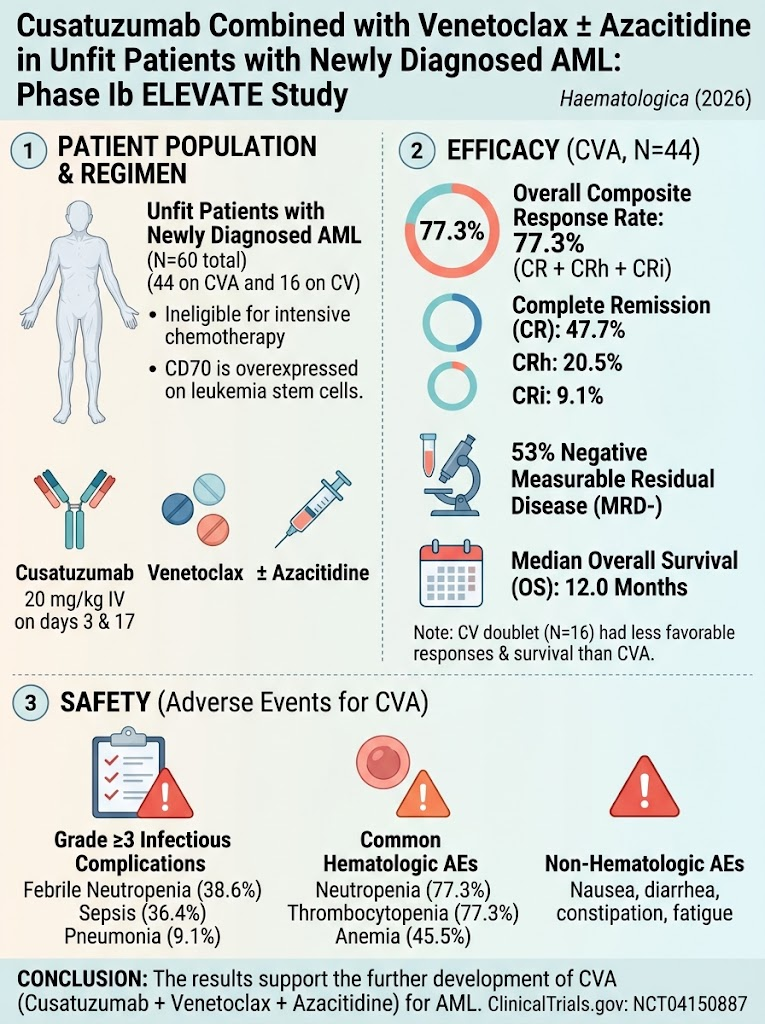
Building on prior data, the ELEVATE trial evaluated the addition of cusatuzumab to venetoclax and azacitidine (CVA regimen) or cusatuzumab plus venetoclax (CV) in patients newly diagnosed with AML who were ineligible for intensive chemotherapy. Forty-four patients received the CVA regimen, receiving cusatuzumab 20 mg/kg intravenously on days 3 and 17 of each 28-day cycle.
Efficacy outcomes were encouraging, with an overall composite response rate (CR + CRh + CRi) of 77.3%, comprising 47.7% CR, 20.5% CR with partial hematologic recovery (CRh), and 9.1% CR with incomplete hematologic recovery (CRi). Of responders, 53% attained negative measurable residual disease (MRD) status by multiparameter flow cytometry, indicating deep remissions. Median overall survival reached 12.0 months, surpassing historical controls treated with venetoclax plus azacitidine alone in similar populations.
The CV doublet without azacitidine was studied in 16 patients and showed comparable safety but less favorable response rates and overall survival, highlighting the importance of the triplet combination.
Safety and Toxicity Profile
Hematologic adverse events were frequent, including grade ≥3 neutropenia and thrombocytopenia in over 75% of patients, consistent with therapy-related myelosuppression. Infectious complications, notably febrile neutropenia (38.6%), sepsis (36.4%), and pneumonia (9.1%), were significant, emphasizing the vulnerability of this patient group and the necessity of rigorous monitoring and prophylaxis.
Non-hematologic toxicities included gastrointestinal symptoms (nausea, diarrhea, constipation) and fatigue, mostly manageable. Infusion-related reactions occurred infrequently but require vigilance during antibody administration.
Expert Commentary
The ELEVATE trial represents a noteworthy advancement by targeting leukemia stem cells via CD70 in combination with established venetoclax-based regimens, aiming to enhance depth of remission and overcome mechanisms of resistance in unfit AML patients. The high composite response rate and MRD negativity are promising indicators that addressing the LSC compartment could improve outcomes beyond standard doublet therapies.
However, the substantial hematologic toxicity and infection risk underscore persistent challenges in treating frail AML populations. Integrating triple regimens requires careful patient selection, dose management, and supportive measures to balance efficacy and safety. Furthermore, the open-label, single-arm design and relatively small sample size of ELEVATE necessitate confirmation in larger randomized trials.
Biologically, disrupting CD70-CD27 signaling not only targets LSCs directly but may also modulate immune responses in the bone marrow microenvironment, potentially synergizing with venetoclax’s pro-apoptotic effects via BCL-2 inhibition and azacitidine’s epigenetic modulation. These complementary mechanisms justify the rationale for the triplet approach.
Future directions include biomarker-driven patient stratification, optimization of dosing schedules to mitigate toxicity, and exploration of combination immunotherapies to enhance leukemia eradication. The translational potential is substantial, yet awareness of caveats such as infectious morbidity remains critical.
Conclusion
The CD70-directed monoclonal antibody cusatuzumab, when added to venetoclax and azacitidine, offers a promising therapeutic strategy in unfit newly diagnosed AML by targeting the leukemia stem cell niche. The ELEVATE trial delivers encouraging evidence for improved composite remission rates and MRD negativity, heralding a potential shift in eliminating residual disease responsible for relapse.
However, substantial hematologic and infectious toxicities necessitate thorough risk-benefit assessment. Confirmatory randomized studies and longer-term follow-up are mandatory to establish clinical benefit and safety definitively. The development of CD70-targeted therapy within multi-agent AML regimens exemplifies precision medicine approaches aiming at durable remissions and survival gains in a historically challenging patient subset.
References
- Lyu T, Zhang Y. Targeting leukemia stem cells in unfit acute myeloid leukemia with a CD70-directed third agent: promise and caveats from the ELEVATE trial. Commentary. Haematologica. 2026 Oct 1. PMID: 42817840. https://pubmed.ncbi.nlm.nih.gov/42817840/
- Ravandi F, et al. Cusatuzumab combined with venetoclax with or without azacitidine in unfit patients with newly diagnosed acute myeloid leukemia: phase Ib ELEVATE study. Haematologica. 2026 Sep 3. PMID: 42689432. https://pubmed.ncbi.nlm.nih.gov/42689432/
- Ball A, et al. Results from a phase I/II trial of cusatuzumab combined with azacitidine in patients with newly diagnosed acute myeloid leukemia who are ineligible for intensive chemotherapy. Haematologica. 2023 Jul 1;108(7):1793-1802. PMID: 36779592. https://pubmed.ncbi.nlm.nih.gov/36779592/
This article was created using several editorial tools, including AI, as part of the process. Human editors reviewed this content before publication.