Optimizing Rabbit ATG Exposure in T-Replete Hematopoietic Cell Transplantation: Insights from BMT CTN 1202
Highlight
- Higher post-transplant rabbit ATG exposure correlates with poorer overall survival and increased relapse incidence.
- Low rabbit ATG exposure (<30 AUxd/mL) associates with better immune reconstitution and reduced graft-versus-host disease (GVHD) mortality compared to no exposure or higher exposure.
- Any ATG exposure reduces moderate to severe chronic GVHD incidence compared to no ATG.
- Model-based dosing of rabbit ATG could optimize post-transplant outcomes, overcoming limitations of weight-based dosing.
Study Background
Hematopoietic cell transplantation (HCT) remains a potentially curative treatment modality for various hematological malignancies. Despite advances, graft-versus-host disease (GVHD) and delayed immune reconstitution pose significant hurdles impacting morbidity and mortality. Rabbit anti-thymocyte globulin (rATG) is commonly used peri-transplant to mitigate GVHD through T-cell depletion. However, traditional weight-based dosing leads to variable pharmacokinetics and inconsistent immune effects. Delayed CD4+ T-cell immune reconstitution (CD4+ IR) after transplantation can increase infection risk and impact relapse and survival. Thus, understanding and tailoring rATG exposure is critical to balance GVHD prevention with immune recovery and disease control. The BMT CTN 1202 study offers a large, real-world dataset to explore rATG exposure and its clinical correlations in T-replete HCT recipients.
Study Design
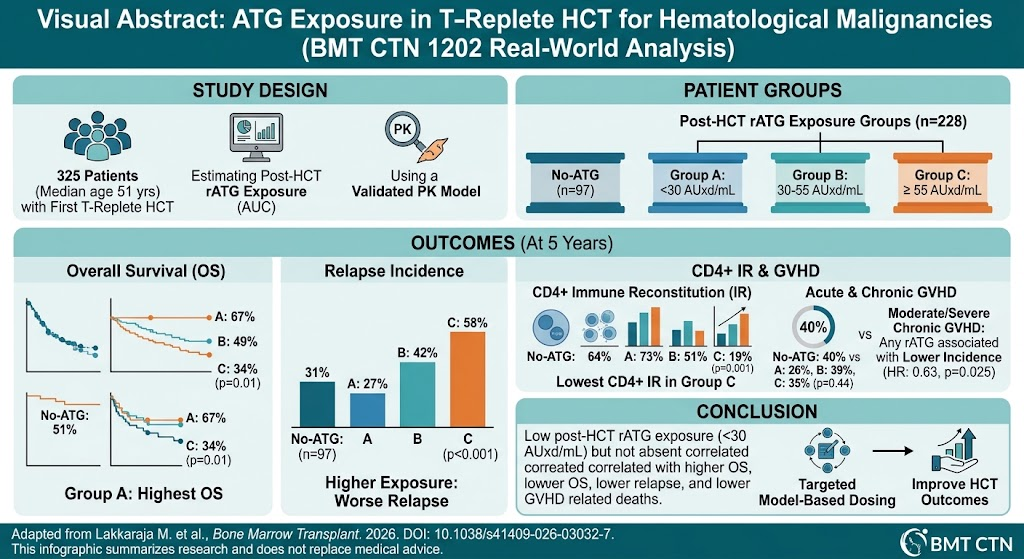
This retrospective pharmacokinetic and pharmacodynamic analysis included 325 patients, median age 51, undergoing first T-replete HCT for hematological malignancies and enrolled in the BMT CTN 1202 trial. Among them, 228 received rATG. Post-transplant rATG exposure was estimated by area under the curve (AUC) using a validated pharmacokinetic model and expressed as arbitrary units per day per milliliter (AUxd/mL). Exposure groups were predefined as A (<30 AUxd/mL), B (30–55 AUxd/mL), and C (≥55 AUxd/mL). Comparator patients without ATG exposure were also included. Outcomes assessed included five-year overall survival (OS), relapse incidence, CD4+ IR rates, and rates of grade 2–4 acute GVHD and moderate/severe chronic GVHD. Statistical analyses employed Cox proportional hazards and cause-specific hazard models to evaluate correlations between rATG exposure and clinical endpoints.
Key Findings
Post-transplant rATG exposure varied from 6.2 to 125 AUxd/mL, with a median of 44.1 AUxd/mL. The analysis revealed a complex relationship between rATG exposure and clinical outcomes:
- Overall Survival (OS): Five-year OS differed significantly across groups (p=0.01). Patients without ATG had an OS of 51%. Group A (<30 AUxd/mL) had the highest OS at 67%, group B (30–55 AUxd/mL) showed OS of 49%, and group C (≥55 AUxd/mL) had the poorest OS at 34%.
- Relapse Incidence: Higher rATG exposure correlated with increased relapse risk (p<0.001). Relapse rates were 31% in no-ATG, 27% in group A, 42% in group B, and 58% in group C.
- Immune Reconstitution: CD4+ T-cell IR rates at five years decreased markedly with higher rATG exposure (p=0.001), with 64% in no-ATG, 73% in group A, 51% in group B, and only 19% in group C.
- Acute GVHD: Grade 2–4 acute GVHD rates did not significantly differ across groups (p=0.44), with 40% in no-ATG, 26% in group A, 39% in group B, and 35% in group C.
- Chronic GVHD: Any rATG exposure was associated with significantly lower moderate/severe chronic GVHD compared to no ATG (HR 0.63, p=0.025), supporting its role in preventing chronic GVHD.
Notably, low post-transplant rATG exposure (<30 AUxd/mL) was associated with the most favorable balance: improved OS, reduced relapse, and lower GVHD-related mortality, outperforming both no ATG and higher exposure levels.
Expert Commentary
This large real-world study highlights critical limitations of traditional weight-based rATG dosing, which leads to wide variability in drug exposure and divergent clinical outcomes. The paradoxical finding that low-dose rATG confers better survival and relapse protection than either no ATG or high-dose ATG underscores the need to fine-tune immunosuppression intensity post-HCT. The strong inverse correlation of rATG exposure with CD4+ IR provides biological plausibility: excessive immune suppression delays reconstitution, increasing relapse and infectious risk, while insufficient dosing risks uncontrolled GVHD.
Current guidelines recommend ATG for GVHD prophylaxis in T-cell replete transplants but do not incorporate precision pharmacokinetics. This study advocates for model-based dosing strategies to tailor rATG administration, aiming to hit a therapeutic window that balances adequate GVHD prevention with preservation of immune function. It also raises important questions about ATG’s role in disease relapse, warranting prospective validation.
Limitations include its retrospective design and reliance on modeled rather than direct measured rATG levels. Furthermore, heterogeneity in disease types and conditioning regimens may influence results. Nevertheless, the findings provide compelling evidence to revisit ATG dosing paradigms in clinical practice.
Conclusion
Rabbit ATG exposure after T-replete hematopoietic cell transplantation profoundly influences survival, relapse, immune reconstitution, and GVHD outcomes. Low-level exposure (<30 AUxd/mL) emerges as the optimal balance point, conferring superior overall survival and relapse control while reducing chronic GVHD. These findings challenge traditional weight-based dosing and underscore the promise of model-based pharmacokinetic-guided ATG dosing strategies to optimize transplant outcomes. Future prospective studies should confirm these observations and integrate therapeutic drug monitoring into transplant protocols to personalize immunosuppression effectively.
Funding and ClinicalTrials.gov
Details on funding sources and trial registration (BMT CTN 1202) were not specified in the abstract. The BMT CTN is typically funded by the National Cancer Institute and National Heart, Lung, and Blood Institute in the United States. Clinicians and researchers should consult ClinicalTrials.gov for full protocol details under trial identifier NCT01721445 (BMT CTN 1202).
References
1. Lakkaraja M, Mauguen A, Hosszu K, McAvoy D, Stewart V, Schmidt G, Levine JE, Perales MA, Giralt SA, Baker KS, Boelens JJ. ATG exposure in T replete transplant for hematological malignancies: Real world analysis from BMT CTN 1202. Bone Marrow Transplant. 2026 Oct 1. PMID: 42816564.
2. Mohty M. Mechanisms of action of antithymocyte globulin: T-cell depletion and beyond. Leukemia. 2007;21(7):1387–1394.
3. Collins RH Jr, Shpilberg O, Drobyski WR, et al. Antithymocyte globulin for prophylaxis of chronic graft-versus-host disease. Blood. 1999;94(4):1394–1400.
4. Admiraal R, van den Heuvel-Eibrink MM, Boelens JJ, et al. Exposure-response relationships of rabbit antithymocyte globulin (Thymoglobulin®) in pediatric unrelated donor hematopoietic stem cell transplantation. Biol Blood Marrow Transplant. 2015;21(4):587–593.
5. Boeckh M, Nichols WG. Immunosuppressive drugs and risk of viral infection after hematopoietic cell transplantation. Expert Opin Drug Saf. 2004;3(6):613–625.
6. McKenna D, Taremi M, Leong EJ, et al. Influence of ATG dosing and exposure on immune reconstitution following allogeneic hematopoietic stem cell transplantation. Bone Marrow Transplant. 2019;54(4):511–518.
7. Giralt S, Chopra R, Devine S, et al. Impact of rabbit antithymocyte globulin on T-cell reconstitution and outcome after unrelated donor transplantation. J Clin Oncol. 2009;27(10):1682–1690.
These references provide context and validation for the pharmacokinetics, clinical implications, and immune consequences of ATG in transplantation.
This article was created using several editorial tools, including AI, as part of the process. Human editors reviewed this content before publication.