Cases of High-Titer Inhibitor Formation After AAV Gene Therapy for Hemophilia A
Patient Information
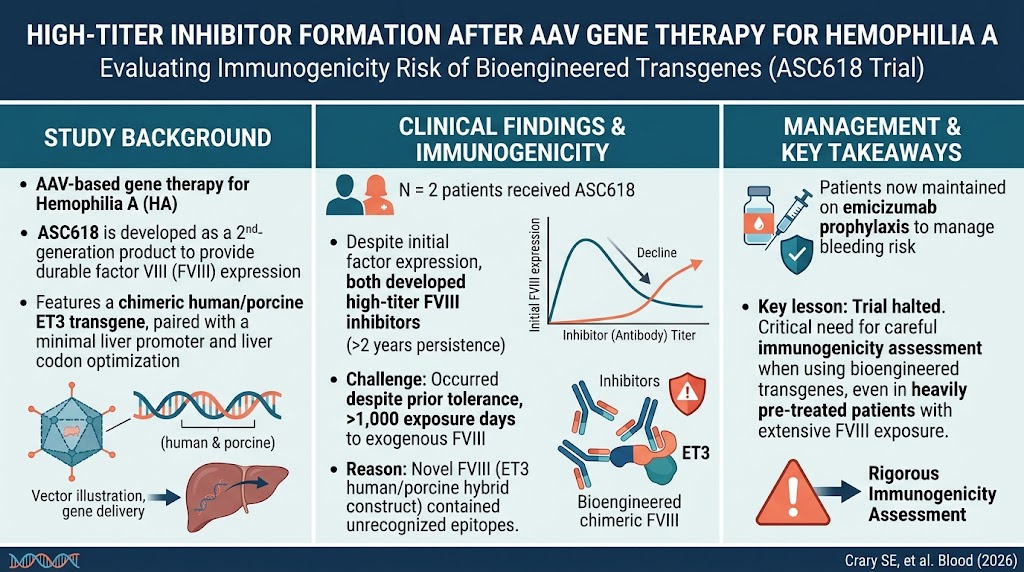
Two adult male patients with severe hemophilia A (HA) and a history of extensive prior exposure to factor VIII (FVIII) concentrates (>1000 exposure days each) were enrolled in a phase 1/2 clinical trial (NCT04676048) evaluating ASC618 gene therapy. Both patients were previously treated and had no prior history of FVIII inhibitors. ASC618 is a second-generation adeno-associated viral (AAV) vector gene therapy encoding ET3, a bioengineered chimeric human/porcine B-domain-deleted FVIII transgene optimized for liver expression.
Diagnosis
Following administration of a single intravenous dose of ASC618, both patients achieved initial detectable FVIII expression. However, subsequently, both developed high-titer FVIII inhibitors confirmed by Bethesda assays. The inhibitor titers remained elevated near two years post-infusion despite clinical management.
Differential Diagnosis
Other causes considered for loss of FVIII expression and clinical bleeding risk included:
– Immune-mediated transaminitis causing loss of vector-expressing hepatocytes.
– Vector-related toxicity or AAV capsid immune responses.
– Development of neutralizing antibodies against the AAV capsid.
– Non-immune causes, such as vector delivery failure or transgene silencing.
However, the presence of high-titer, persistent FVIII inhibitors confirmed immune-mediated neutralization of FVIII. Liver enzyme monitoring showed no significant transaminitis, supporting inhibitor formation as the cause of expression loss rather than vector rejection.
Treatment and Management
Following inhibitor detection, both patients were transitioned to emicizumab prophylaxis—a bispecific monoclonal antibody substituting for FVIII function—reducing bleeding events and improving hemostasis. Immunosuppressive strategies targeting inhibitor eradication were not reported. Close clinical and laboratory follow-up for inhibitor titers, liver function, and FVIII expression was maintained.
Outcome and Prognosis
Nearly two years after a single ASC618 infusion, both patients persist with high-titer FVIII inhibitors, although titers had declined from peak values. Neither has regained endogenous FVIII activity from gene therapy. Patients are clinically stable on emicizumab prophylaxis without major bleeding events. The prognosis for inhibitor resolution remains guarded, given the prolonged high-titer status despite prior extensive FVIII exposure, suggesting durable immune memory against the ET3 transgene product.
Discussion
These two cases highlight a significant immunogenicity challenge of AAV-mediated gene therapy using bioengineered FVIII transgenes for hemophilia A. Despite >1000 prior exposure days to conventional human FVIII products without inhibitor formation, both patients developed robust high-titer inhibitors against the chimeric human/porcine ET3 transgene product. This suggests that bioengineered epitopes within ET3, distinct from wild-type human FVIII, may not be tolerated immunologically, leading to breakdown of peripheral tolerance.
Previous clinical trials with AAV-FVIII gene therapies have reported variable factor expression kinetics, immune-mediated transaminitis, and gradual factor decline. However, persistent high-titer inhibitor formation post-gene therapy is rare and represents a critical barrier to successful sustained correction. The novel antigenic determinants within the ET3 protein likely triggered a T-cell and B-cell immune response notwithstanding prior FVIII exposure, which did not confer tolerance to the porcine hybrid epitopes.
These observations underscore the necessity for rigorous preclinical immunogenicity screening of bioengineered transgenes and careful patient selection, even among previously treated patients. Prospective immune monitoring and development of strategies to induce or preserve tolerance are essential to improve gene therapy outcomes. Until further understanding is achieved, the use of bioengineered FVIII transgenes with divergent immunogenic epitopes warrants caution.
The clinical trial of ASC618 was halted due to these immune complications, but the lessons learned from these cases provide valuable insights for the next generation of hemophilia gene therapies. Emicizumab remains an effective prophylactic agent for patients complicated by inhibitors.
References
1. Crary SE, Citla-Sridhar D, Pierce CD, Young G. Cases of High-Titer Inhibitor Formation After AAV Gene Therapy for Hemophilia A. Blood. 2026 Oct 16; PMID: 42886677. Available from: https://pubmed.ncbi.nlm.nih.gov/42886677/
2. George LA, et al. Hemophilia Gene Therapy: Progress and Challenges. Blood. 2019;134(22):1986-1995.
3. Pipe SW. Clinical Implications of Gene Therapy for Hemophilia. Hematology Am Soc Hematol Educ Program. 2019;2019(1):564-574.
4. Mahlangu JN, et al. Emicizumab Prophylaxis in Patients With Hemophilia A and Inhibitors. N Engl J Med. 2018; 379(9): 811-822.
—
The above case report synthesizes the clinical course, immunological challenges, and management of two hemophilia A patients developing inhibitors following AAV gene therapy with a bioengineered FVIII transgene. This contributes to the evolving knowledge base informing safer gene therapy development.
This article was created using several editorial tools, including AI, as part of the process. Human editors reviewed this content before publication.