Digitally Guided Root Membrane Preparation Using a Dedicated Apex Guide for Immediate Implant Placement: A Retrospective Case Series
Patient Information
Fifteen consecutive adult patients requiring single-tooth extraction and immediate implant placement were retrospectively included in this case series. The cohort involved nine anterior and six posterior single-tooth sites. Inclusion criteria involved sites suitable for root membrane (RM) technique and immediate implant placement. The patients underwent thorough clinical and radiographic evaluation including cone-beam computed tomography (CBCT) and intraoral digital scanning. Baseline demographics such as exact age and gender distribution were not detailed in the source data but patients were presumably adults presenting with dental issues necessitating extraction and implantation.
Diagnosis
Diagnosis included non-restorable single-tooth sites in both anterior and posterior regions where preservation of the facial alveolar bone was crucial. Indications favored immediate implant placement with tissue preservation using the root membrane technique. Radiographic analysis ensured adequate bone volume and morphology for implant placement guided by digital planning.
Differential Diagnosis
Alternative treatment options and diagnoses possibly considered included:
– Traditional extraction followed by delayed implant placement,
– Extraction with socket preservation grafting,
– Immediate implant placement without root membrane preservation,
– Complex ridge augmentation prior to implant placement.
These were likely ruled out due to the advantages of the RM technique in maintaining alveolar ridge contour, achieving optimal esthetics, and reducing treatment time.
Treatment and Management
Treatment employed a fully digital static computer-assisted workflow:
– Preoperative CBCT and intraoral scans were registered for precise planning.
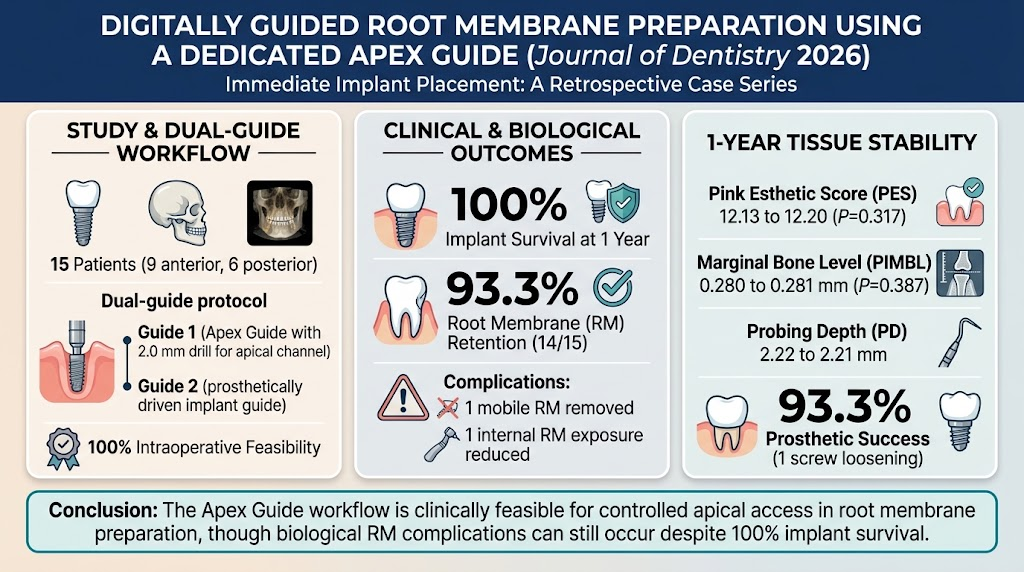
– A tooth-supported Apex Guide was fabricated and used to facilitate a 2.0-mm drill access aligned along the root-oriented trajectory for RM preparation.
– This guide directed the apical access to enable partial root retention while preserving the facial bone and periodontal ligament.
– A separate prosthetically driven surgical guide was then employed for implant osteotomy and placement independent of the Apex Guide to ensure optimal implant positioning for prosthetic outcomes.
This dual-guide approach allowed independent optimization of RM preparation and implant positioning. Careful drilling and handling preserved RM integrity without intraoperative damage to the facial bone or RM in all but one case.
Outcome and Prognosis
– The RM preparation using digital guidance was feasible in all 15 treated sites.
– RM retention was achieved in 14/15 (93.3%) sites. One RM became mobile intraoperatively and required removal; another showed internal exposure that necessitated reduction.
– Implant survival and prosthetic success were high, with implant survival at 100% and prosthetic success slightly reduced (93.3%) due to one episode of screw loosening.
– Clinical parameters remained stable between 6 months and 1 year:
– Pink Esthetic Score (PES) was stable (12.13 ± 0.74 vs 12.20 ± 0.77; P=0.317), indicating excellent esthetic outcomes.
– Probing Depth (PD) remained unchanged (2.22 ± 0.15 vs 2.21 ± 0.10 mm; P=0.655).
– Bleeding on Probing (BOP) showed no significant increase (3.34 ± 6.91% vs 2.23 ± 5.88%; P=0.317).
– Peri-implant marginal bone level (PIMBL) showed minimal change (0.280 ± 0.039 vs 0.281 ± 0.035 mm; P=0.387), signifying excellent hard tissue stability.
The prognosis for this approach is favorable, though longer-term outcomes beyond one year remain to be established.
Discussion
This retrospective case series highlights the clinical feasibility and promising short-term outcomes of using a dedicated Apex Guide within a static computer-assisted workflow for root membrane preparation and immediate implant placement. The Apex Guide allows precise apical access following the root-oriented trajectory, facilitating preservation of the facial bone and periodontal ligament complex which is critical for maintaining alveolar ridge contour and esthetics.
The use of two separate guides—one for RM preparation and another prosthetically driven guide for implant placement—provides versatility by independently optimizing surgical steps. The 93.3% RM retention rate supports the procedure’s reliability, though complications such as RM mobility and internal exposure underline the need for technical precision and cautious clinical execution.
Stable Pink Esthetic Scores, probing depths, minimal bleeding, and marginal bone stability over one year indicate preserved peri-implant tissues and successful implant osseointegration. Implant survival in this cohort was 100%, reinforcing the safety of this digital workflow.
Despite the encouraging results, this small series lacks a control group, and the comparative accuracy or advantages over conventional freehand or guided approaches remain to be established. Moreover, longer follow-up will be necessary to assess long-term hard and soft tissue stability, implant survival, and complication rates.
This study is aligned with the emerging trend toward digitally guided implant surgery that enhances precision, reduces surgical risks, and optimizes esthetic outcomes. Root membrane techniques have been demonstrated to maintain alveolar ridge dimensions better than conventional extraction or socket grafting; digital guidance may enhance the reproducibility of this technique.
Clinicians adopting this workflow should be trained in both digital planning and the specific surgical nuances of RM preparation. Further prospective randomized controlled trials are required to validate the technique’s efficacy, safety, and cost-effectiveness relative to conventional protocols.
References
1. Omar S, Mangano FG. Digitally Guided Root Membrane Preparation Using a Dedicated Apex Guide for Immediate Implant Placement: A Retrospective Case Series. Journal of Dentistry. 2026-10-16:107113.
2. Buser D, et al. Immediate implant placement with or without provisional restoration. Clin Oral Implants Res. 2016;27 Suppl 12:25-30.
3. Pontes AE, et al. Root membrane: a new approach for immediate implant placement in esthetic areas—case series. Int J Oral Maxillofac Implants. 2010;25(4):739-747.
4. Mangano FG, et al. Computer-guided implantology: from static to dynamic navigation systems. Periodontol 2000. 2020;83(1):113-130.
This article was created using several editorial tools, including AI, as part of the process. Human editors reviewed this content before publication.