We use cookies

Our website uses essential cookies and, with your consent, additional cookies to measure performance and improve our services. Cookie Policy.

You can change your choice at any time.

MMedXYNews
HomeVideos
MedXY AI/MedXY News/Section: Internal Medicine

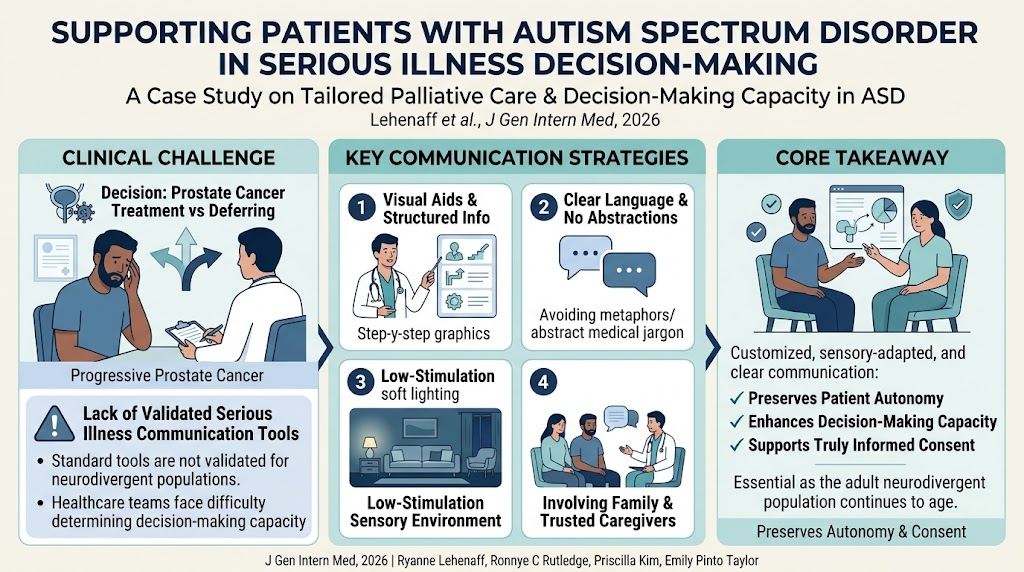
Supporting Patients with Autism Spectrum Disorder and Neurodivergence in Serious Illness Decision-Making
MedXY Editorial Team•Oct 16, 2026•Internal Medicine
autism spectrum disordercase reportdecision-makingneurodivergencepalliative care

Patient Information

A middle-aged man diagnosed with autism spectrum disorder (ASD) was referred to a palliative care clinic for evaluation and assistance regarding his decision-making capacity related to treatment options for his progressive prostate cancer. The patient’s main clinical concern was his preference to defer treatment despite the disease progression. Relevant medical history included his diagnosis of ASD and associated neuropsychiatric comorbidities, which contributed to challenges in communication and healthcare interaction. The patient’s family and caregivers played an active supportive role in his care.

Diagnosis

MedXY registered readers

Sign in free to continue reading

Create or use your MedXY account to unlock the complete article.

This article was created using several editorial tools, including AI, as part of the process. Human editors reviewed this content before publication.

Related articles

Open language-specific specialty feeds and department pages.

Immunosuppression and Long-term Survival After Single Living-donor Lobar Lung Transplantation from the Same Donor as Prior Hematopoietic Stem Cell Transplantation: An All-Japan Case SeriesThis case series examines immunosuppressive management and long-term outcomes in nine Japanese patients undergoing single living-donor lobar lung transplantation from the same donor as prior HSCT, revealing viable reduced immunosuppressionOct 18, 2026An Infant With Extreme Hypernatremia Treated With Peritoneal DialysisA 34-day-old male infant with serum sodium >200 mmol/L from accidental salt ingestion was successfully treated with peritoneal dialysis, leading to full recovery.Oct 16, 2026Acquired Hair Texture Alteration After Regrowth in Alopecia Areata: A Distinct Clinical and Ultrastructural PhenotypeAlopecia areata regrowth may present atypically with acquired curly hair texture, associated with pili torti ultrastructural changes, signifying a unique phenotype requiring clinical recognition.Oct 15, 2026
Loading comments...
MedXY briefing

Get the free newsletter

Evidence-led clinical news, trends, and analysis—delivered to your inbox.

Ask MedXY AI

Most popular

Intimate Health
Five Benefits for Women Continuing Sexual Activity After Menopause
Intimate Health
Why Some Women Have a Strong Sex Drive—And Why Men Shouldn't Worry About It
Nursing & care
How often should a couple have sex?
Cardiology
Precision Medicine for Long QT Syndrome Type 2: Lumacaftor Corrects Trafficking Defects and Shortens QT Interval
General Surgery
Optimizing Postoperative Opioid Prescriptions After Intra-Abdominal Cancer Surgery: Comparing the 5x-Multiplier and 3-Tier Models
© 2026 MedXY
Contact usAbout usPrivacy PolicyMedXY story
The Retrograde Migration of Foreign Bodies inside the Female Genital Tract: A Step-by-Step Hysteroscopic Approach
Two cases of retrograde migration of foreign bodies in the female genital tract were successfully managed with a minimally invasive hysteroscopic technique involving electrosurgical radial incision and Foley catheter dilation, emphasizing s
Oct 14, 2026
Evaluating Early Palliative Care Impact on End-of-Life Outcomes in Surgical Cancer Patients: Insights from the SOPE TrialA randomized trial found no significant benefit of early specialist palliative care on end-of-life outcomes among patients undergoing curative abdominal cancer surgery, suggesting tailored rather than routine involvement.Oct 11, 2026
Biallelic CYB5A Disruptions in 46, XY Disorders of Sex Development: Novel Missense and Deep Intronic Variants in Two Vietnamese SiblingsThis report describes two siblings with 46,XY DSD caused by novel biallelic CYB5A variants including a missense and a deep intronic mutation disrupting splicing, expanding knowledge of CYB5A-related disorders.Oct 11, 2026