Arterial Spin Labeling Hemodynamic Metrics Predict Cognitive Decline and Small Vessel Disease Progression Over 11 Years
Highlight
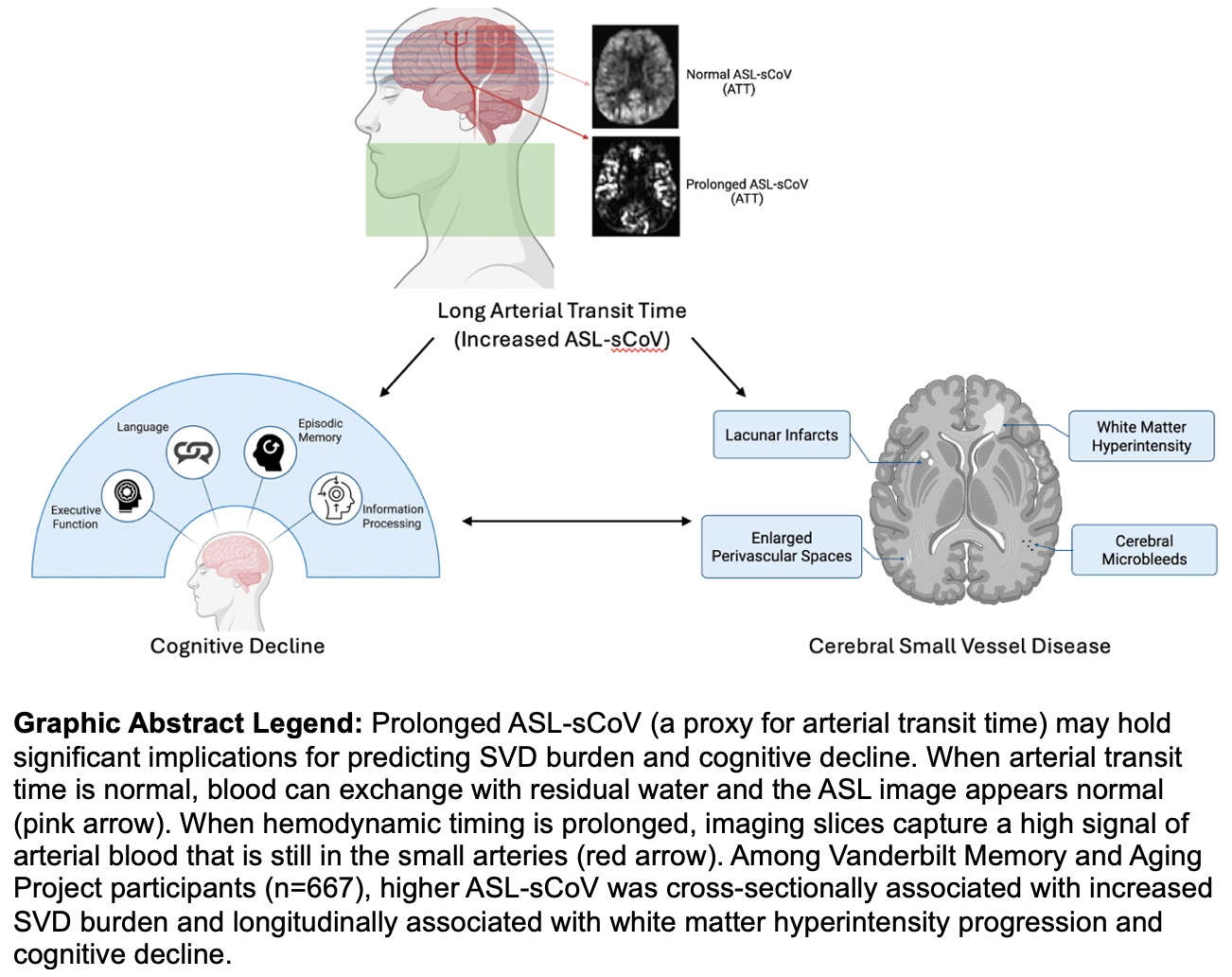
This longitudinal cohort study investigates the relationship between arterial spin labeling-derived hemodynamic indices and cerebral small vessel disease (SVD) markers and cognitive trajectories. The arterial spin labeling spatial coefficient of variation (ASL-sCoV), a proxy for arterial transit time heterogeneity, correlates strongly with SVD burden at baseline and predicts faster progression of white matter hyperintensities and cognitive decline over 11 years. Traditional measures of cerebral blood flow (CBF) did not show similar associations. ASL-sCoV could thus enhance early identification of hemodynamic disturbances linked to SVD progression and inform targeted interventions.
Study Background
Cerebral small vessel disease (SVD) contributes significantly to stroke, cognitive impairment, and vascular dementia globally, posing a major public health challenge. The pathophysiology of SVD involves microvascular dysfunction leading to chronic cerebral hypoperfusion and blood-brain barrier breakdown. Neuroimaging markers such as white matter hyperintensities (WMH), enlarged perivascular spaces (ePVS), cerebral microbleeds (CMB), and lacunar infarcts (LI) indicate cumulative vascular injury but offer limited insight into underlying hemodynamic disturbances. Traditional arterial spin labeling (ASL) measures of cerebral blood flow (CBF) are often confounded by delayed arterial transit times common in SVD, potentially masking perfusion deficits. The ASL spatial coefficient of variation (ASL-sCoV) reflects heterogeneity in arterial transit time and may better capture early hemodynamic alterations associated with SVD burden and progression.
Study Design
This investigation leverages data from the Vanderbilt Memory and Aging Project (VMAP), a prospective longitudinal cohort based in Nashville, Tennessee. The cohort enrolled 667 nondemented, nonstroke participants aged 68±9 years (51% female, 18% mild cognitive impairment) who underwent serial 3T brain MRI and comprehensive neuropsychological assessment between 2012 and 2024, with an average follow-up of 4.9±3.5 years. Pseudo-continuous ASL was employed to assess cerebral blood flow and calculate ASL-sCoV in total gray matter. Neuroimaging markers of SVD (WMH volume, ePVS, CMB, and LI) were quantified using standardized protocols. The study examined baseline ASL-sCoV and CBF in relation to SVD burden cross-sectionally and longitudinally, as well as trajectories of multiple cognitive domains (executive function, information processing speed, language, and visuospatial abilities). Adjustments included demographics, cognitive status, Framingham Stroke Risk Profile excluding age, apolipoprotein E-ε4 status, intracranial volume for imaging outcomes, and follow-up duration for longitudinal models. Linear and linear mixed-effects regression analyses were conducted to explore associations.
Key Findings
Baseline ASL-sCoV was robustly associated with cross-sectional markers of SVD, most notably WMH and ePVS (adjusted pFDR<0.006). Elevated ASL-sCoV predicted an accelerated accumulation of WMH volume over time (pFDR=0.03). Moreover, higher baseline ASL-sCoV correlated with faster decline in executive function, information processing speed, language, and visuospatial performance domains (all p<0.05). By contrast, conventional gray matter cerebral blood flow measures did not show significant cross-sectional or longitudinal relationships with SVD burden or cognitive trajectories (pFDR>0.05 for cross-sectional and pFDR>0.06 for longitudinal analyses). These results suggest that ASL-sCoV captures hemodynamic disturbances indicative of impaired cerebral perfusion more sensitively than absolute CBF values in the context of SVD.
The findings highlight the utility of ASL-sCoV as a noninvasive imaging biomarker reflecting arterial transit time heterogeneity, which may represent microvascular pathology and compromised blood flow delivery in cerebral small vessels. This metric’s predictive value for both structural disease progression and cognitive deterioration underscores its potential clinical applicability for risk stratification and monitoring therapeutic interventions.
Expert Commentary
The study addresses a critical gap in SVD research by applying ASL-based hemodynamic indices beyond absolute CBF to better characterize microvascular dysfunction. Delayed arterial transit times, reflected by increased ASL-sCoV, likely signify impaired vascular compliance and flow alterations preceding overt ischemic injury. This aligns with emerging concepts that perfusion heterogeneity is a key early marker of vascular cognitive impairment. Incorporating ASL-sCoV into routine imaging protocols could enhance detection of subtle hemodynamic deficits, guiding early intervention strategies to mitigate cognitive decline.
However, some limitations warrant consideration. The predominantly older, community-based cohort with low prevalence of advanced dementia may limit generalizability to more severely affected populations. The observational design cannot confirm causality between ASL-sCoV and SVD progression. Future studies should validate these findings across diverse cohorts and investigate therapeutic modulation of ASL-sCoV parameters.
Conclusion
This longitudinal study provides compelling evidence that arterial spin labeling spatial coefficient of variation is a sensitive hemodynamic marker linked to cerebral small vessel disease burden and cognitive decline over more than a decade. The lack of association between conventional cerebral blood flow measures and these outcomes underscores the added value of ASL-sCoV for capturing microvascular impairments. As ASL-sCoV can be readily derived from conventional ASL datasets without additional imaging time, it holds promise to become an accessible tool for early detection and monitoring of progressive cerebral small vessel disease. Integration of ASL-sCoV assessment into clinical research and practice may refine risk stratification and guide interventions aimed at preserving cognitive function in aging populations.
Funding and ClinicalTrials.gov
The Vanderbilt Memory and Aging Project is supported by grants from the National Institute on Aging (grant numbers not specified). The study was conducted following institutional review board approval with informed consent from all participants. The trial is not registered as an interventional clinical trial due to its observational nature.
References
- Wardlaw JM, Smith C, Dichgans M. Mechanisms of sporadic cerebral small vessel disease: insights from neuroimaging. Lancet Neurol. 2013;12(5):483-497. doi:10.1016/S1474-4422(13)70060-7
- Chen JE, Wang DJJ, Detre JA. Inflated cerebral blood flow fMRI signal in smaller cerebral vessels of patients with cerebral small vessel disease. Neurology. 2016;87(5):381-387. doi:10.1212/WNL.0000000000002921
- van der Thiel A, van Uden IWM, Ivanov D, et al. Arterial spin labeling detects microvascular perfusion impairments in cerebral small vessel disease. J Cereb Blood Flow Metab. 2019;39(6):1121-1133. doi:10.1177/0271678X19835039
- Robb WH, Santner AM, Zhang P, et al. Arterial Spin Labeling Hemodynamic Indices Relate to Cognitive and Small Vessel Disease Trajectories Over 11 Years. Stroke. 2026 Sep 10. PMID: 42717860.
This article was created using several editorial tools, including AI, as part of the process. Human editors reviewed this content before publication.