Plasma Biomarkers for Neocortical Tau Burden
Introduction
Tau pathology, notably the accumulation of neurofibrillary tangles in the neocortex, plays a central role in the progression of Alzheimer’s disease (AD). Phosphorylated tau-217 (p-tau217) in plasma has emerged as a promising biomarker to assess amyloid-β pathology and early tau changes. Yet, its accuracy in detecting advanced neocortical tau burden remains limited, underscoring the need for more precise tools to evaluate tau pathology non-invasively.
As anti-amyloid and emerging anti-tau therapies advance, accurately staging tau pathology is crucial for both clinical decision-making and therapeutic trial design. Enhanced plasma biomarker panels could revolutionize patient stratification, identify candidates for tau-targeted interventions, and reduce reliance on more costly or less accessible modalities such as tau positron emission tomography (PET).
Study Objective
This study aimed to develop and validate a multi-protein plasma biomarker panel that surpasses p-tau217 alone in identifying advanced tau pathology in neocortical brain regions characteristic of Braak stages V and VI. Such a panel would ideally improve clinical accuracy in individuals already positive for amyloid and at risk for AD progression.
Methods
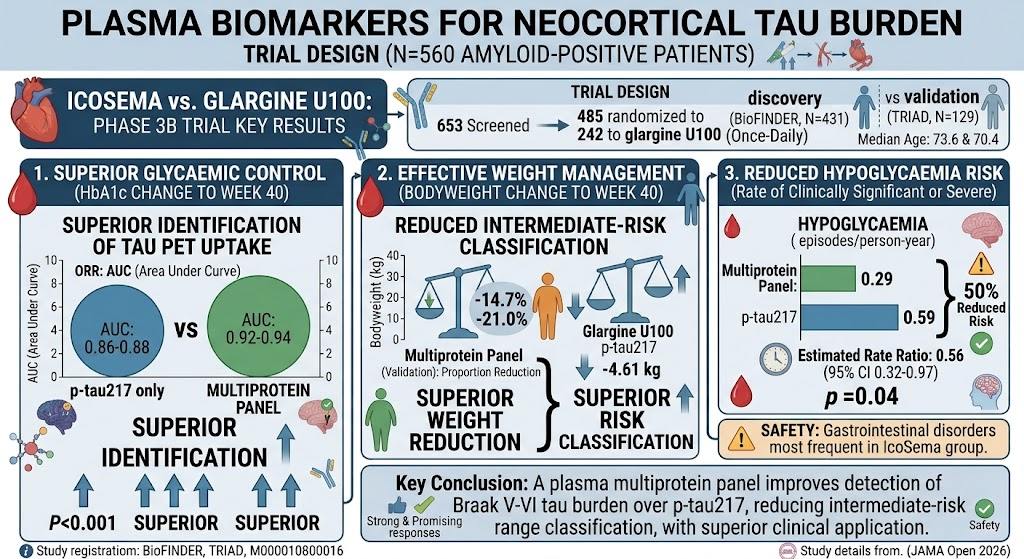
The multicenter cohort study leveraged two independent observational cohorts: the Swedish BioFINDER study and the Translational Biomarkers in Aging and Dementia (TRIAD) project. Between 2017 and 2024, clinical and blood sample data were collected from 560 participants spanning from cognitively normal to dementia, including 431 from BioFINDER and 129 from TRIAD.
Plasma samples were analyzed for concentrations of 125 proteins using a Nucleic Linked Immuno-Sandwich Assay central nervous system panel. The primary outcome was the presence of advanced tau pathology, defined by tau PET tracer uptake localized within Braak stage V and VI neocortical regions.
Predictive performance of biomarker combinations was assessed by multivariable logistic regression models and quantified via the area under the receiver operating characteristic curve (AUC), with a focus on improving upon p-tau217’s predictive capacity.
Results
The cohorts included individuals positive for amyloid plaques and exhibited a balanced representation by sex and ages mainly in the 70s. The multivariate approach identified a seven-protein plasma panel that demonstrated significantly improved performance in detecting advanced tau PET positivity compared with p-tau217 alone.
Specifically, while p-tau217 showed good accuracy (AUC of 0.86 to 0.88), the multi-protein panel increased AUC values to between 0.92 and 0.94 (95% CI, 0.89-0.98), reaching statistical significance (DeLong P < .001) across both discovery and validation cohorts. Notably, this improvement reduced the proportion of individuals falling into an uncertain intermediate-risk category by approximately 15-21% in the validation sample, enhancing diagnostic clarity.
Interpretation and Significance
Integrating multiple plasma proteins with p-tau217 markedly enhances predictive accuracy for advanced neocortical tau pathology. This suggests that such multiplexed biomarker panels could serve as scalable, cost-effective, and less invasive alternatives to tau PET imaging, facilitating earlier and more precise staging of neurofibrillary tangle pathology in clinical practice and research.
Improved staging tools can help tailor therapeutic decisions, such as the timely initiation of anti-tau drugs currently under development or more personalized monitoring of disease progression. Furthermore, refining participant selection in clinical trials based on robust plasma markers may optimize trial efficiency and outcomes.
Broader Context of Tau Biomarkers
Tau protein pathology progresses through characteristic brain regions in defined stages (Braak stages I-VI), with advanced stages (V and VI) reflecting widespread neocortical involvement linked to clinical dementia. While cerebrospinal fluid (CSF) markers and PET imaging have been the gold standards for tau assessment, their invasiveness, cost, and limited availability hinder routine use.
Blood-based markers harnessed through sensitive immunoassays represent a transformative development. Besides p-tau217, other tau phosphorylation sites and associated proteins indicative of neuronal injury, synaptic dysfunction, inflammation, and amyloid interaction may contribute complementary information, enabling a fuller pathological picture from a simple blood draw.
Limitations and Future Directions
While promising, the multi-protein panel requires further validation across diverse populations and clinical settings to confirm generalizability. The contribution of individual panel proteins to the predictive model warrants additional mechanistic studies, which could reveal novel therapeutic targets or pathways.
Longitudinal studies are also essential to determine the panel’s ability to track disease progression or response to therapy. Integration with other biomarkers, including genetic risk factors and imaging modalities, could refine predictive algorithms further.
Conclusion
This multicohort study demonstrates that adding a select set of plasma proteins significantly enhances the diagnostic performance of p-tau217 for identifying advanced neocortical tau pathology in amyloid-positive individuals. A multiprotein plasma biomarker panel offers a feasible, scalable alternative to tau PET imaging, with strong potential to improve Alzheimer’s disease management and clinical trial design.
Continued research and clinical validation efforts are needed to bring such biomarker panels into routine practice, where they could play a pivotal role in the era of targeted disease-modifying therapies.
References
Di Molfetta G, Brum WS, Pola I, et al. Plasma Biomarkers for Neocortical Tau Burden. JAMA Neurol. 2026 Aug 10. PMID: 42573994. https://pubmed.ncbi.nlm.nih.gov/42573994/
This article was created using several editorial tools, including AI, as part of the process. Human editors reviewed this content before publication.