We use cookies

Our website uses essential cookies and, with your consent, additional cookies to measure performance and improve our services. Cookie Policy.

You can change your choice at any time.

MMedXYNews
HomeVideos
MedXY AI/MedXY News/Section: Clinical Updates

Early Life Vascular Risk and Midlife Markers of Brain Aging: Insights from Longitudinal Neuroimaging and Cognitive Trajectory Studies
MedXY Editorial Team•Sep 17, 2026•Clinical Updates
midlife brain agingNeuroimaging Biomarkersvascular riskcognitive decline

Highlights

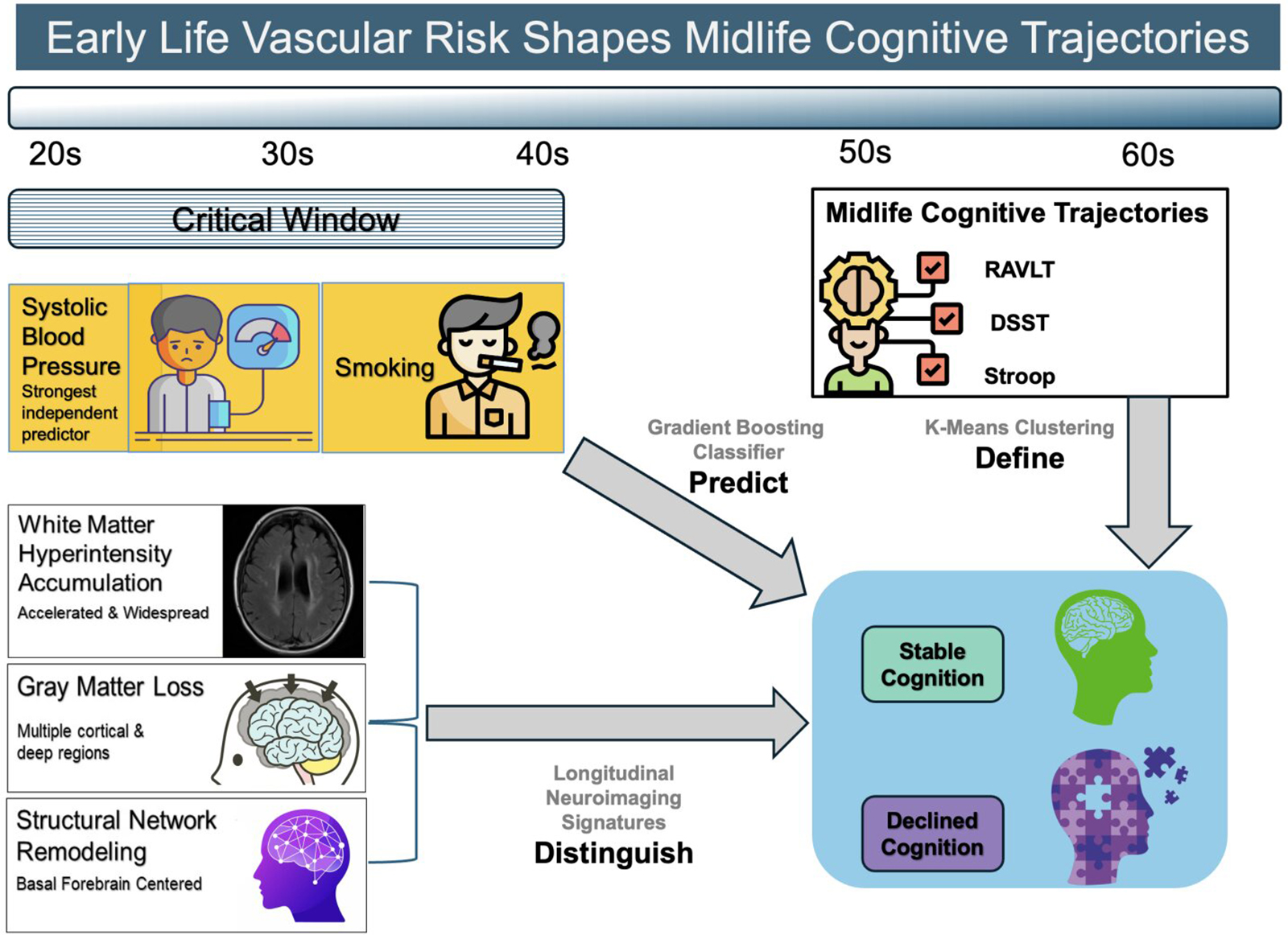
  • Early-life vascular risk factors, especially elevated systolic blood pressure and smoking before age 40, strongly predict cognitive decline by midlife.
  • Longitudinal neuroimaging reveals accelerated white matter hyperintensity accumulation and gray matter volume changes in frontal, temporal, occipital, and thalamic regions linked to cognitive trajectories.
  • Network-level brain reorganization centers on the basal forebrain, potentially reflecting cholinergic and glial responses to early vascular stress, serving as an early biomarker.
  • Findings underscore the critical window before age 40 for vascular risk management to preserve midlife cognition and delay neurodegenerative processes.

Background

MedXY registered readers

Sign in free to continue reading

Create or use your MedXY account to unlock the complete article.

This article was created using several editorial tools, including AI, as part of the process. Human editors reviewed this content before publication.

Related articles

Open language-specific specialty feeds and department pages.

Arterial Spin Labeling Hemodynamic Metrics Predict Cognitive Decline and Small Vessel Disease Progression Over 11 YearsThis study demonstrates that arterial spin labeling spatial coefficient of variation (ASL-sCoV) correlates with cerebral small vessel disease burden and predicts cognitive decline over 11 years, outperforming traditional cerebral blood flowSep 19, 2026Association of Clonal Hematopoiesis With Silent Brain Lesions and Cognitive Decline in Patients With Atrial Fibrillation: An Integrative ReviewClonal hematopoiesis (CHIP) significantly associates with increased silent brain lesions and progressive cognitive decline in atrial fibrillation patients, highlighting a novel neurovascular risk factor with implications for patient managemAug 24, 2026Oral Anticoagulants, Cognition, and Clinical Outcomes in Atrial Fibrillation and Alzheimer’s Disease: Insights from a Swedish Nationwide StudyThis review synthesizes evidence linking NOAC use to slower cognitive decline and improved clinical outcomes in patients with atrial fibrillation and Alzheimer’s disease, highlighting advantages over warfarin and non-use.Aug 13, 2026
Loading comments...
MedXY briefing

Get the free newsletter

Evidence-led clinical news, trends, and analysis—delivered to your inbox.

Ask MedXY AI

Most popular

Intimate Health
Five Benefits for Women Continuing Sexual Activity After Menopause
Intimate Health
Why Some Women Have a Strong Sex Drive—And Why Men Shouldn't Worry About It
Nursing & care
How often should a couple have sex?
Intimate Health
Classic Intimacy Recommendations: How to Help Women Reach Orgasm and Enjoy Mutual Pleasure
Intimate Health
What Makes a Woman "Physiologically Addicted" Is Never Money, But These Two Relationship Qualities
© 2026 MedXY
Contact usAbout usPrivacy PolicyMedXY story
Brain-Predicted Age Difference Enhances Dementia Risk Stratification in Subjective Cognitive Decline Beyond Standard MRI AssessmentBrain-predicted age difference (brain-PAD) from MRI improves early dementia risk prediction in patients with subjective cognitive decline, outperforming traditional visual MRI ratings and offering prognostic value beyond amyloid biomarkers,Aug 11, 2026
Deciphering the Link Between Postoperative Delirium, Rehospitalization, and Cognitive Decline in Older AdultsThis study investigates whether recurrent hospitalizations mediate the association of postoperative delirium with long-term cognitive decline in seniors after major surgery, finding that rehospitalization does not significantly affect thisAug 10, 2026
Persistence of Blood Inflammatory Biomarkers as Predictors of Long-Term Recurrent Stroke Risk: Insights From the Oxford Vascular StudyInflammatory blood biomarkers consistently predict long-term recurrent stroke risk up to 10 years post-event, independent of traditional vascular risk factors, underscoring the potential for anti-inflammatory secondary prevention strategiesAug 6, 2026