Validated Risk Stratification for RYR2-Mediated Catecholaminergic Polymorphic Ventricular Tachycardia on Beta-Blocker Therapy
Highlight
• A large multicenter study developed and externally validated risk prediction models for arrhythmic events in RYR2-mediated catecholaminergic polymorphic ventricular tachycardia (CPVT) patients treated with beta-blockers.
• Key clinical predictors include prior arrhythmic syncope or sudden cardiac arrest and age at initiation of beta-blocker therapy.
• The models effectively stratify patients into low- and high-risk categories to guide personalized management strategies.
• These findings support enhanced clinical decision-making to prevent life-threatening arrhythmias in CPVT.
Study Background
Catecholaminergic polymorphic ventricular tachycardia (CPVT) is a rare but highly malignant inherited arrhythmia syndrome characterized by stress- or exercise-induced ventricular tachycardia. The most common genetic substrate involves mutations in the ryanodine receptor 2 (RYR2) gene, which encodes a critical calcium release channel in cardiac myocytes. Despite standard beta-blocker therapy, patients remain at elevated risk for potentially fatal arrhythmic events (AEs), including arrhythmic syncope, appropriate implantable cardioverter-defibrillator (ICD) shocks, sudden cardiac arrest (SCA), and sudden cardiac death (SCD). Identifying patients at highest risk while under beta-blocker treatment remains a clinical challenge, limiting optimal individualized therapeutic strategies.
Study Design
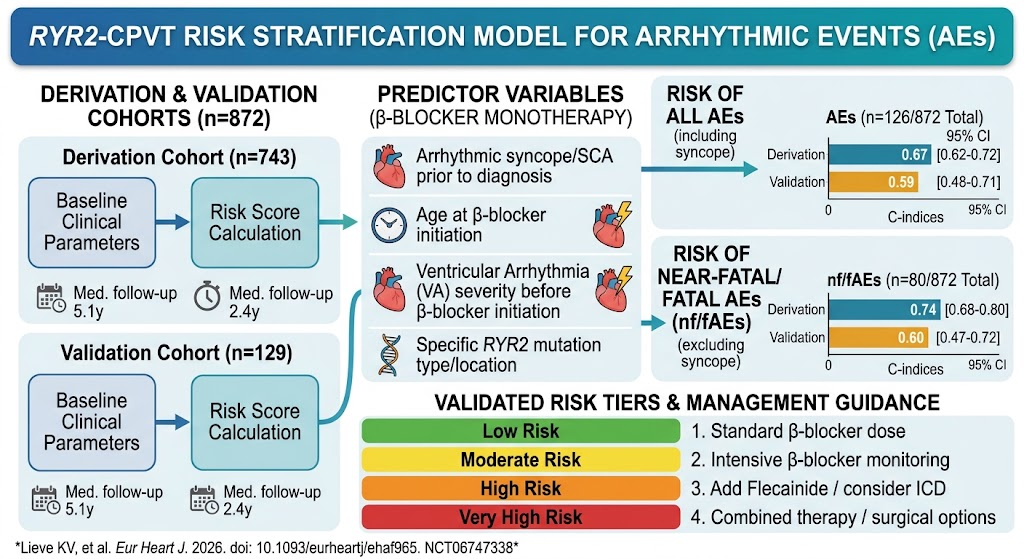
This comprehensive study involved 743 patients in the derivation cohort and 129 patients in an independent external validation cohort, all with genetically confirmed RYR2-mediated CPVT receiving beta-blocker monotherapy. Patients were followed longitudinally for arrhythmic outcomes, with a median follow-up of 5.1 years in the derivation group and 2.4 years in validation. Adverse events included arrhythmic syncope, appropriate ICD shocks, SCA, and SCD. Near-fatal or fatal arrhythmic events (nf/fAEs) were defined as all events excluding arrhythmic syncope.
Clinical variables were assessed as potential predictors, and multivariable Cox proportional hazards regression models were constructed. The models underwent rigorous internal and external validation to evaluate discrimination (C-index) and calibration.
Key Findings
In the derivation cohort, 13.7% (102/743) experienced ≥1 AE; in validation, this was 18.6% (24/129). Independent predictors of arrhythmic events were:
– History of arrhythmic syncope or SCA prior to diagnosis.
– Younger age at initiation of beta-blockers.
For near-fatal or fatal events, a fourth predictor—ventricular arrhythmia severity before beta-blocker initiation—was added. The models demonstrated moderate discrimination for AEs (derivation optimism-corrected C-index 0.67 [95% CI 0.62–0.72]; validation C-index 0.59 [95% CI 0.48–0.71]) and better discrimination for nf/fAEs (derivation C-index 0.74 [95% CI 0.68–0.80]; validation C-index 0.60 [95% CI 0.47–0.72]). Calibration slopes approximated ideal prediction in derivation (slope=1.00) for both outcomes.
The risk stratification model identified low-risk patients who may be effectively managed on beta-blocker monotherapy and high-risk patients for whom additional interventions—such as ICD implantation, left cardiac sympathetic denervation, or adjunctive antiarrhythmic therapies—could be considered.
Expert Commentary
CPVT remains a clinical challenge due to the unpredictability and severity of arrhythmia triggered by adrenergic stimulation. This large multicenter study markedly advances personalized risk assessment by integrating simple clinical variables readily available at baseline. While the modest discrimination in external validation highlights potential heterogeneity or unmeasured factors in real-world cohorts, the model’s clinical utility lies in its ability to distinguish risk groups and guide treatment intensity.
Importantly, the study excluded patients on combination therapies, focusing exclusively on beta-blocker monotherapy, which reflects a common initial management but may not capture risk dynamics with advanced therapies. Future research should explore how other genetic modifiers and biomarkers of arrhythmogenic susceptibility could augment this model. Moreover, prospective validation and cost-effectiveness analyses are needed to optimally integrate this risk stratification into clinical pathways.
Conclusion
This study provides a validated, clinically applicable risk prediction tool for patients with RYR2-mediated CPVT receiving beta-blockers. By identifying individuals at low and high risk for arrhythmic events, clinicians can tailor surveillance intensity and consider prophylactic interventions to prevent fatal arrhythmias. This represents a meaningful step toward precision medicine in inherited arrhythmia syndromes, emphasizing the critical role of detailed phenotyping and longitudinal data in improving patient outcomes.
Funding and ClinicalTrials.gov
The original study was conducted by an international consortium and supported by multiple academic and institutional grants. Details regarding specific funding sources or clinical trial registration were not specified in the original publication abstract.
References
1. Lieve KV et al. Catecholaminergic polymorphic ventricular tachycardia mediated by ryanodine receptor 2: a validated risk stratification. European Heart Journal. 2026;47(33):4606-4617. PMID: 41416846.
2. Priori SG, Wilde AA, Horie M, et al. 2015 ESC Guidelines for the management of patients with ventricular arrhythmias and the prevention of sudden cardiac death. European Heart Journal. 2015;36(41):2793-2867.
3. Hwang HJ, Song YB. Current perspectives in CPVT: Genetics, clinical features, and management. Korean Circulation Journal. 2021;51(3):173-185.
4. Sumitomo N, et al. Clinical characteristics and long-term prognosis of catecholaminergic polymorphic ventricular tachycardia. Circulation. 2003;107(1):45-50.
This article was created using several editorial tools, including AI, as part of the process. Human editors reviewed this content before publication.