Genotype and Arrhythmic Risk in Dilated Cardiomyopathy: An Integrative Review of Genetic Stratification and Clinical Implications
Highlights
High-risk pathogenic variants in genes such as LMNA, DSP, FLNC, and others markedly increase ventricular arrhythmia and heart failure risk in DCM, independent of ejection fraction and clinical demographics.
Genetic diagnosis refines sudden cardiac death prevention strategies, identifying patients at risk even with preserved left ventricular ejection fraction (LVEF ≥ 50%).
Emerging evidence highlights novel pathogenic genes like NKX2-5 implicated in familial DCM with arrhythmias, expanding the genetic spectrum beyond sarcomeric proteins.
Polymorphisms in adrenergic receptor-related genes modulate cardiovascular event risk, underscoring the influence of genetic modifiers on arrhythmia susceptibility in DCM.
Background
Dilated cardiomyopathy (DCM) is a common myocardial disorder characterized by ventricular dilation and impaired systolic function, leading to heart failure (HF) and life-threatening arrhythmias. It substantially contributes to cardiovascular morbidity and mortality worldwide. While clinical parameters such as left ventricular ejection fraction (LVEF) have traditionally guided prognosis and therapy, the variable arrhythmic risk in DCM challenges optimal risk stratification for sudden cardiac death (SCD). Increasingly, genetic insights reveal that identified pathogenic variants confer distinct arrhythmic risks, influencing clinical management. However, the magnitude of risk attributable to specific genotypes and the role of genetic diagnosis in guiding interventions remain incompletely defined. This review synthesizes evidence from the international Sarcomeric Human Cardiomyopathy Registry (SHaRe) and other pivotal studies, elucidating the relationship between genotype and arrhythmic risk in DCM and discussing translational implications.
Key Content
1. Large-Scale Genetic Risk Stratification from DCM-SHaRe Registry
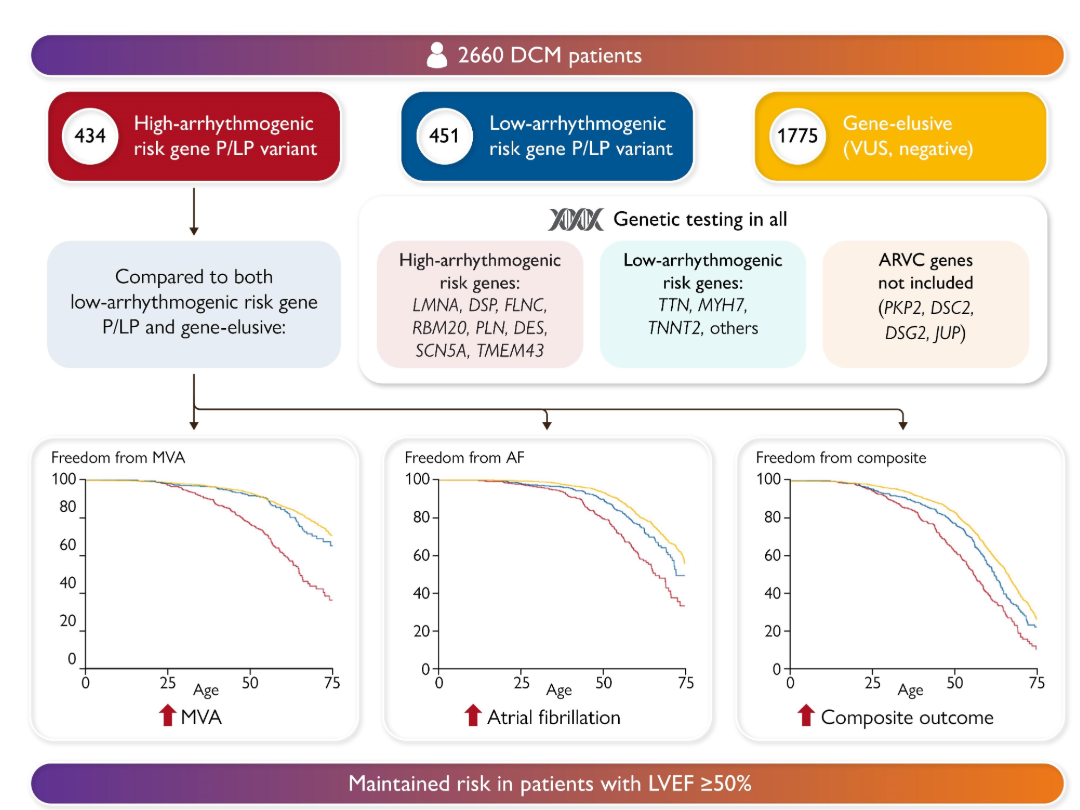
The recent multi-center analysis by Padalia et al. (2026) encompassing 2,660 adults with genotyped DCM offers the most comprehensive evaluation of genotype-specific arrhythmic risk to date. Patients were categorized based on presence of pathogenic/likely pathogenic (P/LP) variants into high-arrhythmogenic risk genes (LMNA, DSP, FLNC, RBM20, PLN, SCN5A, DES, TMEM43), low-risk genes (TTN, TNNT2, MYH7, others), or gene-elusive.
Key findings include:
High-arrhythmogenic gene variants were detected in 16% of patients and conferred a more than threefold increased hazard of major ventricular arrhythmia (MVA) compared to gene-elusive individuals (HR 3.25, 95% CI 2.63–4.01), adjusted for age, sex, and LVEF.
These patients also exhibited higher risks of atrial fibrillation (AF) and heart failure, reflecting broader myocardial vulnerability.
Significantly, the elevated arrhythmic risk persisted among carriers with preserved LVEF (≥ 50%), emphasizing genotype’s independent prognostic value beyond conventional clinical measures.
Low-risk gene variant carriers demonstrated intermediate risks, whereas gene-elusive patients showed the lowest event rates.
This study underscores the utility of comprehensive genetic testing in refining individual arrhythmic risk, potentially guiding decisions regarding implantable cardioverter-defibrillator (ICD) therapy and closer arrhythmia surveillance.
2. Insights into Specific High-Risk Genes and Mechanisms
Several genes with high arrhythmogenic propensity encode nuclear envelope proteins (LMNA), desmosomal components (DSP, FLNC), or RNA-binding and calcium regulation proteins (RBM20, PLN).
– LMNA Mutations: Associated with penetrant electrical instability, conduction disease, and sustained ventricular arrhythmias. Mechanistically, LMNA mutations disrupt nuclear integrity and signaling pathways, leading to myocardial fibrosis and arrhythmogenic substrate formation.
– DSP and FLNC Mutations: Linked to overlapping phenotypes of DCM and arrhythmogenic cardiomyopathy, these genes compromise cytoskeletal integrity, facilitating fibrofatty myocardial replacement and arrhythmias.
– SCN5A Variants: Affect sodium channel function, contributing to conduction abnormalities and arrhythmic risks.
This mechanistic heterogeneity informs personalized risk and therapeutic approaches in genotype-tailored management.
3. Expanding Genetic Spectrum Beyond Classic Sarcomeric Genes
The 2015 study by Yuan et al. identified a novel heterozygous loss-of-function mutation in NKX2-5—a homeodomain transcription factor crucial for cardiac development—in a familial DCM cohort with co-segregating arrhythmias including paroxysmal atrial fibrillation and atrioventricular block. Functional assays demonstrated reduced transcriptional activity, expanding the mutational landscape and supporting the role of transcription factors in arrhythmogenesis within DCM. Such data advocate for broader gene panels in genetic testing.
4. Genetic Modifiers and Adrenergic Pathway Polymorphisms
The interaction between genetic polymorphisms in adrenergic receptor-related genes and clinical outcomes was explored by Ogimoto et al. (2012), who demonstrated that combined polymorphisms in ADRB1 and norepinephrine transporter (NET) genes were associated with increased cardiovascular events—including arrhythmias—in DCM patients. This highlights how synergistic genetic modifiers can potentiate risk beyond primary pathogenic variants and suggests targets for risk stratification and therapy modulation.
5. Clinical Implications and Guidelines
Integrating genetic data into clinical practice improves risk stratification, enabling early identification of high-risk individuals despite preserved LVEF. International guidelines increasingly advocate genetic testing in cardiomyopathies to clarify diagnosis, inform prognosis, and guide ICD therapy decisions. However, genotype-driven risk stratification must be complemented with clinical phenotyping, imaging, and electrophysiologic assessment.
Expert Commentary
The SHaRe registry findings solidify genotype as a cornerstone of arrhythmic risk assessment in DCM. They address a key unmet need: the uncertainty in stratifying sudden death risk among patients with relatively preserved ventricular function. High-risk genes such as LMNA and DSP emerge as potent harbingers of arrhythmias, advocating for a genotype-based paradigm shift from LVEF-centric approaches.
Nonetheless, certain limitations temper clinical application. Genetic heterogeneity and incomplete penetrance mean not all carriers develop arrhythmias, necessitating multifactorial risk models. The gene-elusive group, constituting two-thirds of cases, underscores remaining gaps in discovering causal genetics. Moreover, varying gene-specific risk profiles and modifier effects call for larger genotype-phenotype correlation studies and prospective validation.
Mechanistic insights reveal arrhythmogenic pathways involving nuclear architecture, cytoskeletal integrity, and electrophysiological disturbances. These open avenues for targeted therapies and molecular diagnostics. For example, LMNA mutation carriers might benefit from early ICD consideration, given their propensity for ventricular tachyarrhythmias despite preserved LVEF.
The inclusion of emerging genes like NKX2-5 suggests that diagnostic panels should be comprehensive, integrating structural and developmental gene mutations to avoid underdiagnosis.
From a translational standpoint, integrating genetics with advanced imaging (e.g., late gadolinium enhancement for fibrosis) and electrophysiologic testing can enhance risk prediction accuracy. Personalized management algorithms may soon incorporate polygenic risk scores and pharmacogenomic markers to tailor therapy.
Conclusion
Genetic determinants play a pivotal role in modulating arrhythmic and heart failure risks in dilated cardiomyopathy. The international SHaRe registry provides compelling evidence that P/LP variants in specific high-risk genes substantially elevate risk independent of traditional clinical variables including LVEF. This advances the clinical utility of genetic testing from diagnosis towards prognostication and personalized therapy.
Expanding the genetic spectrum to include transcription factors such as NKX2-5 and considering genetic modifiers in adrenergic pathways further enrich our understanding of arrhythmogenesis in DCM.
Future research priorities include enhancing gene discovery in gene-elusive cases, elucidating gene-gene and gene-environment interactions, and integrating multimodal biomarkers for comprehensive risk stratification. Ultimately, genotype-guided management promises improved SCD prevention and patient outcomes in DCM.
References
Padalia K, Fornaro A, Claggett B, et al. Genotype and arrhythmic risk in dilated cardiomyopathy. Eur Heart J. 2026 Oct 13; doi:10.1093/eurheartj/ehag648. PMID: 42864989.
This article was created using several editorial tools, including AI, as part of the process. Human editors reviewed this content before publication.