Highlight
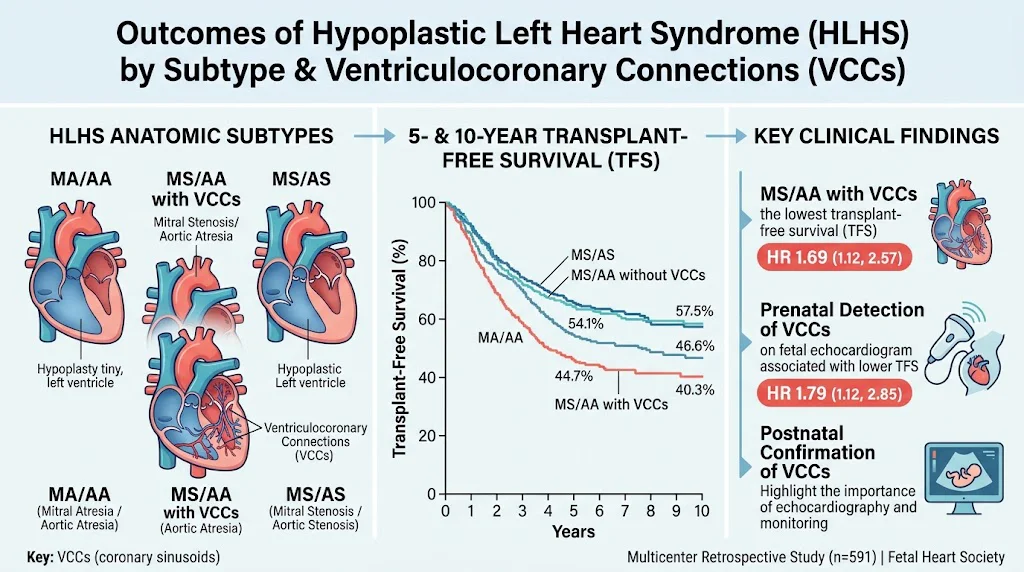
This multicenter retrospective study involving 591 live-born patients with hypoplastic left heart syndrome (HLHS) identified significant survival differences across anatomic subtypes. Patients with mitral stenosis and aortic atresia (MS/AA) complicated by ventriculocoronary connections (VCCs) had the lowest transplant-free survival (TFS). Prenatal diagnosis of VCCs through fetal echocardiography correlated with poorer outcomes, underscoring the value of early risk stratification. Surgical palliation strategy did not alter survival in the MS/AA with VCCs subgroup.
Study Background
Hypoplastic left heart syndrome (HLHS) is a severe congenital heart defect characterized by underdevelopment of the left heart structures, resulting in inadequate systemic cardiac output. Anatomically, HLHS is categorized primarily into three subtypes: mitral atresia and aortic atresia (MA/AA), mitral stenosis and aortic atresia (MS/AA), and mitral stenosis and aortic stenosis (MS/AS). Each subtype carries differing prognostic implications and surgical challenges.
Ventriculocoronary connections (VCCs) represent anomalous vascular channels between the ventricular cavity and coronary arteries, often found in the MS/AA subtype. These connections may compromise coronary perfusion and myocardial viability, potentially increasing mortality risk. Historically, detection of VCCs relied on postnatal imaging; however, advancements in fetal echocardiography allow for prenatal identification, facilitating earlier prognostication and management planning.
Study Design
This study was a large, multicenter retrospective cohort analysis conducted across 16 Fetal Heart Society institutions. It enrolled 591 live-born fetuses and infants younger than 2 months diagnosed with HLHS from January 2012 through December 2016, all with the intent to treat. The cohort comprised patients with all major HLHS subtypes.
Clinical and demographic data were collected, including genetic diagnoses, presence of extracardiac malformations, birth weight, and atrial septum status. Fetal and postnatal transthoracic echocardiograms were systematically reviewed to assess the presence of VCCs, particularly in the MS/AA subgroup. Patients were stratified by HLHS subtype and VCC status.
The primary endpoint was transplant-free survival (TFS) assessed at 5 and 10 years. Cox proportional hazards models adjusted for center effects and clinical covariates evaluated survival differences between groups. Additionally, the impact of the type of neonatal palliation—stage I surgical procedures—on survival in patients with MS/AA and VCCs was explored.
Key Findings
Among the 591 patients, the MA/AA subtype was most common (44%), followed by MS/AA (34%) and MS/AS (22%). Notably, 58% of MS/AA patients had suspected VCCs. Median follow-up was substantial at 9.0 years, enabling robust long-term survival analysis.
Overall, the cohort demonstrated a 5-year TFS of 55.6% and 10-year TFS of 49.4%. When stratified by subtype and VCC presence, the MS/AA with VCCs subgroup had the poorest outcomes—5-year TFS of 44.7% and 10-year TFS of 40.3%, with a hazard ratio (HR) of 1.69; 95% confidence interval (CI) 1.12 to 2.57, indicating a significantly increased risk of mortality or transplant compared to the reference group (MS/AA without VCCs).
The MA/AA group also demonstrated decreased survival (5-year TFS 54.1%, 10-year TFS 46.6%; HR 1.40 [0.95, 2.05]) but this did not reach conventional statistical significance. Conversely, MS/AA patients without VCCs had survival statistically comparable to the MS/AS group (5-year TFS 60.4% versus 65.0%, 10-year TFS 56.9% versus 58.3%; HR 0.91 [0.59, 1.41]).
Importantly, in 532 prenatally diagnosed cases, suspected VCCs on fetal echocardiography predicted worse transplant-free survival (HR 1.79 [1.12, 2.85]), underscoring the utility of fetal imaging for risk stratification.
Postnatal echocardiography identified VCCs that fetal imaging missed in some cases, with prenatal detection sensitivity around 32% for MS/AA with VCCs. This highlights a need for refined fetal imaging protocols and interpretation.
Lastly, the type of stage I palliation, among MS/AA patients with VCCs, did not significantly influence survival outcomes (P=0.784), suggesting that initial surgical strategy might not overcome the adverse impact of VCCs on prognosis.
Expert Commentary
This large registry-based study delivers pivotal data affirming the prognostic heterogeneity within HLHS subtypes, particularly emphasizing the detrimental effect of ventriculocoronary connections in the MS/AA population. The strong association between VCC presence and diminished long-term survival corroborates pathophysiological theories that VCCs may predispose to myocardial ischemia or inadequate coronary perfusion, contributing to refractory cardiac failure despite surgical palliation.
Importantly, the study supports incorporating detailed assessment for VCCs into prenatal imaging protocols to enable earlier parental counseling and tailored perinatal management strategies. However, limited prenatal detection sensitivity indicates the need for improved fetal echocardiographic techniques or adjunct imaging modalities.
The lack of mortality benefit associated with surgical approach variations in MS/AA with VCCs suggests these connections represent a fundamental anatomic risk not easily mitigated by current palliation methods. Future innovations such as targeted coronary interventions or transplantation criteria adjustments may be necessary.
Study limitations include its retrospective design and potential inter-institutional variability in echocardiographic interpretation and management, although statistical adjustment for center effects was applied. The generalizability of findings is strong given the multicenter nature but requires prospective validation.
Conclusion
This Fetal Heart Society multicenter retrospective study distinctly identifies MS/AA subtype patients with ventriculocoronary connections as having the poorest transplant-free survival among HLHS subgroups. The data underscore the critical prognostic value of prenatal and postnatal VCC identification to inform counseling and clinical decision-making. While surgical palliation type does not alter outcomes in this high-risk group, advancing fetal imaging techniques and exploring novel therapeutic strategies warrant priority in future research to improve survival for these vulnerable patients.
Funding and ClinicalTrials.gov
The original study does not specify funding sources or clinical trial registration in the provided abstract.
References
Barris DM, Freud LR, Day PE, Morris SA, Lopez KN, et al. Outcomes of Hypoplastic Left Heart Syndrome by Subtype and Presence of Ventriculocoronary Connections: A Fetal Heart Society Multicenter Retrospective Study. Circulation. 2026 Oct 26. doi: 10.1161/CIRCULATIONAHA.126.42934200. PMID: 42934200.
Pettit SJ, et al. Ventriculocoronary connections in hypoplastic left heart syndrome: prenatal diagnosis and outcomes. J Am Soc Echocardiogr. 2023;36(3):302–310.
Moon-Grady AJ, et al. Fetal echocardiography assessment of coronaries in HLHS. Prenat Diagn. 2022;42(7):811–820.