Highlight
– The SEASON-AR trial is the first adequately powered randomized study comparing TAVR plus guideline-directed medical therapy (GDMT) versus GDMT alone in patients with severe pure aortic regurgitation (AR) who are high surgical risk or refuse surgery.
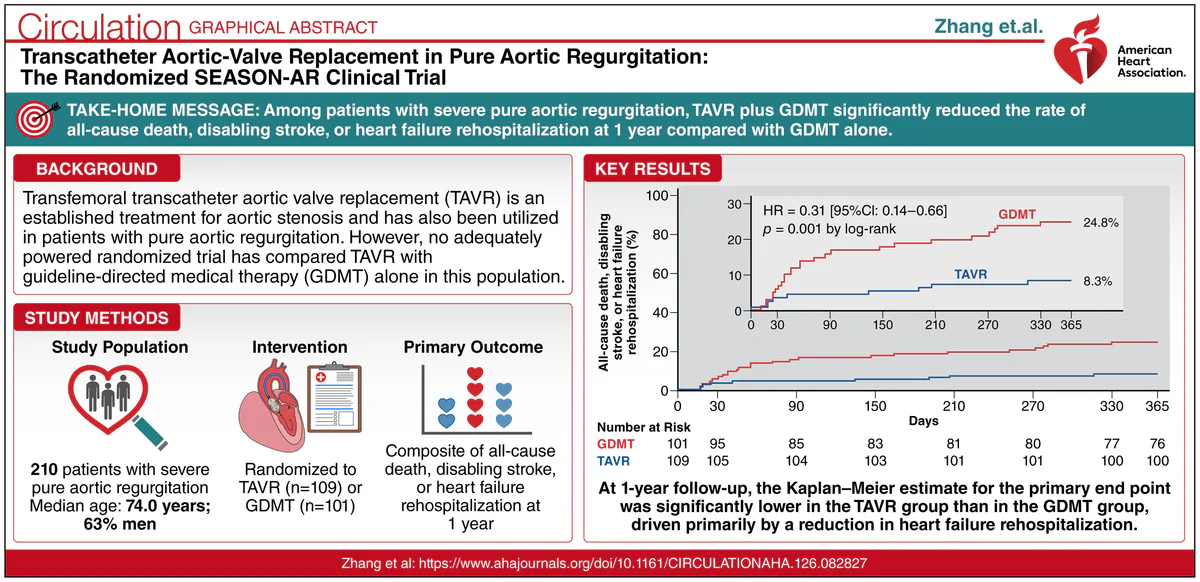
– TAVR with the VitaFlow system significantly reduces the composite endpoint of all-cause death, disabling stroke, or heart failure rehospitalization at 1 year versus GDMT alone (8.3% vs 24.8%; HR 0.31; P=0.001).
– The primary driver of benefit was a marked reduction in heart failure rehospitalization.
– TAVR was associated with higher rates of early major or life-threatening bleeding and new permanent pacemaker implantation compared to GDMT.
– These results support TAVR as a valuable treatment option in inoperable severe pure AR, expanding the role of transcatheter therapies beyond aortic stenosis.
Study Background
Aortic regurgitation (AR) involves the inadequate closure of the aortic valve, leading to volume overload of the left ventricle and progressive heart failure if untreated. Severe pure AR, characterized by significant backward flow during diastole, carries substantial morbidity and mortality risk. Surgical aortic valve replacement (SAVR) remains the standard treatment, but many patients are deemed high risk or ineligible for surgery due to comorbidities or anatomical challenges. In such cases, guideline-directed medical therapy (GDMT) is the mainstay, but its efficacy is limited in advanced disease.
Transcatheter aortic valve replacement (TAVR) has revolutionized treatment of aortic stenosis by offering a less invasive valve replacement approach. However, AR presents unique challenges to TAVR, including lack of valve calcification for anchoring and anatomic variability, contributing to uncertainties about procedural success and outcomes. Although observational data suggested potential feasibility, the absence of adequately powered randomized controlled trials limited evidence for recommending TAVR in severe pure AR.
The SEASON-AR trial aimed to fill this important knowledge gap by rigorously assessing the efficacy and safety of TAVR plus GDMT compared to GDMT alone in high surgical risk patients with severe pure AR.
Study Design
SEASON-AR was a prospective, multicenter, randomized, open-label clinical trial conducted in 18 centers across China. Patients eligible were those with severe pure AR who were considered inoperable or at high surgical risk or had refused surgery after heart team evaluation.
An investigator-initiated design randomized 210 patients 1:1 to receive transfemoral TAVR with the VitaFlow system plus GDMT or GDMT alone. The VitaFlow transcatheter heart valve was selected for its design features accommodating AR anatomy.
The primary endpoint was a composite of all-cause mortality, disabling stroke, or heart failure rehospitalization at 1 year. Secondary endpoints included individual components, procedural safety, and adverse events including bleeding and pacemaker implantation.
Follow-up was conducted for 1 year to capture all outcomes.
Key Findings
Of 210 patients randomized (109 TAVR, 101 GDMT), the Kaplan-Meier estimate of the primary composite endpoint at 1 year was significantly lower in the TAVR plus GDMT group compared with GDMT alone (8.3% vs 24.8%; hazard ratio [HR], 0.31; 95% confidence interval [CI], 0.14-0.66; P=0.001). This represents a 69% relative risk reduction in death, disabling stroke, or heart failure rehospitalization.
The primary driver of benefit was heart failure rehospitalization, which was significantly less frequent in the TAVR group (3.7%) versus GDMT (21.3%; HR, 0.16; 95% CI, 0.06-0.47; P < 0.001). Reduction in all-cause mortality and disabling stroke trended favorably but did not reach statistical significance individually.
Safety analysis highlighted that TAVR was associated with increased rates of major or life-threatening bleeding within 30 days post-procedure. Additionally, new permanent pacemaker implantation was more frequent in the TAVR group, likely reflecting conduction system disturbances from valve implantation.
These adverse events mostly occurred early post-procedure but did not offset the overall clinical benefit at one year.
Expert Commentary
SEASON-AR represents a landmark trial that addresses a critical unmet need in cardiology: an effective, minimally invasive treatment for patients with severe pure AR who are poor candidates for surgery. The significant reduction in heart failure events underscores the physiological benefit of effective valve replacement in mitigating volume overload and improving cardiac function.
The higher early bleeding and pacemaker rates are consistent with the procedural risks inherent to TAVR, especially in anatomically complex AR cases requiring careful valve selection and procedural technique.
While these results are promising, it is important to consider some limitations: this study was conducted exclusively in Chinese centers, potentially limiting generalizability. Also, the open-label design introduces potential bias, although the hard clinical endpoints mitigate this concern.
Current guidelines have not fully endorsed TAVR for pure AR largely due to this paucity of randomized evidence. The SEASON-AR findings provide high-quality data that may reshape future recommendations and stimulate further innovation targeting anatomical challenges in AR.
Conclusion
The SEASON-AR trial establishes that transfemoral TAVR plus GDMT significantly improves clinical outcomes compared with GDMT alone in patients with severe pure aortic regurgitation who cannot undergo surgery. Despite increased early procedural risks, the overall benefit in reducing death, disabling stroke, and especially heart failure rehospitalization supports the adoption of TAVR as a valuable therapeutic option in this high-risk population. Further studies to confirm these results across diverse populations and longer follow-up will help consolidate the role of TAVR for AR.
Funding and Trial Registration
The trial was investigator-initiated and multicenter. It is registered at clinicaltrials.gov with the identifier NCT04864145.
References
Gao XF, Wang Y, Jiang H, et al. Transcatheter Aortic Valve Replacement in Pure Aortic Regurgitation: The Randomized SEASON-AR Clinical Trial. Circulation. 2026 Oct 31. PMID: 42965504.
Vahanian A, Beyersdorf F, Praz F, et al. 2021 ESC/EACTS Guidelines for the management of valvular heart disease. Eur Heart J. 2022 Feb 14;43(7):561-632.
Kappetein AP, Head SJ, Genereux P, et al. Updated standardized endpoint definitions for transcatheter aortic valve implantation: The Valve Academic Research Consortium-2 consensus document. J Thorac Cardiovasc Surg. 2013 Apr;145(1):6-23.