We use cookies

Our website uses essential cookies and, with your consent, additional cookies to measure performance and improve our services. Cookie Policy.

You can change your choice at any time.

MMedXYNews
HomeVideos
MedXY AI/MedXY News/Tag: TAVR
MedXY News
EnglishTag

TAVR

Ask MedXY AI
type 2 diabetesclinical trialheart failureimmunotherapyobesitycardiovascular riskatrial fibrillationbiomarkerscritical careclinical trialsHypertensionartificial intelligenceCardiologyoncologypublic healthtype 1 diabetesdiabetesMortalityAlzheimer's diseasecardiovascular diseasebreast cancerepidemiology

Latest news

Tag

Short-Term Anticoagulant Therapy and Subclinical Leaflet Thickening in Transcatheter Aortic Valves: Evidence and Insights from the NOTION-4 Trial
CardiologyTAVRDOAC

Short-Term Anticoagulant Therapy and Subclinical Leaflet Thickening in Transcatheter Aortic Valves: Evidence and Insights from the NOTION-4 Trial

By MedXY|Sep 1, 2026

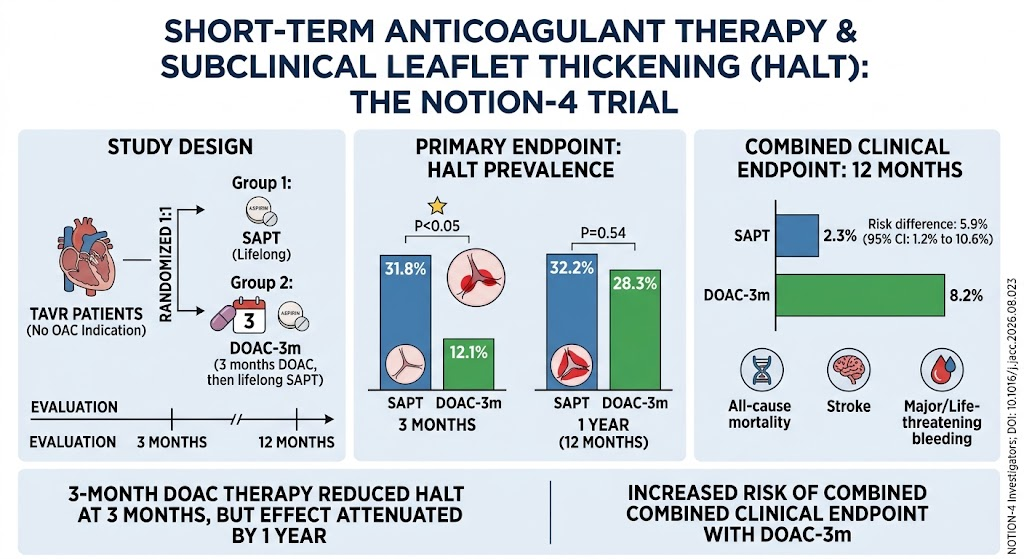
The NOTION-4 trial demonstrates that 3 months of DOAC therapy post-TAVR reduces early HALT incidence compared to SAPT, but benefits diminish after discontinuation, highlighting nuanced balance between thrombosis prevention and bleeding risk


Seven-Year Health Outcomes After TAVR Versus SAVR in Low-Risk Aortic Stenosis Patients: Insights from the PARTNER 3 Trial
Cardiology
© 2026 MedXY
Contact usAbout usPrivacy PolicyMedXY story
TAVR
long-term outcomes

Seven-Year Health Outcomes After TAVR Versus SAVR in Low-Risk Aortic Stenosis Patients: Insights from the PARTNER 3 Trial

By MedXY|Aug 18, 2026

In low-risk severe aortic stenosis patients, both TAVR and SAVR provide sustained health status improvements over seven years, with TAVR offering faster early recovery but similar long-term health outcomes.

Seven-Year Valve Durability Outcomes Comparing Transcatheter and Surgical Aortic Valve Replacement: Insights from the PARTNER 3 Randomized Trial
Cardiologybioprosthetic valve failureSurgical Aortic Valve Replacement

Seven-Year Valve Durability Outcomes Comparing Transcatheter and Surgical Aortic Valve Replacement: Insights from the PARTNER 3 Randomized Trial

By MedXY|Jun 24, 2026

An evidence-based review of the 7-year durability of transcatheter versus surgical aortic bioprosthetic valves in low-risk severe aortic stenosis patients, highlighting comparable long-term structural performance and need for reintervention

10-Year Randomized Outcomes of Transcatheter or Surgical Aortic Valve Replacement in Intermediate-Risk Aortic Stenosis: What PARTNER 2A Adds to the Long-Term TAVR Evidence Base
Cardiologyaortic stenosislong-term outcomes

10-Year Randomized Outcomes of Transcatheter or Surgical Aortic Valve Replacement in Intermediate-Risk Aortic Stenosis: What PARTNER 2A Adds to the Long-Term TAVR Evidence Base

By MedXY|Jun 17, 2026

The PARTNER 2A 10-year data show higher mortality and reintervention with balloon-expandable SAPIEN XT TAVR versus surgery in intermediate-risk patients, driven mainly by transthoracic access. Contemporary 10-year SAPIEN 3 data, however, su

Myocardial Fibrosis Predicts Outcomes in Asymptomatic Severe Aortic Stenosis, But Early Valve Replacement May Not Offer Universal Benefit
Cardiologyaortic stenosisCardiac Magnetic Resonance

Myocardial Fibrosis Predicts Outcomes in Asymptomatic Severe Aortic Stenosis, But Early Valve Replacement May Not Offer Universal Benefit

By MedXY|Apr 17, 2026

The EVOLVED trial reveals that higher myocardial fibrosis burden associates with adverse events in asymptomatic severe aortic stenosis patients, yet early intervention benefits appear nuanced—showing promise for reducing hospitalizations in

Superior Long-Term Hemodynamics with Self-Expanding Valves in Small Failed Bioprostheses: 3-Year Insights from the LYTEN Trial
CardiologyCardiologyhemodynamics

Superior Long-Term Hemodynamics with Self-Expanding Valves in Small Failed Bioprostheses: 3-Year Insights from the LYTEN Trial

By MedXY|Mar 3, 2026

The 3-year analysis of the LYTEN trial reveals that self-expanding valves (SEV) significantly outperform balloon-expandable valves (BEV) in hemodynamic metrics for valve-in-valve TAVR in patients with small surgical bioprostheses, although

Persistent Risk of Cardiac Structural Complications in TAVR: A Decade-Long Analysis Reveals High Mortality and Stagnant Incidence
CardiologyTAVR介入心脏病学

Persistent Risk of Cardiac Structural Complications in TAVR: A Decade-Long Analysis Reveals High Mortality and Stagnant Incidence

By MedXY|Mar 2, 2026

A 10-year multicenter study highlights that cardiac structural complications (CSCs) affect 2.1% of TAVR recipients. With a 35% 30-day mortality rate and no decline in incidence over a decade, these events remain a formidable challenge for i

Percutaneous Coronary Intervention Before TAVR: A Nationwide Synthesis of Clinical Outcomes and Bleeding Risks
Cardiologyclinical trialscoronary artery disease

Percutaneous Coronary Intervention Before TAVR: A Nationwide Synthesis of Clinical Outcomes and Bleeding Risks

By MedXY|Mar 2, 2026

A nationwide Swedish registry analysis demonstrates that routine PCI before TAVR for significant coronary artery disease does not improve survival or reduce urgent revascularization, but significantly increases bleeding risk while reducing

TAVR vs. Surgery in Low-Risk Patients: 7-Year PARTNER 3 Results Confirm Long-Term Parity
Cardiologyaortic stenosisPARTNER 3

TAVR vs. Surgery in Low-Risk Patients: 7-Year PARTNER 3 Results Confirm Long-Term Parity

By MedXY|Feb 22, 2026

Seven-year data from the PARTNER 3 trial demonstrate that TAVR remains noninferior to surgical aortic-valve replacement in low-risk patients, with comparable rates of death, stroke, and valve durability, supporting TAVR as a sustained alter

TAVR vs. SAVR in Younger Low-Risk Patients: 3-Year NOTION-2 Insights Highlight Bicuspid Challenges
CardiologySAVRStructural valve deterioration

TAVR vs. SAVR in Younger Low-Risk Patients: 3-Year NOTION-2 Insights Highlight Bicuspid Challenges

By MedXY|Jan 18, 2026

Three-year results from the NOTION-2 trial show comparable clinical outcomes between TAVR and SAVR in younger, low-risk patients. However, higher event rates in the bicuspid subgroup suggest a need for caution and individualized procedural

Validating the 0.80 FFR Threshold: Long-Term Outcomes from the NOTION-3 Trial in TAVR Patients
Cardiologycoronary artery diseaseFractional Flow Reserve

Validating the 0.80 FFR Threshold: Long-Term Outcomes from the NOTION-3 Trial in TAVR Patients

By MedXY|Jan 17, 2026

The NOTION-3 trial demonstrates that FFR-guided revascularization significantly reduces cardiovascular risks in TAVR patients with coronary artery disease, validating the 0.80 threshold for clinical decision-making.

Pioneer Valve Demonstrates Mid-Term Efficacy for Pure Aortic Regurgitation in Multicenter Trial
CardiologyTAVR主动脉反流

Pioneer Valve Demonstrates Mid-Term Efficacy for Pure Aortic Regurgitation in Multicenter Trial

By MedXY|Jan 17, 2026

The prospective Pioneer Trial demonstrates that a novel self-expanding TAVR device achieves 99.1% technical success and low mortality (2.7%) at one year for high-risk patients with pure aortic regurgitation, providing a safe, hemodynamicall

Myval THV Demonstrates 1-Year Noninferiority to Established Transcatheter Heart Valves: Insights from the LANDMARK Trial
Cardiologyaortic stenosisTAVR

Myval THV Demonstrates 1-Year Noninferiority to Established Transcatheter Heart Valves: Insights from the LANDMARK Trial

By MedXY|Dec 25, 2025

The LANDMARK trial reports that the novel Myval balloon-expandable transcatheter heart valve is clinically noninferior to contemporary SAPIEN and Evolut series at one year, offering comparable safety, hemodynamic performance, and quality-of

Obstructive Coronary Artery Disease Does Not Diminish Long-Term Health Status or Clinical Efficacy After TAVR: 3-Year Insights from SCOPE I
CardiologyCardiologyclinical trials

Obstructive Coronary Artery Disease Does Not Diminish Long-Term Health Status or Clinical Efficacy After TAVR: 3-Year Insights from SCOPE I

By MedXY|Dec 21, 2025

A post hoc analysis of the SCOPE I trial reveals that obstructive coronary artery disease (CAD) does not significantly impact 3-year survival or patient-reported health status following TAVR, questioning the routine necessity of periprocedu

Rare but High-Risk: New-Onset RBBB After TAVR Strongly Linked to Pacemaker Need
CardiologyConduction DisturbancesPacemaker

Rare but High-Risk: New-Onset RBBB After TAVR Strongly Linked to Pacemaker Need

By MedXY|Dec 17, 2025

New-onset right bundle branch block after TAVR is rare but carries a high risk of requiring permanent pacing within one week.

Prophylactic Pacemakers After TAVR: Low Pacing Burden Raises Questions on Routine Use
CardiologyCardiologyTAVR

Prophylactic Pacemakers After TAVR: Low Pacing Burden Raises Questions on Routine Use

By MedXY|Dec 17, 2025

One-fourth of TAVR patients receive prophylactic pacemakers, but most have minimal pacing needs at 30 days.

PROMOTE Study Validates Algorithm for Conduction Disturbance Management After TAVR
CardiologyCardiologyConduction Disturbances

PROMOTE Study Validates Algorithm for Conduction Disturbance Management After TAVR

By MedXY|Dec 17, 2025

A prospective multicenter study confirms that a prespecified algorithm for conduction disturbance management after TAVR is safe, with low sudden cardiac death risk but persistent high pacemaker rates.

Distinct Mechanisms Drive Early and Delayed Heart Block After TAVR: Insights from Boston Cohort Study
CardiologyElectrophysiologyPacemaker

Distinct Mechanisms Drive Early and Delayed Heart Block After TAVR: Insights from Boston Cohort Study

By MedXY|Dec 17, 2025

Prospective cohort study reveals AV nodal versus infranodal conduction patterns underpinning timing of heart block after TAVR.

Surgical Aortic Valve Replacement Emits Twice the CO2 of TAVR: What This Means for Practice and Policy
Cardiologyaortic stenosisSAVR

Surgical Aortic Valve Replacement Emits Twice the CO2 of TAVR: What This Means for Practice and Policy

By MedXY|Nov 29, 2025

A life cycle assessment found SAVR produces roughly double the carbon footprint of transcatheter aortic valve replacement (TAVR), with postoperative ICU and ward care as the main drivers. Results highlight opportunities to decarbonize cardi

Surgical aortic valve replacement produces about twice the carbon footprint of transcatheter approaches: clinical and stewardship implications
Cardiologyaortic valve replacementcarbon footprint

Surgical aortic valve replacement produces about twice the carbon footprint of transcatheter approaches: clinical and stewardship implications

By MedXY|Nov 29, 2025

A life cycle assessment found SAVR emits ~620–750 kg CO2e per case—roughly double OR- or cath-lab TAVR (~280–360 kg CO2e). ICU length of stay and postoperative care were the dominant contributors, highlighting targets for low-carbon periope

1 / 2
12
Next
Ask MedXY AI

Most popular

Intimate Health
Five Benefits for Women Continuing Sexual Activity After Menopause
Intimate Health
Why Some Women Have a Strong Sex Drive—And Why Men Shouldn't Worry About It
Nursing & care
How often should a couple have sex?
Intimate Health
Classic Intimacy Recommendations: How to Help Women Reach Orgasm and Enjoy Mutual Pleasure
Intimate Health
What Makes a Woman "Physiologically Addicted" Is Never Money, But These Two Relationship Qualities