Highlight
1. Among patients with moderate aortic stenosis (AS) and at-risk features, transcatheter aortic valve replacement (TAVR) significantly lowers the composite outcome of death or heart-failure events at 2 years versus clinical surveillance.
2. The PROGRESS randomized trial enrolled 744 patients, revealing a 7.2 percentage point absolute risk reduction in the primary composite endpoint favoring TAVR.
3. Although mortality rates alone were similar, TAVR markedly reduced heart failure events, highlighting its role in mitigating disease progression.
4. Procedural safety was comparable with no meaningful increase in adverse events, supporting TAVR’s feasibility in moderate AS patients at risk.
Study Background
Aortic stenosis is a progressive valvular heart disease characterized by narrowing of the aortic valve orifice, leading to obstruction of left ventricular outflow. While severe AS is well-established as an indication for valve intervention due to its association with high morbidity and mortality, moderate AS patients are traditionally managed conservatively with periodic clinical and echocardiographic surveillance. Current guidelines recommend follow-up intervals of one to two years given the slower progression and less immediate life-threatening risk compared to severe AS.
However, subsets of moderate AS patients show “at-risk features”—such as symptoms or structural/functional cardiac abnormalities—that have been linked to accelerated disease progression and adverse cardiovascular outcomes. These patients may harbor a heightened risk of heart failure events and mortality, raising the question whether early intervention via TAVR could improve long-term outcomes beyond surveillance alone.
Study Design
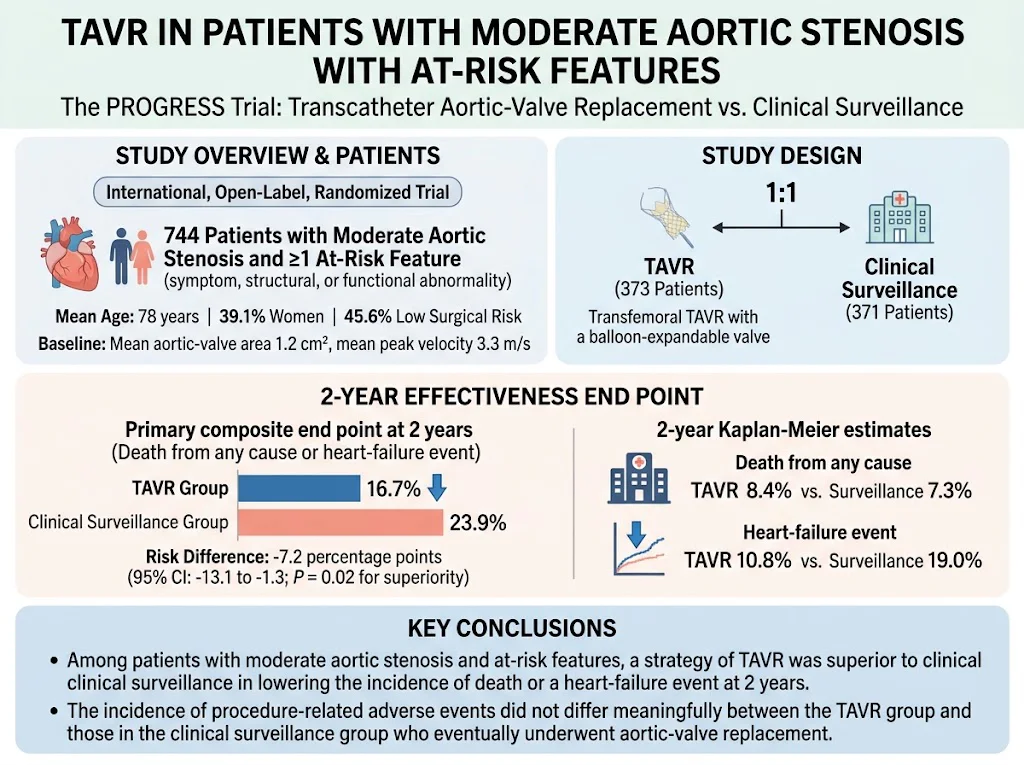
The PROGRESS trial was an international, open-label, randomized controlled study designed to compare outcomes of transfemoral TAVR using a balloon-expandable valve versus clinical surveillance in patients with moderate AS exhibiting at least one at-risk feature. The trial enrolled 744 patients assigned in a 1:1 ratio: 373 to TAVR and 371 to clinical surveillance.
Inclusion criteria mandated moderate AS diagnosis confirmed by echocardiography (mean aortic-valve area 1.2 cm2 and peak velocity 3.3 m/s) alongside clinical or imaging features predictive of higher risk. The mean age was 78 years with 39.1% women and 45.6% categorized as low surgical risk. Patients were followed for events over a 2-year period.
The primary effectiveness endpoint was a composite of death from any cause or heart-failure events, with or without hospitalization, at 2 years. The trial employed intention-to-treat analysis with superiority testing for the primary endpoint.
Key Findings
At 2 years, the TAVR group demonstrated a significantly lower incidence of the primary composite endpoint with a Kaplan-Meier estimate of 16.7% versus 23.9% in the surveillance group, corresponding to a risk difference of -7.2 percentage points (95% confidence interval, -13.1 to -1.3; P=0.02).
Breaking down the components, all-cause mortality was similar between groups: 8.4% in the TAVR group and 7.3% in the clinical surveillance group, indicating that survival benefit by TAVR was not evident over this timeframe. However, heart-failure events were reduced substantially by TAVR (10.8% vs. 19.0%), suggesting that early valve replacement effectively mitigates progression to symptomatic heart failure.
Regarding safety, procedural complications and adverse events did not differ meaningfully between patients undergoing TAVR and those who later required aortic valve replacement in the surveillance arm, underscoring TAVR’s acceptable risk profile in this population.
Expert Commentary
The PROGRESS trial provides compelling evidence that patients with moderate AS and at-risk features benefit from earlier intervention with TAVR compared to guideline-directed surveillance. The reduction in heart failure events is clinically meaningful and aligns with pathophysiological insights that moderate AS combined with ventricular decompensation contributes to adverse outcomes.
While mortality was not improved at 2 years, longer term follow-up may reveal survival benefits as heart failure burden decreases. It is also notable that nearly half of participants were low surgical risk, a group traditionally managed conservatively, hinting at a potential paradigm shift in treatment algorithms.
Limitations include the open-label design and the enrollment of patients with diverse at-risk features, which may impact generalizability. Further research is needed to refine patient selection criteria and evaluate long-term valve durability and outcomes.
Conclusion
The PROGRESS trial demonstrates that for patients with moderate aortic stenosis harboring at-risk clinical or structural features, early intervention with TAVR reduces the combined risk of death or heart failure events over 2 years compared to clinical surveillance. This evidence supports reconsidering current management paradigms, potentially expanding TAVR indications to moderate AS subsets at higher risk. Ongoing research and guideline updates will be critical to optimizing patient care pathways.
Funding and ClinicalTrials.gov
This study was funded by Edwards Lifesciences. The clinical trial is registered at ClinicalTrials.gov (NCT04889872).
References
Généreux P, Makkar RR, Pibarot P, et al. TAVR in Patients with Moderate Aortic Stenosis with At-Risk Features. N Engl J Med. 2026; 42970708. doi:10.1056/NEJMoa2608538.
Otto CM, Nishimura RA, Bonow RO, et al. 2020 ACC/AHA Guideline for the Management of Patients With Valvular Heart Disease. J Am Coll Cardiol. 2021;77(4):e25-e197.