Highlight
The PREVENT-HF risk equations effectively predict overall 10-year heart failure (HF) risk, showing superior discrimination for heart failure with preserved ejection fraction (HFpEF) versus reduced ejection fraction (HFrEF).
Validation across five longitudinal cohort studies and two large healthcare system electronic health record (EHR) datasets demonstrates generalizability to diverse populations without prior cardiovascular disease.
Calibration metrics indicate reliable absolute risk estimation, though subtype-specific risk thresholds need further elaboration for clinical implementation.
Findings underscore the potential for incorporating PREVENT-HF into preventative cardiology and personalized risk assessment, particularly for HFpEF where risk stratification is a critical unmet need.
Study Background
Heart failure (HF) remains a leading cause of morbidity and mortality globally. The clinical classification of HF into subtypes—heart failure with preserved ejection fraction (HFpEF) and heart failure with reduced ejection fraction (HFrEF)—reflects distinct pathophysiologic mechanisms, risk profiles, and therapeutic responses. While numerous risk prediction algorithms estimate overall HF risk, tools explicitly validated for subtype-specific prediction are scarce. Given that management strategies diverge importantly between HFpEF and HFrEF, improved risk stratification tools are essential to guide prevention and early intervention.
The PREVENT-HF equations, developed to estimate 10-year incident HF risk, encompass both HF subtypes but have not been critically appraised for subtype-specific predictive performance across differing real-world and research-based cohorts. Evaluating these equations’ discrimination and calibration by HF subtype is a vital step toward subtype-tailored risk prediction.
Study Design
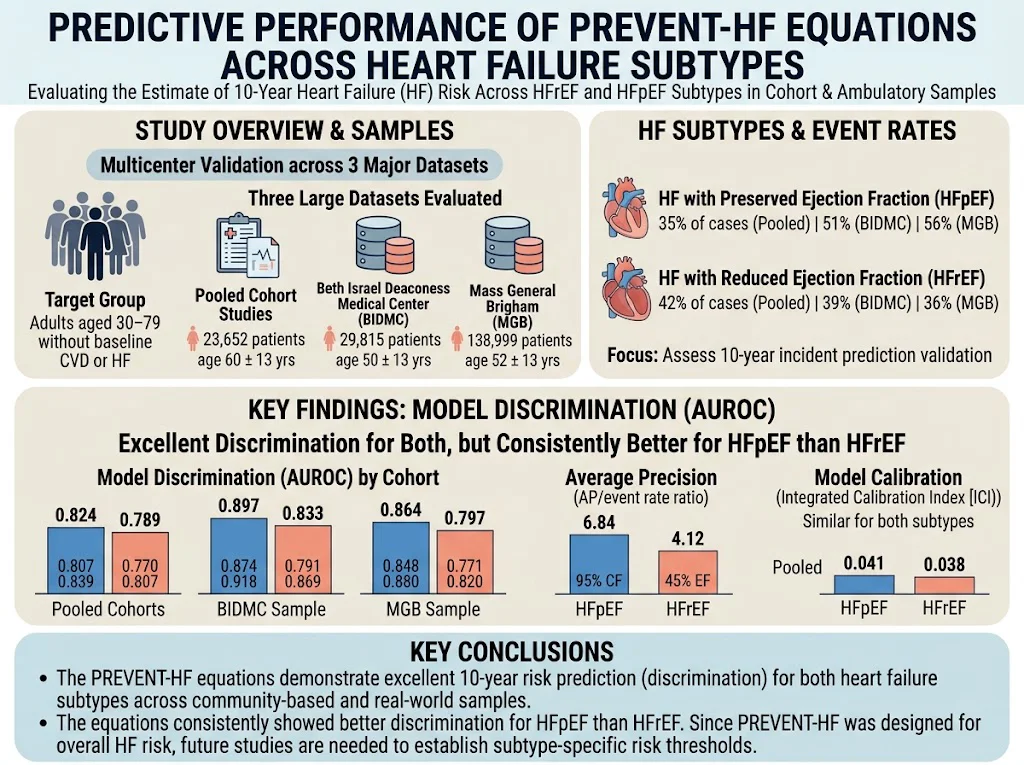
The investigators pooled data from five community-based longitudinal cohort studies with baseline examinations conducted between 1989 and 2013, encompassing 23,652 adults aged 30-79 years without prevalent cardiovascular disease or HF. HF events and subtype classification (HFpEF vs. HFrEF) were ascertained over 10 years.
Additionally, two large ambulatory healthcare samples drawn from electronic health record (EHR) data at Beth Israel Deaconess Medical Center (BIDMC; 29,815 participants, baseline 2004-2014) and Mass General Brigham (MGB; 138,999 participants, baseline 2001-2018) were analyzed similarly.
The primary analysis assessed the performance of PREVENT-HF equations for predicting 10-year incident HF subtypes. Discrimination was quantified via area under the receiver operating characteristic curve (AUROC) and average precision (AP) relative to event rate. Calibration was evaluated using the integrated calibration index (ICI).
Key Findings
Among the pooled cohort studies (n=23,652), 1,232 incident HF events occurred, with 35% classified as HFpEF and 42% as HFrEF. BIDMC recorded 259 HF events (51% HFpEF, 39% HFrEF), while MGB noted 1,050 HF events (56% HFpEF, 36% HFrEF).
Discrimination: PREVENT-HF generally demonstrated excellent discriminatory ability across settings, consistently higher for HFpEF than HFrEF:
Pooled cohorts: AUROC 0.824 (95% CI 0.807-0.839) for HFpEF vs. 0.789 (95% CI 0.770-0.807) for HFrEF.
BIDMC EHR: AUROC 0.897 (95% CI 0.874-0.918) for HFpEF vs. 0.833 (95% CI 0.791-0.869) for HFrEF.
MGB EHR: AUROC 0.864 (95% CI 0.848-0.880) for HFpEF vs. 0.797 (95% CI 0.771-0.820) for HFrEF.
Similar patterns emerged in average precision to event rate ratios, reflecting superior positive predictive value for HFpEF.
Calibration: Absolute risk calibration was comparable for HFpEF and HFrEF across cohorts. For example, the integrated calibration index was similar between subtypes in pooled cohorts: 0.041 for HFpEF and 0.038 for HFrEF, indicating modest deviation between predicted and observed risks.
Expert Commentary
These results highlight that although PREVENT-HF was developed to estimate overall HF risk, it robustly discriminates between individuals at risk for HFpEF and HFrEF, with better performance in HFpEF. This might reflect the differential prevalence and stronger contribution of traditional risk factors such as hypertension and obesity that are more strongly linked to HFpEF.
Clinically, this distinction is meaningful because HFpEF currently lacks widely accepted preventive therapies and has a heterogeneous phenotype often challenging to identify early. Accurate risk prediction could enable targeting lifestyle and risk factor modification interventions earlier in the disease trajectory.
Limitations include that PREVENT-HF does not yet provide subtype-specific risk thresholds or guidance for clinical decision-making tailored to HF subtypes. The populations studied, while diverse, may not fully represent all racial/ethnic groups or those with advanced comorbidities.
Future research is warranted to refine PREVENT-HF equations toward subtype-specific models and to validate thresholds that can trigger preventive or diagnostic workup for HF subtypes.
Conclusion
In summary, PREVENT-HF delivers excellent 10-year HF risk prediction in community and EHR-based cohorts, with consistently superior discrimination for HFpEF compared to HFrEF. This suggests considerable promise for operationalizing PREVENT-HF in clinical practice to identify individuals at elevated subtype-specific HF risk, with potential to guide personalized prevention strategies. Development of subtype-specific risk thresholds and expansion across diverse populations remain important next steps to optimize clinical utility.
Funding and ClinicalTrials.gov
The study was supported by multiple institutional and governmental grants (details as per original publication). The original cohorts may be registered in clinical trial databases, but no singular clinical trial number was noted for this pooled analysis.
References
Mounsey LA, Wang D, Ribeiro PH, et al. Performance of the PREVENT-HF Equations Across Heart Failure Subtypes in Community-Based and Ambulatory Healthcare Samples. Circulation. 2026 Nov 2; PMID: 42969101.
Benjamin EJ, Muntner P, Alonso A, et al. Heart Disease and Stroke Statistics—2019 Update: A Report From the American Heart Association. Circulation. 2019;139(10):e56-e528.
Yancy CW, Jessup M, Bozkurt B, et al. 2017 ACC/AHA/HFSA Focused Update of the 2013 ACCF/AHA Guideline for the Management of Heart Failure. Circulation. 2017;136(6):e137-e161.
Bozkurt B, Coats AJ, Tsutsui H, et al. Universal Definition and Classification of Heart Failure. J Card Fail. 2021;27(4):387-413.