Long-Term Efficacy and Safety of First-Line Ibrutinib-Venetoclax in Older Patients with Chronic Lymphocytic Leukemia: Insights from the 67-Month GLOW Study
Highlight
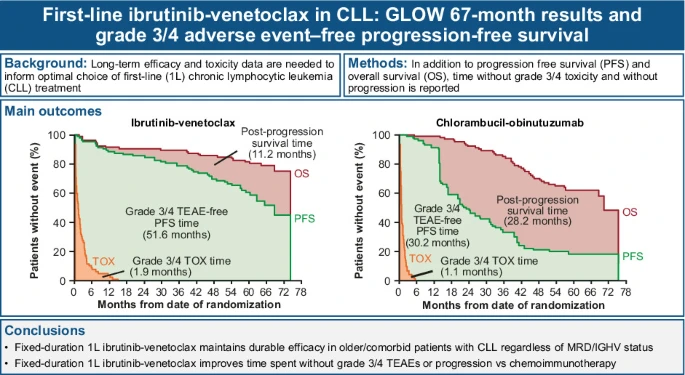
- The 67-month median follow-up of the GLOW phase III trial demonstrates superior overall survival (OS) and progression-free survival (PFS) with first-line fixed-duration ibrutinib-venetoclax compared to chlorambucil-obinutuzumab in older/comorbid patients with previously untreated chronic lymphocytic leukemia (CLL).
- Ibrutinib-venetoclax significantly reduces the risk of requiring second-line therapy by 77.4% and prolongs PFS independent of IGHV mutation status and measurable residual disease (MRD) levels.
- Patients achieving undetectable MRD at end-of-treatment exhibited better PFS, especially among those with unmutated IGHV, supporting MRD as a prognostic biomarker to guide therapy.
- Grade 3/4 treatment-emergent adverse event (TEAE)-free PFS was notably longer with ibrutinib-venetoclax, indicating improved tolerability and quality of life without compromising efficacy.
Background
Chronic lymphocytic leukemia (CLL) is the most common adult leukemia in Western countries, characterized by clonal proliferation and accumulation of mature B-lymphocytes. Disease incidence increases with age and is frequently accompanied by comorbidities, which complicate the choice of first-line therapy. Historically, chemoimmunotherapy regimens such as chlorambucil combined with anti-CD20 antibodies (e.g., obinutuzumab) have been standard for older, less fit patients, but are associated with limited efficacy and notable toxicity.
Targeted therapies, including Bruton’s tyrosine kinase inhibitors like ibrutinib and BCL-2 antagonists such as venetoclax, have transformed CLL treatment by improving response rates with manageable safety profiles. The combination of ibrutinib and venetoclax offers a chemotherapy-free, fixed-duration regimen that aims to deepen responses, eradicate measurable residual disease (MRD), and prevent resistance development. However, long-term data assessing durable efficacy, safety, and treatment-emergent adverse event (TEAE)-free progression-free survival (PFS) in older or comorbid patients remain limited.
Study Design
The phase III GLOW study (NCT03462719) enrolled 211 older or comorbid patients with previously untreated CLL, randomly assigned 1:1 to receive fixed-duration ibrutinib-venetoclax (n=106) or chlorambucil-obinutuzumab (n=105). The study’s median follow-up was 67 months, enabling robust long-term evaluation.
The intervention group received oral ibrutinib combined with venetoclax for a fixed duration, whereas the control group was treated with chlorambucil plus obinutuzumab as per label. Key endpoints analyzed included overall survival (OS), progression-free survival (PFS), time to second-line therapy, and grade 3/4 TEAE-free PFS. Molecular prognostic factors such as IGHV mutation status and MRD levels at end-of-treatment were also assessed to correlate with outcomes.
Key Findings
Overall Survival and Progression-Free Survival
At 66 months, estimated OS rates were significantly higher in the ibrutinib-venetoclax arm compared with chlorambucil-obinutuzumab (79.0% vs 60.8%; hazard ratio [HR] 0.46), indicating a 54% reduction in risk of death. Similarly, PFS rates favored ibrutinib-venetoclax at 51.7% versus 18.1% in the control (HR 0.27), highlighting a durable disease control benefit.
Reduction in Need for Second-Line Therapy
Patients treated with ibrutinib-venetoclax had a 77.4% lower risk of requiring second-line treatment, indicating prolonged disease remission and preservation of subsequent therapeutic options.
Impact of MRD Status and IGHV Mutation
Undetectable MRD at end-of-treatment correlated strongly with better PFS outcomes. This effect was particularly pronounced in patients harboring unmutated IGHV, a subgroup traditionally associated with aggressive disease biology and poorer prognosis. These results underscore the value of MRD-guided response assessment and personalization of therapy duration.
Grade 3/4 TEAE-Free Progression-Free Survival
An innovative metric, grade 3/4 TEAE-free PFS, was 21.4 months longer in the ibrutinib-venetoclax group (51.6 months vs 30.2 months), suggesting superior tolerability without compromising efficacy. This is clinically meaningful, as higher-grade adverse events significantly affect patient quality of life and treatment adherence.
Safety Profile
The incidence of severe adverse events was overall manageable and consistent with known safety profiles of ibrutinib and venetoclax, with no new safety signals identified over extended follow-up.
Expert Commentary
The GLOW study’s long-term data strongly support fixed-duration ibrutinib-venetoclax as a preferred first-line option in older and/or comorbid patients with previously untreated CLL. These data align with evolving treatment paradigms emphasizing targeted agents that minimize chemotherapy exposure, improve survival, and reduce toxicity burden. Notably, the study highlights MRD as a critical biomarker for tailoring therapy, especially in molecularly high-risk subgroups.
While the comparator arm involved chlorambucil-obinutuzumab—a regimen increasingly supplanted by novel agents in clinical practice—the results remain relevant to patients who may not tolerate or have access to newer therapies. Limitations include the relatively selected trial population and the evolving landscape with emerging therapies such as second-generation BTK inhibitors and combination regimens.
Mechanistically, combining ibrutinib’s kinase inhibition, which disrupts microenvironmental survival signals, with venetoclax’s BCL-2 antagonism synergistically induces deeper apoptosis and MRD negativity. This underpins the improved clinical outcomes observed.
Conclusion
Fixed-duration ibrutinib-venetoclax provides durable, superior overall survival and progression-free survival compared to chlorambucil-obinutuzumab in older/comorbid patients with treatment-naïve CLL, with a favorable safety and tolerability profile. This regimen significantly reduces the risk of requiring second-line treatment and achieves sustained disease control, especially in patients achieving undetectable MRD. These findings support ibrutinib-venetoclax as an effective frontline therapeutic strategy, balancing efficacy and long-term quality of life, and highlight MRD assessment as a valuable prognostic tool for individualized care.
Funding and Clinical Trial Registration
The GLOW study was funded and conducted under protocols registered at ClinicalTrials.gov (NCT03462719). No specific funding disclosures were detailed in the primary publication.
References
U Niemann C, Munir T, Owen C, Follows G, Hernández-Rivas JÁ, Benjamini O, Janssens A, Levin MD, Robak T, Simkovic M, Voloshin S, Vorobyev V, Ysebaert L, Schuier N, Baeten K, Tran N, Levitan B, Kavanagh C, Kater AP. First-line ibrutinib-venetoclax in chronic lymphocytic leukemia: GLOW 67-month results and grade 3/4 adverse event-free progression-free survival. Leukemia. 2026 Oct 2. doi: 10.1038/s41375-026-03150-7. Epub ahead of print. PMID: 42827117.
This article was created using several editorial tools, including AI, as part of the process. Human editors reviewed this content before publication.