Short-Term Anticoagulant Therapy and Subclinical Leaflet Thickening in Transcatheter Aortic Valves: Evidence and Insights from the NOTION-4 Trial
Highlights
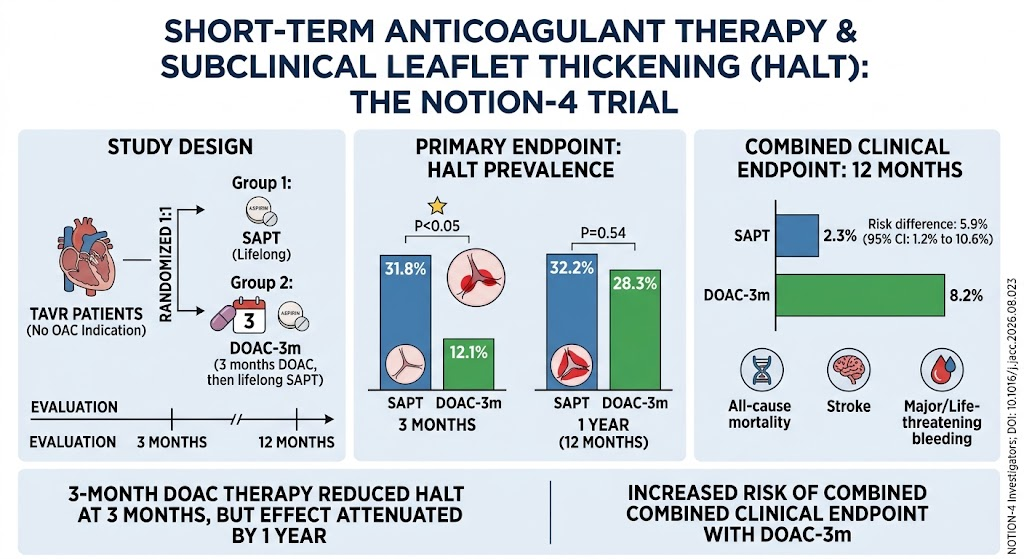
- Short-term (3-month) direct oral anticoagulant (DOAC) therapy after TAVR significantly reduces hypoattenuated leaflet thickening (HALT) at 3 months compared to lifelong single antiplatelet therapy (SAPT).
- The protective effect of DOAC on HALT prevalence wanes by 12 months after therapy cessation, underlining the transient benefit of short-term anticoagulation.
- DOAC use was associated with a higher risk of combined adverse events including major bleeding, mortality, and stroke, indicating a critical safety consideration.
- Current evidence reveals ongoing uncertainty regarding optimal antithrombotic strategies post-TAVR, emphasizing individualized risk assessment and need for further trials.
Background
Transcatheter aortic valve replacement (TAVR) has emerged as a transformative intervention for symptomatic severe aortic stenosis across surgical risk profiles. Despite procedural success, subclinical leaflet thrombosis is frequently detected on cardiac computed tomography (CT) as hypoattenuated leaflet thickening (HALT). HALT has been implicated as a potential precursor to thromboembolic complications and prosthetic valve dysfunction, posing a clinical challenge in post-TAVR management. The optimal antithrombotic strategy to prevent HALT and its consequences remains controversial, particularly in patients without an established indication for chronic oral anticoagulation. The NOTION-4 trial was designed to evaluate whether short-term direct oral anticoagulant therapy confers superior prevention of HALT relative to standard lifelong SAPT in this population.
Key Content
Chronological and Trial Evidence on Antithrombotic Strategies Post-TAVR
Since the recognition of HALT in bioprosthetic valves, multiple studies including registry analyses (e.g., SAVORY registry) and randomized trials have sought to clarify its clinical relevance and preventive approaches. Earlier observational data indicated that oral anticoagulation—either vitamin K antagonists or DOACs—could reduce HALT incidence compared to antiplatelet therapy alone, with some studies suggesting regression of leaflet thickening under anticoagulants.
NOTION-4, a randomized controlled trial published in 2026, enrolled 352 patients post-TAVR who had no indication for oral anticoagulation. It compared lifelong SAPT versus an early 3-month course of DOAC followed by lifelong SAPT. The primary endpoint was HALT prevalence at 12 months. At 3 months, HALT was observed significantly less often in the DOAC-3m group (12.1%) compared to SAPT alone (31.8%), demonstrating a clear short-term benefit of DOAC therapy in preventing subclinical leaflet thrombosis.
However, by 12 months, the difference was attenuated and not statistically significant (28.3% DOAC-3m vs. 32.2% SAPT, p=0.54), indicating the transient nature of the anticoagulation effect. Importantly, the combined safety endpoint (all-cause mortality, stroke, or major/life-threatening bleeding) was significantly higher in the DOAC-3m group (8.2%) compared to SAPT (2.3%), underscoring the bleeding risk associated with anticoagulant use.
Parallel investigations such as the ATLANTIS trial substantiated the notion that factor Xa inhibitors (e.g., apixaban) can reduce subclinical valve thrombosis compared to antiplatelet regimens, though without clear superiority over vitamin K antagonists and accompanied by safety considerations. The Rotterdam Edoxaban (REDOX) trial similarly examines the impact of short-term anticoagulation on HALT incidence, and the ACASA-TAVI trial focuses on the comparative efficacy and safety of anti-factor Xa monotherapy versus SAPT.
Mechanistic Insights and Clinical Implications
HALT represents thrombus formation on bioprosthetic leaflets leading to restricted leaflet motion (RELM) and potentially increased transprosthetic gradients. While some studies (e.g., ADAPT-TAVR) found no significant impact of HALT on valve hemodynamics at 6 months, long-term consequences on valve durability remain under investigation. The biological rationale for anticoagulation centers on mitigating thrombin generation and platelet activation on bioprosthetic tissue exposed to altered flow dynamics.
Short-term anticoagulation appears effective in preventing early HALT formation, but the rebound in HALT prevalence after therapy cessation suggests either incomplete thrombosis resolution or new thrombus development, raising questions about optimal duration and patient selection for anticoagulation therapy.
Expert Commentary
Current evidence from NOTION-4 and related studies delineates a trade-off between short-term efficacy in HALT prevention and increased bleeding risk with DOAC therapy post-TAVR in patients without standard anticoagulation indications. The lack of sustained HALT reduction at one year post-DOAC discontinuation indicates that transient anticoagulation may be insufficient for long-term leaflet protection.
Guidelines remain equivocal due to limited large-scale randomized data demonstrating clinical outcome benefits. Moreover, the clinical significance of subclinical HALT without hemodynamic impairment or overt valve dysfunction is debated. Individualized evaluation of ischemic and bleeding risk, valve type, and patient comorbidities is critical in tailoring antithrombotic regimens.
Ongoing trials such as REAC-TAVI 2 and SCOPE are exploring alternative antiplatelet agents and anticoagulation durations, aiming to optimize net clinical benefit. Mechanistic studies utilizing 4D CT imaging provide valuable insights into HALT evolution and resolution dynamics.
Challenges persist in balancing thrombotic risk against bleeding complications, highlighting the need for biomarkers or imaging predictors to stratify patients most likely to benefit from anticoagulation. Integration of long-term outcomes beyond surrogate imaging endpoints will inform future recommendations.
Conclusion
The NOTION-4 trial provides robust evidence that a short 3-month course of DOAC therapy after TAVR significantly reduces early subclinical leaflet thrombosis as detected by HALT on cardiac CT, compared with lifelong SAPT. However, this protective effect is not maintained at 12 months following anticoagulation discontinuation, and DOAC therapy is associated with increased bleeding and adverse events, emphasizing the complexity of antithrombotic management post-TAVR.
This evolving paradigm underscores the necessity for personalized antithrombotic strategies incorporating patient-specific thrombotic and bleeding risks, optimized treatment duration, and valve-specific factors. Larger randomized trials with longer follow-up and clinical outcome focus are essential to resolve current uncertainties and refine guidelines for anticoagulation after TAVR.
References
- Jørgensen TH, Larsen AF, Jensen JM, et al. Short-Term Anticoagulant Therapy and Subclinical Leaflet Thickening in Transcatheter Aortic Valves: The NOTION-4 Trial. J Am Coll Cardiol. 2026 Aug 30;S0735-1097(26)07505-4. doi:10.1016/j.jacc.2026.08.023. PMID: 42669071.
- Gujarathi N, Leon MB, Vavuranakis M, et al. Apixaban and Valve Thrombosis After Transcatheter Aortic Valve Replacement: The ATLANTIS-4D-CT Randomized Clinical Trial Substudy. JACC Cardiovasc Interv. 2022 Sep 26;15(18):1794-1804. doi:10.1016/j.jcin.2022.07.014. PMID: 36137682.
- Mahtta D, Shahzad SA, Muller O, et al. Impact of leaflet thrombosis on valve haemodynamic status after transcatheter aortic valve replacement. Heart. 2023 Dec 20;110(2):140-147. doi:10.1136/heartjnl-2023-322946. PMID: 37586823.
- De Backer O, Søndergaard L, Muntendam P, et al. Natural history of subclinical leaflet thrombosis affecting motion in bioprosthetic aortic valves. Eur Heart J. 2017 Jul 21;38(28):2201-2207. doi:10.1093/eurheartj/ehx369. PMID: 28838044.
- Van Mieghem NM, Kemp I, Tchetche D, et al. Rationale and design of the REAC-TAVI 2 trial comparing aspirin versus ticagrelor after TAVI. Am Heart J. 2026 Feb;292:107293. doi:10.1016/j.ahj.2025.107293. PMID: 41177202.
This article was created using several editorial tools, including AI, as part of the process. Human editors reviewed this content before publication.