Highlight
– Common cardiovascular risk prediction models demonstrate poor discrimination and calibration in postmenopausal women with CKD.
– Risk is consistently underpredicted by multiple models, including the PREVENT model, for women with and without CKD.
– The QRISK3 and PREVENT models performed better in women without CKD but still lacked precision in the CKD subgroup.
– There is a critical need for validated, CKD-specific cardiovascular risk tools for improved clinical decision-making in women.
Study Background
Chronic kidney disease (CKD) is a well-recognized independent risk factor for cardiovascular disease (CVD), a leading cause of morbidity and mortality worldwide. Postmenopausal women, an already vulnerable demographic due to hormonal changes affecting cardiovascular health, carry an elevated risk when they have concurrent CKD. Despite this, existing cardiovascular risk prediction models are generally developed in populations without CKD or significant female representation, raising concerns about their accuracy in this subgroup.
Accurate risk stratification tools are essential for guiding preventive interventions such as lipid-lowering therapies, lifestyle modifications, and blood pressure control. Therefore, understanding how established cardiovascular risk models perform in postmenopausal women with CKD could directly impact clinical management and outcomes.
Study Design
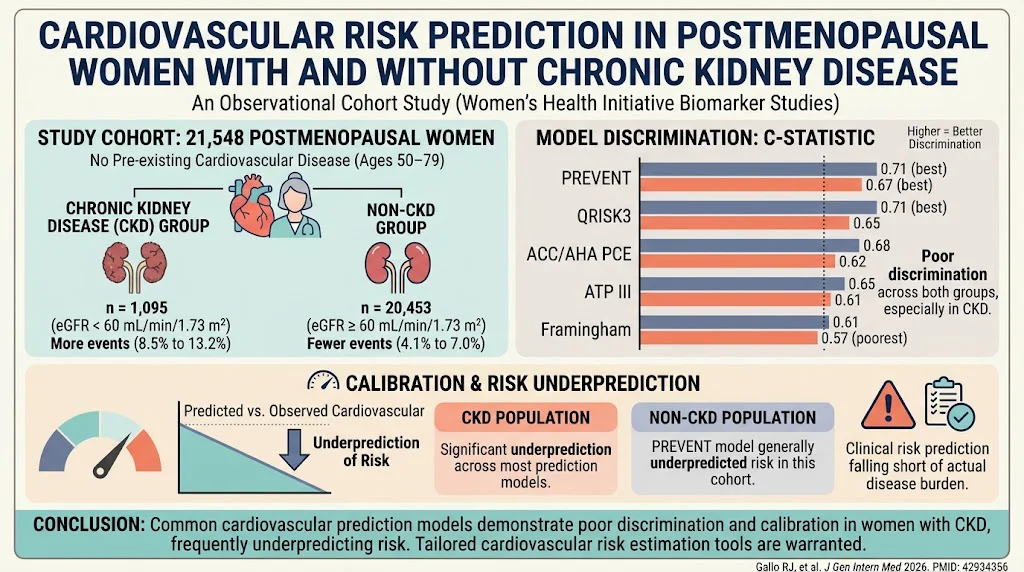
This study is a secondary analysis of the Women’s Health Initiative Biomarker Studies, a prospective cohort encompassing 21,548 postmenopausal women aged 50–79 years without prior cardiovascular events at enrollment. Of these, 1,095 women had CKD defined by estimated glomerular filtration rate (eGFR) less than 60 mL/min per 1.73 m2.
The study evaluated five cardiovascular risk prediction models: the Framingham Risk Score, Adult Treatment Panel (ATP) III, ACC/AHA Pooled Cohort Equations (PCE), QRISK3, and PREVENT. The models differ in their inclusion criteria for cardiovascular events, with outcomes ranging from coronary heart disease (CHD) death and myocardial infarction to ischemic stroke and transient ischemic attack.
Main measures included discrimination, assessed by the C-statistic (area under the ROC curve), and calibration, analyzed through clinically relevant decision-making thresholds. The goal was to compare model performance between women with and without CKD.
Key Findings
Cardiovascular event rates varied depending on the outcome definitions: in women without CKD, events ranged from 4.1% (ATP III) to 7.0% (QRISK3), while in women with CKD, event rates were higher, between 8.5% (ATP III) and 13.2% (QRISK3).
Discrimination: In women with CKD, the models’ ability to differentiate between those who developed cardiovascular events and those who did not was generally poor. The C-statistics ranged from 0.57 (Framingham) to 0.67 (PREVENT). In contrast, in women without CKD, discrimination was somewhat better, ranging from 0.61 (Framingham) to 0.71 (QRISK3 and PREVENT), though still modest.
Calibration: Calibration reflects how closely predicted risk matches observed events. Across the board, calibration was poor, with most models underpredicting cardiovascular risk in women with CKD, meaning they estimated lower risk than actually experienced. This underprediction was also noted in the non-CKD group for the PREVENT model. The implication is that applying these models as-is could result in under-treatment of high-risk women, particularly those with CKD.
These findings suggest that while models like QRISK3 and PREVENT performed relatively better than older scores such as Framingham and ATP III, no model achieved adequate predictive accuracy or calibration in postmenopausal women with CKD.
Expert Commentary
The study underscores a critical gap in cardiovascular risk prediction for women with CKD. Biological and clinical nuances of CKD, such as uremic milieu, inflammation, and vascular calcification, likely contribute to elevated cardiovascular risk but are not captured adequately by conventional risk factors used in standard models.
Moreover, women’s cardiovascular risk profiles differ from men’s in terms of disease presentation and progression, exacerbated by CKD-associated pathophysiology. This combination may explain the poor model performance.
Current guidelines acknowledge CKD as a risk enhancer but emphasize the need for improved risk stratification tools. This study’s findings align with calls for CKD-specific or integrated models that assimilate kidney function metrics and perhaps novel biomarkers.
Limitations include reliance on secondary analysis and possible selection biases inherent in cohort studies. Also, the cohort includes only postmenopausal women, limiting generalizability to men or younger populations. Nonetheless, the large sample and well-characterized endpoints strengthen the evidence.
Conclusion
Common cardiovascular risk prediction models inadequately discriminate and calibrate risk in postmenopausal women with CKD, frequently underestimating their true cardiovascular risk. Given CKD’s significant cardiovascular burden, there is an urgent need to develop, validate, and implement CKD-tailored prediction tools that can better guide primary prevention strategies in this high-risk group. Clinicians should exercise caution when applying current models to women with CKD and consider integrating clinical judgment, kidney function status, and emerging risk markers into their risk assessments.
Funding and Clinical Trial Information
This study was a secondary analysis of the Women’s Health Initiative Biomarker Studies cohort. No specific clinical trial registration applies.
References
1. Gallo RJ, Qin F, Hedlin H, et al. Cardiovascular Risk Prediction in Postmenopausal Women With and Without Chronic Kidney Disease: An Observational Cohort Study. J Gen Intern Med. 2026 Oct 26. PMID: 42934356.
2. KDIGO 2012 Clinical Practice Guideline for the Evaluation and Management of Chronic Kidney Disease. Kidney Int Suppl. 2013;3(1):1–150.
3. ACC/AHA Guideline on the Primary Prevention of Cardiovascular Disease. Circulation. 2019.
4. Hippisley-Cox J, et al. Predicting cardiovascular risk in women with CKD: Issues and approaches. Kidney Int. 2020;97(3):553-563.