We use cookies

Our website uses essential cookies and, with your consent, additional cookies to measure performance and improve our services. Cookie Policy.

You can change your choice at any time.

MMedXYNews
HomeVideos
MedXY AI/MedXY News/Section: Neurology

Rising Stroke Incidence in Young Adults: Evolving Risk Profiles and Mortality Trends from a Population-Based Study
MedXY Editorial Team•Sep 28, 2026•Neurology
strokecase fatality rateYoung Adultsrisk factorsincidence trends

Highlight

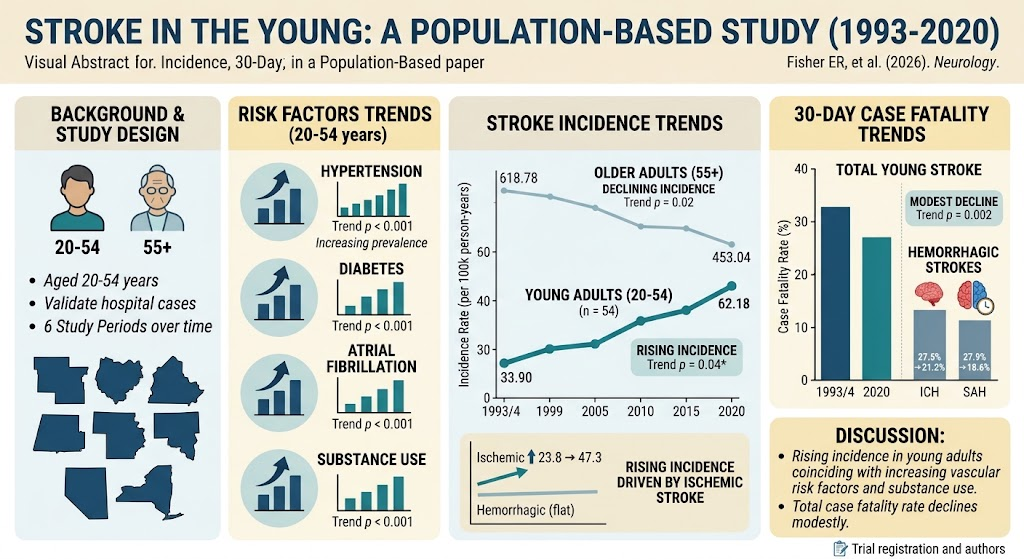
1. Stroke incidence rates among young adults (20-54 years) nearly doubled from 1993/4 to 2020, particularly driven by ischemic strokes.
2. Despite the rising stroke occurrence, 30-day case fatality rates modestly declined, especially in hemorrhagic stroke types.
3. Increases in traditional vascular risk factors such as hypertension, diabetes, atrial fibrillation, and substance use were noted over the study periods.
4. Contrarily, stroke incidence decreased in older adults (>54 years) during the same timeframe.

Study Background

MedXY registered readers

Sign in free to continue reading

Create or use your MedXY account to unlock the complete article.

This article was created using several editorial tools, including AI, as part of the process. Human editors reviewed this content before publication.

Related articles

Open language-specific specialty feeds and department pages.

Hospital Stroke Center Designation Influences Reported Stroke Rates After TAVR: Implications for Quality AssessmentNational data show that Comprehensive Stroke Center status and trial participation independently predict reported stroke rates after TAVR, highlighting potential ascertainment bias affecting hospital performance metrics.Oct 3, 2026Distinct Pustular Psoriasis Flares After Biologic Withdrawal in Plaque Psoriasis: Clinical Features and Risk FactorsThis multicenter study identifies a unique pustular psoriasis flare phenotype occurring after biologic therapy withdrawal in plaque psoriasis, detailing clinical characteristics and independent risk factors to guide vigilant monitoring and Sep 29, 2026Long-Term Dementia Risk After TIA: A Population-Based Study Reveals Sustained Cognitive ThreatA large Ontario cohort study found that transient ischemic attack (TIA) significantly increases long-term dementia risk, rivaling stroke’s impact, underscoring the need for cognitive-focused prevention strategies.Sep 28, 2026
Loading comments...
MedXY briefing

Get the free newsletter

Evidence-led clinical news, trends, and analysis—delivered to your inbox.

Ask MedXY AI

Most popular

Intimate Health
Five Benefits for Women Continuing Sexual Activity After Menopause
Intimate Health
Why Some Women Have a Strong Sex Drive—And Why Men Shouldn't Worry About It
Nursing & care
How often should a couple have sex?
General Surgery
Optimizing Postoperative Opioid Prescriptions After Intra-Abdominal Cancer Surgery: Comparing the 5x-Multiplier and 3-Tier Models
Cardiology
Precision Medicine for Long QT Syndrome Type 2: Lumacaftor Corrects Trafficking Defects and Shortens QT Interval
© 2026 MedXY
Contact usAbout usPrivacy PolicyMedXY story
Stroke and Systemic Embolism Following Atrial Fibrillation Ablation: Insights from the EMBOL-AF Global Registry and Contemporary Evidence
The EMBOL-AF Global Registry provides comprehensive data on stroke and systemic embolism post-atrial fibrillation ablation, highlighting incidence, timing, risk factors, and procedural impacts alongside evolving ablation strategies and long
Sep 27, 2026
Retinal OCTA as a Window into Cerebral Small Vessel Disease and Cognitive Decline Post-StrokeThis longitudinal study shows that retinal microvascular changes measured by OCTA correspond with cerebral small vessel disease progression and cognitive decline in mild ischemic stroke patients, highlighting OCTA’s potential as a nonSep 21, 2026
From Mild-to-Moderate to Severe Asthma: Risk Factors and Patient Profiles from the NORDSTAR Cohort and Advances in Severe Asthma ManagementThis review summarizes the progression risk from mild-to-moderate to severe asthma based on the NORDSTAR cohort and integrates emerging evidence on biologic therapies that improve severe asthma outcomes across diverse patient profiles.Sep 17, 2026