Predicting Short-Term Outcomes in Pemphigus Patients Treated with Rituximab and Glucocorticoids: Insights from a Multicenter Chinese Cohort
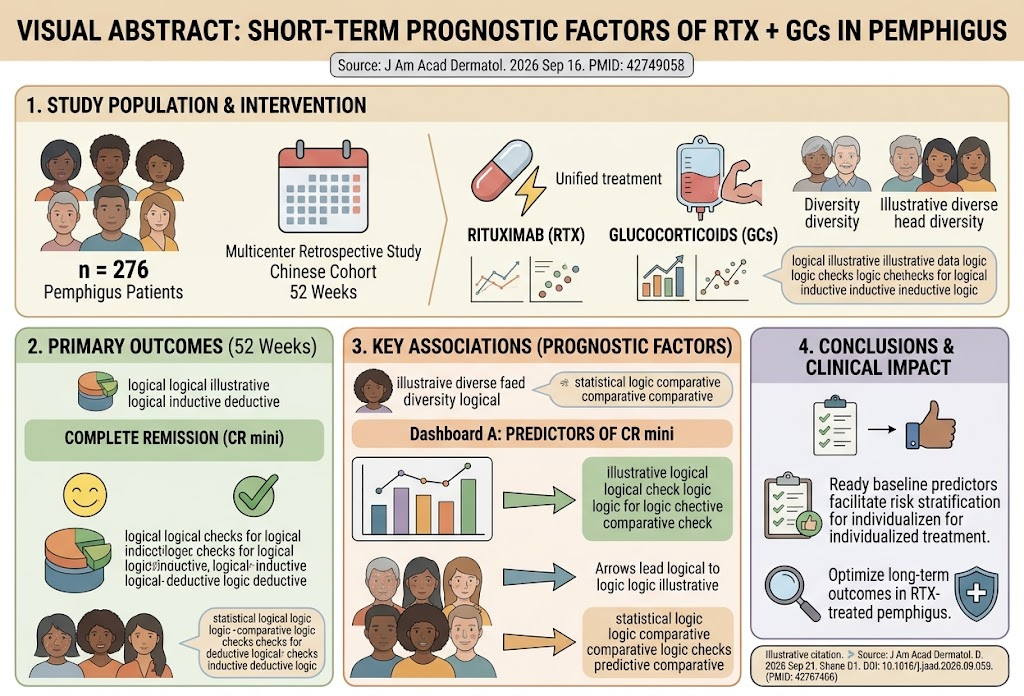
Highlight
– Rituximab combined with glucocorticoids achieves nearly 50% complete remission on minimal therapy (CR mini) at 52 weeks in a large Chinese pemphigus cohort.
– Three rituximab infusions, higher baseline IgM levels, and absence of herpes simplex virus infection predict better remission outcomes.
– Higher body weight, prior immunosuppressant, and cyclophosphamide use increase relapse risk.
– Adverse events, mainly infections, occur in 23% but do not differ by prognostic subgroup.
Study Background
Pemphigus is a rare, potentially life-threatening autoimmune blistering disorder characterized by autoantibodies targeting desmogleins, critical proteins for keratinocyte adhesion. Before biologics, management heavily relied on systemic glucocorticoids and immunosuppressants, often complicated by relapse and significant adverse effects. Rituximab (RTX), a CD20-targeting monoclonal antibody, has emerged as a first-line agent in pemphigus treatment, improving outcomes by depleting pathogenic B cells. Nevertheless, short-term prognostic outcomes and predictors in real-world Chinese populations remain underexplored, limiting personalized approaches.
Study Design
This multicenter retrospective cohort study enrolled 276 patients with pemphigus across multiple centers in China. All patients received initial treatment with rituximab combined with systemic glucocorticoids. The study’s primary endpoints included achieving complete remission on minimal therapy (CR mini) at 52 weeks, defined as the absence of new or established lesions while on minimal doses of glucocorticoids, and relapse rates within the same timeframe.
Data on baseline clinical characteristics, immunological parameters, prior treatments, and adverse events were collected. Univariate and multivariate logistic regression analyses were performed to identify independent predictors associated with CR mini and relapse.
Key Findings
After 52 weeks, 48.6% (134/276) of patients achieved CR mini, and 12.7% (35/276) experienced relapse. The remission rate aligns with prior reports supporting rituximab’s efficacy but provides novel insight into predictors influencing outcomes in a Chinese cohort.
Predictors of Complete Remission on Minimal Therapy (CR mini)
Multivariate analysis revealed three independent predictors associated with achieving CR mini:
- Three rituximab infusions: Patients receiving three infusions had significantly higher likelihood of remission compared to fewer doses, underscoring the importance of optimal dosing schedules.
- Higher baseline immunoglobulin M (IgM) levels: Elevated IgM may indicate more robust humoral immunity potentially contributing to better disease control or reflect less immune dysregulation.
- Absence of baseline herpes simplex virus (HSV) infection: Patients without active HSV infection had improved remission rates, suggesting viral co-infections may impair immune recovery or disease response.
Predictors of Relapse
Regarding relapse, independent predictors included:
- Higher body weight: Possibly affecting drug pharmacokinetics and disease severity, higher weight was associated with increased relapse risk.
- Prior immunosuppressant use: History of immunosuppressant treatments may indicate more refractory or severe disease.
- Prior cyclophosphamide use: Similarly, this may reflect resistant disease or cumulative immunosuppressive effects impacting long-term remission.
Safety and Adverse Events
Adverse events were reported in 23.2% of patients, with infections constituting the majority, consistent with immune modulation by rituximab and glucocorticoids. Importantly, adverse event incidence did not significantly differ between remission and relapse groups, indicating that these baseline prognostic factors are independent of short-term safety profiles.
Expert Commentary
This comprehensive multicenter study contributes valuable real-world evidence on prognostic factors for short-term outcomes in pemphigus managed with rituximab plus glucocorticoids, specific to the Chinese population. Identification of baseline IgM levels and infection status highlights the interplay between immune status and treatment response. The association between higher body weight and relapse may prompt future investigations into dose optimization and personalized treatment regimens.
While retrospective design limits causal inferences and lacks longitudinal biomarker dynamics, these findings nonetheless facilitate early risk stratification and tailored therapy planning, potentially improving long-term disease control and minimizing glucocorticoid-related morbidity.
Conclusion
In summary, this multicenter study demonstrates that about half of pemphigus patients treated with rituximab and glucocorticoids can achieve complete remission on minimal therapy within one year. Key baseline factors such as rituximab dosing frequency, immunoglobulin levels, viral infection status, body weight, and prior immunosuppressive history independently influence remission and relapse risks.
These readily obtainable clinical parameters enable clinicians to identify patients at higher risk for suboptimal outcomes early in treatment and adapt therapeutic strategies accordingly, ultimately advancing personalized medicine approaches in pemphigus care.
Funding and Clinical Trials Registration
No funding or clinical trial registration information was provided in the source study.
References
Wu Z, Jiang J, Chen S, et al. Short-term prognostic factors of rituximab combined with glucocorticoids in the treatment of pemphigus: A multicenter retrospective study. J Am Acad Dermatol. 2026 Sep 16; PMID: 42749058.
Bystryn JC, Rudolph JL. Pemphigus. Lancet. 2005;366(9479):61-73.
Shimanovich I, Schmidt E. Treatment of pemphigus with rituximab: Opportunities and challenges. Expert Opin Biol Ther. 2017;17(11):1353-1360.
This article was created using several editorial tools, including AI, as part of the process. Human editors reviewed this content before publication.