We use cookies

Our website uses essential cookies and, with your consent, additional cookies to measure performance and improve our services. Cookie Policy.

You can change your choice at any time.

MMedXYNews
HomeVideos
MedXY AI/MedXY News/Section: Hematology-Oncology

Impact of Induction Course Number on Outcomes of Allogeneic Stem Cell Transplant with Post-Transplant Cyclophosphamide in AML

MedXY Editorial Team•Sep 12, 2026•Hematology-Oncology
acute myeloid leukemiaallogeneic stem cell transplantationinduction chemotherapyposttransplant cyclophosphamiderelapse
Highlight

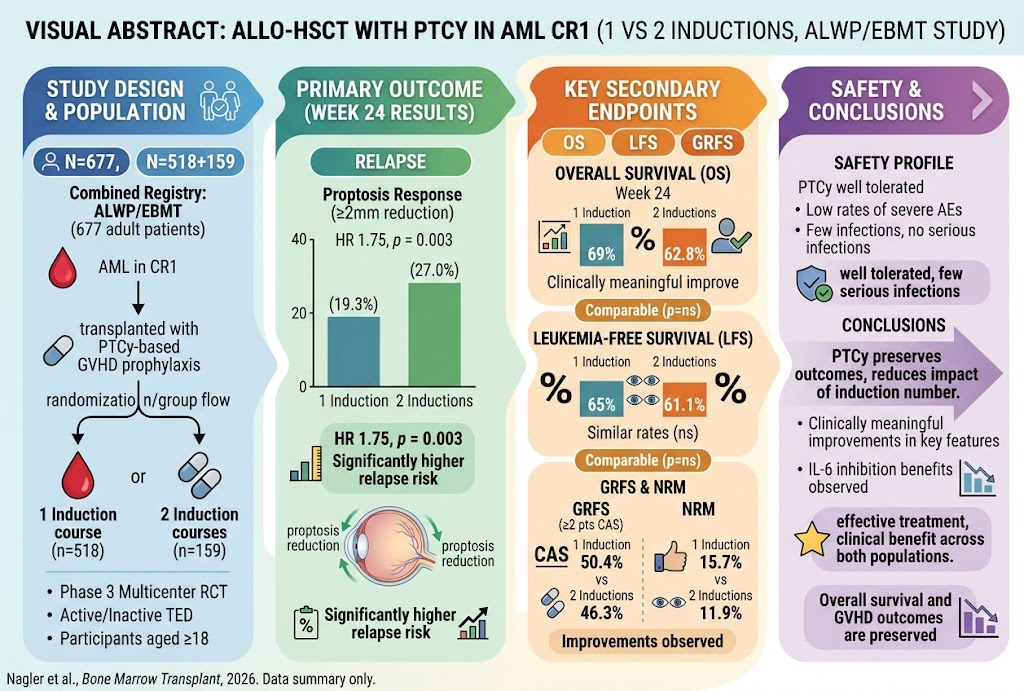
  • Analysis of 677 adult AML patients undergoing allogeneic stem cell transplantation (alloHSCT) with post-transplant cyclophosphamide (PTCy) in first complete remission.
  • Comparison between patients achieving CR1 after one induction chemotherapy course versus those requiring two courses.
  • Similar overall survival, leukemia-free survival, and GVHD-free/relapse-free survival despite higher relapse incidence in the two-induction group.
  • Findings support alloHSCT with PTCy as effective regardless of induction course number needed for remission.

Study Background

MedXY registered readers

Sign in free to continue reading

Create or use your MedXY account to unlock the complete article.

This article was created using several editorial tools, including AI, as part of the process. Human editors reviewed this content before publication.

Related articles

Open language-specific specialty feeds and department pages.

Evaluating Myeloablative Treosulfan-Fludarabine Conditioning in AML: A Promising Alternative for Middle-Aged AdultsA phase II trial demonstrates the safety and efficacy of myeloablative-dose treosulfan plus fludarabine (FT14) conditioning in AML patients aged 40-65, showing high leukemia-free survival and low toxicity, supporting its use over busulfan rSep 18, 2026Innovative CD38-Targeted Bispecific Antibody XmAb18968 Shows Promise in Relapsed/Refractory AML and T-ALLA phase 1 trial of XmAb18968, a CD38-CD3 bispecific antibody, demonstrates safety and encouraging efficacy in heavily pretreated relapsed/refractory AML and T-ALL patients, highlighting a novel therapeutic avenue.Sep 18, 2026ATG versus Alemtuzumab for GvHD Prophylaxis in AML Allo-HCT: Insights from the EBMT RegistryIn AML patients undergoing unrelated donor allo-HCT with intermediate-intensity conditioning, ATG-based GvHD prophylaxis demonstrated better overall and leukemia-free survival and reduced relapse compared to alemtuzumab, despite higher acutSep 17, 2026
Loading comments...
MedXY briefing

Get the free newsletter

Evidence-led clinical news, trends, and analysis—delivered to your inbox.

Ask MedXY AI

Most popular

Intimate Health
Five Benefits for Women Continuing Sexual Activity After Menopause
Intimate Health
Why Some Women Have a Strong Sex Drive—And Why Men Shouldn't Worry About It
Nursing & care
How often should a couple have sex?
Intimate Health
Classic Intimacy Recommendations: How to Help Women Reach Orgasm and Enjoy Mutual Pleasure
Intimate Health
What Makes a Woman "Physiologically Addicted" Is Never Money, But These Two Relationship Qualities
© 2026 MedXY
Contact usAbout usPrivacy PolicyMedXY story
Optimizing GVHD Prophylaxis after Reduced-Intensity Matched Donor Transplantation in AML and MDS: Insights from PTCy and ATG Strategies
A large registry analysis supports post-transplant cyclophosphamide (PTCy) as an effective alternative to anti-thymocyte globulin (ATG) for preventing graft-versus-host disease (GVHD) in reduced-intensity conditioning matched donor peripher
Sep 17, 2026
Tisagenlecleucel for Post-Transplant Relapse in Young Acute Lymphoblastic Leukemia Patients: European Real-World Determinants of OutcomeThis study evaluates the outcomes and critical factors influencing the success of tisagenlecleucel therapy for children and young adults with B-cell acute lymphoblastic leukemia relapsing after hematopoietic stem cell transplant across EuroSep 17, 2026
Targeting PRMT9 to Overcome Venetoclax Resistance in AML: A Paradigm Shift in Therapeutic StrategyPRMT9-mediated arginine methylation drives venetoclax resistance in AML by altering RNA splicing and protein synthesis. Targeting PRMT9 restores venetoclax sensitivity, offering a promising approach to combat resistant AML.Sep 13, 2026