TP53 Mutations in Acute Myeloid Leukemia: Impact on Outcomes Post-Allogeneic Hematopoietic Cell Transplantation
Highlight
- TP53 mutations identify a biologically distinct, high-risk AML subset with complex cytogenetics and therapy resistance.
- Following allogeneic hematopoietic cell transplantation (allo-HCT), TP53-mutated AML patients have significantly worse overall survival mainly due to higher relapse incidence.
- Multivariable analysis confirms TP53 alterations as the strongest independent predictor of poor outcome, irrespective of cytogenetic risk and disease risk indices.
- Molecular heterogeneity within TP53-mutated AML reveals subgroups with significantly different survival, informing future trial stratification and targeted therapies post-transplant.
Study Background
Acute myeloid leukemia (AML) is a heterogeneous hematological malignancy characterized by clonal proliferation of myeloid precursor cells. Despite advances in chemotherapy and targeted agents, relapsed or refractory disease remains a major cause of mortality. Allogeneic hematopoietic cell transplantation (allo-HCT) offers a potentially curative approach by leveraging graft-versus-leukemia effects but outcomes vary substantially based on disease biology.
TP53 is a crucial tumor suppressor gene regulating genomic integrity. Mutations in TP53 occur in approximately 5-10% of AML patients and are strongly associated with complex cytogenetics, therapy resistance, and poor prognosis. TP53 mutations define a distinct biological and clinical AML subset with dismal outcomes in conventional treatment settings. However, the impact of TP53 alterations on outcomes following allo-HCT has been incompletely characterized, limiting risk-adapted transplantation strategies.
This study addresses a critical clinical need by investigating the prognostic significance of TP53 mutations in a well-defined cohort of AML patients treated with allo-HCT at a single center, compared with a large control group of TP53 wild-type cases. Furthermore, exploration of TP53 mutational heterogeneity offers insights into prognosis and potential tailored interventions.
Study Design
This retrospective single-center cohort study included 61 consecutive adult patients with TP53-altered AML who underwent first allo-HCT at the Medical Center Freiburg from 2007 to 2025. A comparator group comprised 636 AML patients with TP53-wild-type undergoing the same treatment at the center during the same period.
Clinical data, molecular profiles, and transplant characteristics were systematically collected. TP53 alterations included point mutations and deletions, identified by sequencing and cytogenetic analyses. Primary endpoints were overall survival (OS), cumulative incidence of relapse (CIR), and non-relapse mortality (NRM).
Multivariable Cox proportional hazards models adjusted for established prognostic factors including cytogenetics and the refined Disease Risk Index (DRI). Additionally, exploratory hierarchical clustering incorporating seven TP53-mutated patients from a second center was performed to examine molecular heterogeneity within TP53-altered AML.
Key Findings
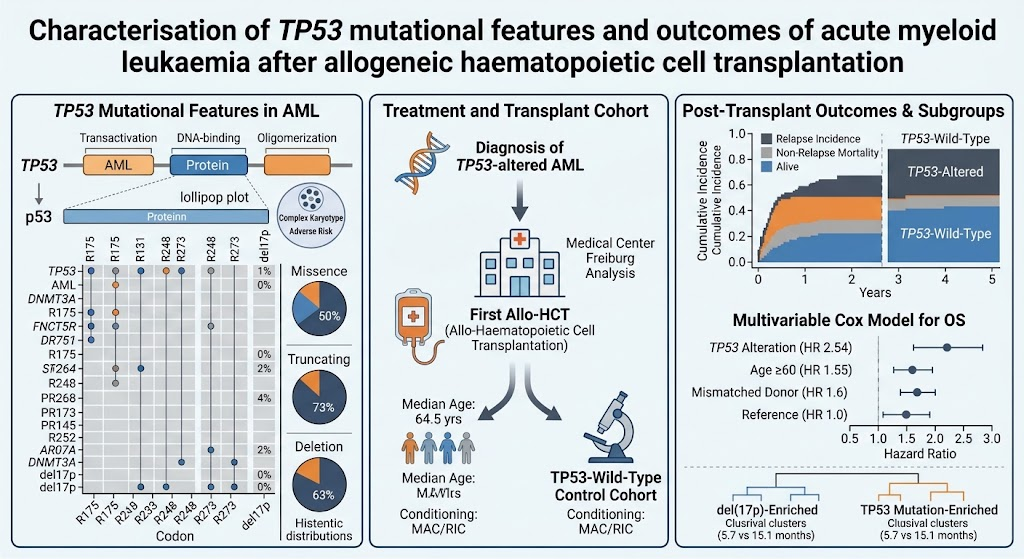
The presence of TP53 alterations portended markedly inferior survival outcomes after allo-HCT. The median OS was 379 days for TP53-mutated patients versus 1694 days for TP53-wild-type controls. Five-year OS was 18% in the TP53-mutated group compared to 50% in controls (p<0.001).
Relapse was the predominant driver of poor outcomes, with a 5-year cumulative incidence of relapse of 55% in TP53-mutated patients versus 33% in wild-type (p<0.001). Notably, non-relapse mortality did not significantly differ between groups (28.5% vs. 23%, p=0.426), indicating that excess mortality was attributable primarily to leukemia recurrence.
On multivariable Cox regression, TP53 alteration emerged as the strongest independent adverse prognostic factor with a hazard ratio (HR) for death of 2.54 (95% CI 1.77-3.64, p<0.001), maintaining statistical significance after adjusting for cytogenetic risk categories and the refined DRI.
Hierarchical clustering analysis revealed two distinct subgroups within TP53-mutated AML: (1) a del(17p)-enriched cluster (n=12) with a particularly poor median OS of 5.7 months, and (2) a TP53 point mutation-enriched cluster (n=56) with comparatively longer median OS of 15.1 months. This suggests molecular heterogeneity within TP53-altered AML influences transplant outcomes.
Expert Commentary
This study provides robust evidence affirming TP53 mutation status as the most powerful independent predictor of outcome after allo-HCT among AML patients. The finding that relapse drives mortality highlights the need for novel post-transplant relapse prevention strategies in this high-risk population.
The identification of molecular subgroups within TP53-mutated AML suggests that not all TP53 alterations confer equal risk. Patients harboring del(17p) have especially dismal prognosis, likely reflecting loss of functional TP53 and genomic instability. In contrast, point mutations may preserve partial function or associate with different co-mutations influencing disease biology.
These data warrant incorporation of TP53 mutation status into transplant risk stratification models and clinical trial design. Targeted therapies, including novel TP53-reactivating agents or tailored maintenance regimens, should be prioritized to improve outcomes for these patients.
Limitations include the retrospective nature and single-center design, which may introduce selection bias. Validation in larger, multicenter prospective cohorts is needed. Additionally, the interplay of TP53 mutations with other molecular lesions and immune factors post-transplant remains to be elucidated.
Conclusion
TP53 mutations define a biologically and clinically adverse AML subset with notably inferior survival following allo-HCT, driven principally by increased relapse. TP53 alterations independently predict poor outcomes beyond established cytogenetic and clinical risk indices. Molecular heterogeneity exists within TP53-mutated AML, with distinct subgroups demonstrating variable prognosis. These insights underscore the necessity of personalized risk-adapted transplant approaches and development of targeted post-transplant interventions to mitigate relapse and improve survival.
Funding and Clinical Trials Registration
This study was conducted at the Medical Center Freiburg and supported by institutional resources. No specific external funding or clinical trial registration was indicated in the original publication.
References
1. Reuss M, Meyer T, Ingelfinger F, et al. Characterisation of TP53 mutational features and outcomes of acute myeloid leukaemia after allogeneic haematopoietic cell transplantation. Bone Marrow Transplant. 2026 Sep 4. doi:10.1038/s41409-026-. PubMed PMID: 42697934.
2. Sallman DA, DeZern AE, Steensma DP, et al. TP53 Mutations in Myelodysplastic Syndromes and Acute Myeloid Leukemia: Biological and Clinical Implications. Blood Rev. 2021;48:100760.
3. Lindsley RC, Mar BG, Mazzola E, et al. Acute myeloid leukemia ontogeny is defined by distinct somatic mutations. Blood. 2015;125(9):1367-76.
4. Döhner H, Estey E, Grimwade D, et al. Diagnosis and management of AML in adults: 2017 ELN recommendations from an international expert panel. Blood. 2017;129(4):424-447.
5. Bhatnagar B, Ochoa-Bayona JL, Dillman KS. TP53 aberrations and complex karyotype in AML: Understanding the interplay. Leukemia. 2020;34(4):1051-1063.
This article was created using several editorial tools, including AI, as part of the process. Human editors reviewed this content before publication.