Optimizing Step Counts and Intensity to Reduce Mortality Risk: Insights from UK Biobank Accelerometer Data
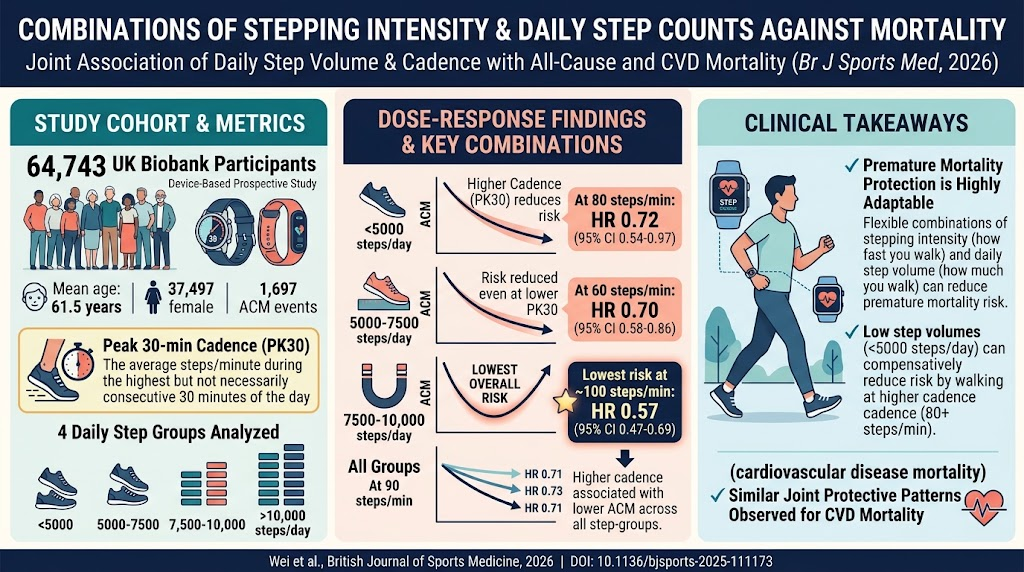
Highlight
Both stepping intensity and daily step counts independently influence all-cause and cardiovascular mortality risk.
Mortality risk reduction exhibits dose-response relationships with combinations of stepping cadence and step volume.
7500–10 000 steps/day combined with around 100 steps/min peak cadence is associated with the lowest mortality risk.
Diverse strategies involving either higher step counts or higher stepping intensity can be effective for premature mortality prevention.
Study Background
Physical inactivity remains a leading modifiable risk factor for premature mortality and cardiovascular disease (CVD). Walking is a widely accessible form of physical activity often recommended for health promotion. Current physical activity guidelines emphasize both quantity (step counts) and quality (intensity) of activity, yet the combined impact of daily step volume and stepping intensity on mortality outcomes has been understudied. Objective, device-based assessments of step counts and stepping cadence provide novel opportunities to understand their joint effects on health outcomes. This study addresses the clinical and public health need to clarify pragmatic step-based physical activity strategies to effectively reduce premature all-cause and cardiovascular mortality risk in middle-aged to older adults.
Study Design
This prospective cohort analysis utilized data from the UK Biobank subsample who wore wrist accelerometers, allowing precise measurement of physical activity patterns. The sample comprised 64,743 participants (mean age 61.5 years, 37,497 females). The study quantified stepping intensity using peak 30-minute cadence (PK30)—the average steps per minute during the highest 30 minutes of stepping in a day, not necessarily consecutive. Participants’ daily step counts were categorized into four groups: less than 5,000, 5,000–7,500, 7,500–10,000, and more than 10,000 steps/day. Multivariable-adjusted Cox proportional hazards models and Fine and Gray subdistribution hazard models assessed dose-response relationships of PK30 and daily step counts with all-cause mortality (ACM) and CVD mortality, respectively. Covariates included demographic, behavioral, and health factors to mitigate confounding.
Key Findings
During follow-up, 1,697 all-cause mortality events were recorded. The analyses revealed nuanced interactions between step quantity and intensity:
– In the lowest step count group (10,000 steps/day.
– Cardiovascular mortality risk patterns closely mirrored those for all-cause mortality, confirming the cardiovascular benefits of combined stepping metrics.
These findings suggest that both stepping intensity and daily step count independently contribute to mortality risk reduction, with the greatest benefits observed through certain combined thresholds.
Expert Commentary
This large-scale, device-based study advances understanding of how quantity and intensity of ambulatory activity jointly affect mortality risk. The objective measurement of peak stepping cadence overcomes recall biases inherent in self-reported physical activity. The observed U-shaped relationship for stepping intensity at moderate step counts may reflect differential biological effects, such as cardiovascular conditioning versus overexertion risks in certain populations. The study’s strengths include a substantial sample size, adjustment for confounders, and robust statistical modeling. However, residual confounding and the observational nature limit causal inference. Additionally, the population predominantly consists of middle-aged to older UK adults, which may affect generalizability. Mechanistically, higher step intensity may enhance cardiorespiratory fitness and endothelial function, thereby reducing cardiovascular risk factors and mortality.
Clinically, these findings support personalized physical activity prescriptions emphasizing either increased step volume, enhanced stepping intensity, or tailored combinations according to individual capacities and preferences. For patients unable to achieve high step counts, augmenting stepping pace could still convey meaningful health benefits. Conversely, sustained moderate-intensity walking with sufficient step volume appears optimal for longevity.
Conclusion
The joint evaluation of stepping intensity and daily step counts reveals distinct yet complementary pathways to lower all-cause and cardiovascular mortality risk. Aspiring to achieve 7,500 to 10,000 steps per day coupled with peak stepping intensities around 100 steps/minute appears optimal for mortality risk reduction. Nonetheless, varied combinations tailored to individual capacity also confer substantial benefit. These data inform nuanced, pragmatic physical activity guidelines aiming to reduce premature mortality through accessible and scalable stepping behaviors. Further investigations are warranted to confirm causality, examine longitudinal dose changes, and evaluate intervention efficacy in diverse populations.
Funding and ClinicalTrials.gov
This study was supported by UK Biobank and relevant governmental research bodies. As a prospective observational cohort analysis, no clinical trial registration applies.
References
1. Wei L, Ahmadi MN, Koemel NA, et al. Combinations of stepping intensity and daily step counts against all-cause and cardiovascular disease mortality: insights from a device-based prospective study. Br J Sports Med. 2026;60(18):1401-1408. doi:10.1136/bjsports-2023-107772
2. Lee IM, Shiroma EJ, Lobelo F, et al. Effect of physical inactivity on major non-communicable diseases worldwide: an analysis of burden of disease and life expectancy. Lancet. 2012;380(9838):219-229.
3. Saint-Maurice PF, Troiano RP, Bassett DR Jr, et al. Association of daily step count and step intensity with mortality among US adults. JAMA. 2020;323(12):1151-1160.
4. Thompson WR, Gordon NF, Pescatello LS. ACSM’s Guidelines for Exercise Testing and Prescription. 10th ed. Philadelphia, PA: Wolters Kluwer; 2018.
This article was created using several editorial tools, including AI, as part of the process. Human editors reviewed this content before publication.