Reevaluating Oliguria Thresholds in Critical Care: Implications for AKI, CKD, and Mortality Risk
Highlight
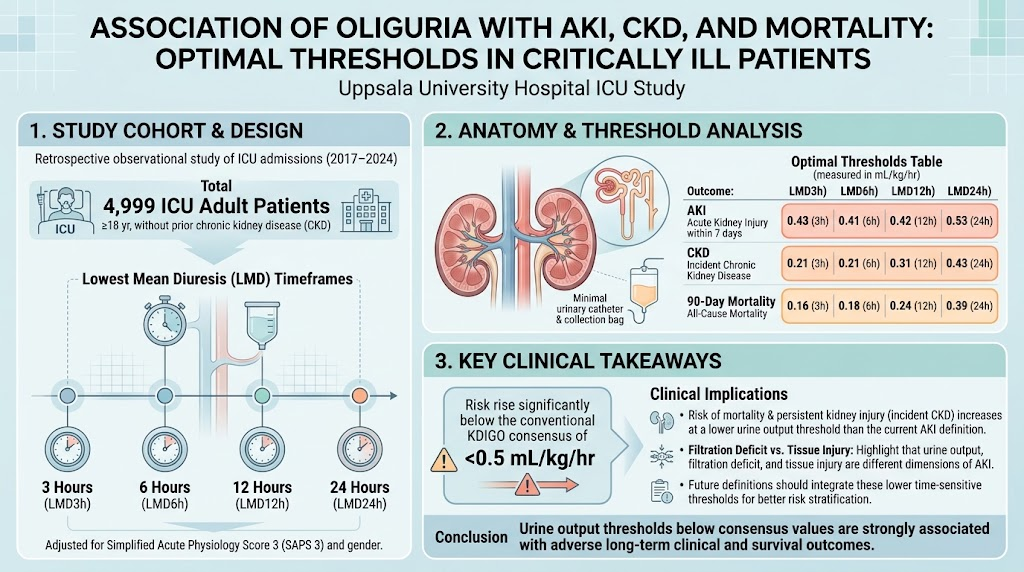
• Current oliguria definition (<0.5 mL/kg/hr) for acute kidney injury (AKI) risk assessment may be too high.
• Lower urine output thresholds are linked with increased risk of AKI, incident chronic kidney disease (CKD), and 90-day mortality.
• Risk thresholds vary depending on urine output measurement intervals (3 to 24 hours).
• Findings support considering urine output, filtration deficit, and tissue injury as distinct AKI dimensions.
Study Background
Oliguria, characterized by reduced urine output, is a recognized early marker for acute kidney injury (AKI), particularly in critically ill patients. Its standard definition, a urine output of less than 0.5 mL/kg/hr over six hours, guides clinical decisions and AKI staging per Kidney Disease Improving Global Outcomes (KDIGO) criteria. However, clinical observations and emerging data have questioned whether this threshold optimally identifies patients at risk of adverse kidney outcomes and mortality. Understanding more precise thresholds could improve early diagnosis, risk stratification, and management in intensive care unit (ICU) settings, potentially reducing long-term kidney sequelae such as chronic kidney disease (CKD) and mortality.
Study Design
This retrospective observational study was conducted in the ICU at Uppsala University Hospital, Sweden, over the period from 2017 to 2024. It included 4999 adult patients (≥18 years) who had no preexisting CKD at admission. No interventions were applied as it was an observational analysis. Urine output was calculated as the lowest mean diuresis (LMD) over intervals of 3, 6, 12, and 24 hours, termed LMD3h through LMD24h. Outcomes examined were AKI development within 7 days (based on KDIGO serum creatinine criteria), new-onset CKD after ICU discharge, and 90-day all-cause mortality. Statistical analyses used generalized additive models adjusted for baseline risk factors including Simplified Acute Physiology Score 3 estimated mortality ratio and gender.
Key Findings
Across all time intervals (LMD3h to LMD24h), lower urine outputs were significantly associated with higher incidence of AKI, CKD, and mortality (all p < 0.0001). The thresholds of urine output below which risk increased varied by outcome and time frame:
AKI thresholds: 0.43, 0.41, 0.42, and 0.53 mL/kg/hr for LMD3h, LMD6h, LMD12h, and LMD24h respectively.
CKD thresholds: considerably lower at 0.21, 0.21, 0.31, and 0.43 mL/kg/hr for the respective intervals.
Mortality thresholds: even lower cut-offs at 0.16, 0.18, 0.24, and 0.39 mL/kg/hr, indicating that the risk of death manifests at substantially lower urine outputs than those defining AKI.
The data demonstrate that the conventional 0.5 mL/kg/hr benchmark might not be sensitive enough to detect severe AKI risk or predict long-term kidney dysfunction and mortality accurately. Instead, different meaningful thresholds exist according to the adverse clinical outcome assessed, with mortality being associated with the most restrictive urine output levels.
Expert Commentary
This study provides compelling evidence to revisit the current oliguria definition used in AKI diagnosis. The separation of thresholds for AKI, CKD, and mortality underscores the multifaceted nature of kidney injury — where urine output reduction, filtration impairment, and structural tissue damage may represent overlapping but not identical pathophysiologic phenomena. Future AKI definitions may benefit from integrating multidimensional criteria that incorporate urine output dynamics over time, biochemical markers, and clinical outcomes rather than a single fixed cut-off.
Limitations include the study’s retrospective design and single-center setting, which may affect generalizability. Moreover, while urine output is a readily available metric in critical care, confounders such as volume status, use of diuretics, and hemodynamic instability should be considered when interpreting thresholds. Nonetheless, the large sample size and robust modeling approach lend credence to the findings.
Conclusion
This comprehensive evaluation indicates that the traditional urine output threshold defining oliguria and AKI could be revised to lower values, particularly when forecasting chronic kidney impairment and mortality in critically ill patients. Recognizing different urine output thresholds aligned with specific renal and survival outcomes could enable earlier and more tailored interventions. These insights advocate for an updated, nuanced AKI classification system that reflects the complexity of kidney injury beyond filtration deficits alone.
Funding and Registrations
No interventions or external funding sources were reported in the provided study details. No clinical trial registration was applicable.
References
Mossberg R, Lipcsey M, Marks-Hultström M, Eriksson M. Association of Oliguria With Acute Kidney Injury, Chronic Kidney Disease, and Mortality: Determining the Optimal Threshold in Critically Ill Patients. Crit Care Med. 2026 Oct 14. PMID: 42872921.
Kidney Disease: Improving Global Outcomes (KDIGO) Acute Kidney Injury Work Group. KDIGO Clinical Practice Guideline for Acute Kidney Injury. Kidney Int Suppl. 2012;2(1):1–138.
Hoste EA, Bagshaw SM, Bellomo R, et al. Epidemiology of acute kidney injury in critically ill patients: the multinational AKI-EPI study. Intensive Care Med. 2015;41(8):1411–1423.
This article was created using several editorial tools, including AI, as part of the process. Human editors reviewed this content before publication.