Highlight
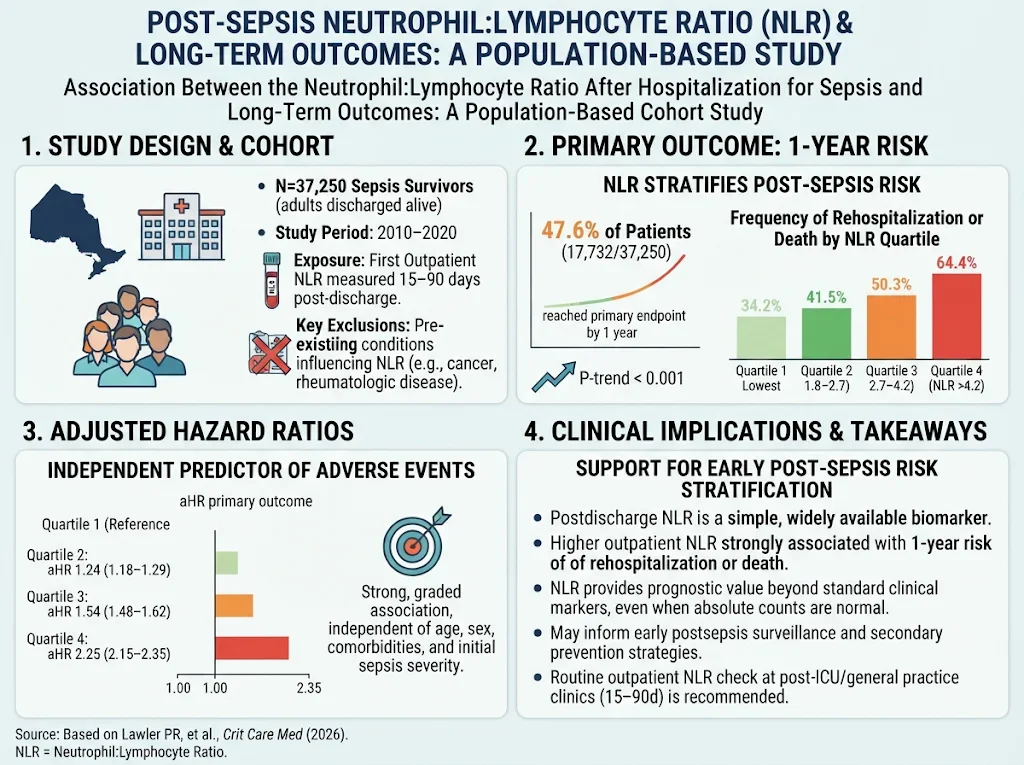
This population-based cohort study of 37,250 sepsis survivors in Ontario, Canada, identified a strong association between the neutrophil:lymphocyte ratio (NLR) measured 15 to 90 days after hospital discharge and long-term outcomes. Higher outpatient NLR quartiles correlated with significantly increased risks of rehospitalization or death within one year. The NLR returned to patient-specific baseline levels for most patients, which independently predicted outcomes, positioning NLR as an accessible biomarker to guide post-sepsis risk stratification and secondary prevention.
Study Background
Sepsis remains a critical global health burden characterized by a dysregulated immune response to infection leading to life-threatening organ dysfunction. Despite advances in acute management improving survival, sepsis survivors experience substantial long-term morbidity and mortality. Post-sepsis patients frequently endure recurrent hospitalizations, impaired quality of life, and elevated mortality rates for months to years after discharge. Current clinical practice lacks reliable, widely available laboratory tests to stratify long-term risk following sepsis. Establishing such tools is vital to identifying patients who might benefit from intensified follow-up and targeted secondary prevention interventions.
The neutrophil:lymphocyte ratio (NLR), derived from routine complete blood counts, reflects a balance between innate (neutrophils) and adaptive (lymphocytes) immunity. Elevated NLR has gained attention as a prognostic biomarker in various acute inflammatory and infectious states, including sepsis. However, its prognostic value in the post-discharge outpatient period and association with long-term adverse outcomes after sepsis remains inadequately explored.
Study Design
This population-based cohort study analyzed adult patients discharged alive after a sepsis hospitalization in Ontario, Canada, from 2010 to 2020. The exposure of interest was the first outpatient NLR measurement obtained between 15 and 90 days after hospital discharge, corresponding to the timing of routine post-intensive care unit (ICU) clinic visits. Patients were followed for one year to capture the composite endpoint of rehospitalization or death.
No interventions were performed as part of the study; it was an observational assessment of routinely collected clinical and laboratory data. The median time from sepsis discharge to outpatient NLR measurement was 34 days. The study population included 37,250 survivors with available outpatient NLR data.
Key Findings
The median NLR among survivors during the outpatient period was 2.7 (IQR 1.8–4.2). Within one year of discharge, 47.6% of patients experienced rehospitalization or death, with a median time-to-event of 82 days.
Analysis across NLR quartiles revealed a graded increase in adverse outcomes: 34.2% in the lowest quartile, 41.5% in the second, 50.3% in the third, and 64.4% in the highest quartile, with a statistically significant trend (ptrend < 0.001). Multivariable-adjusted hazard ratios for rehospitalization or death compared to the lowest NLR quartile were 1.24 (95% CI 1.18–1.29) for the second quartile, 1.54 (1.48–1.62) for the third, and 2.25 (2.15–2.35) for the highest quartile, highlighting a strong, dose-dependent association.
Importantly, for most patients, the outpatient NLR returned to their individual pre-sepsis baseline levels, indicating immune homeostasis restoration. This patient-specific ambient NLR was itself a prognostic indicator, suggesting that deviations from personal immune set-points might have clinical relevance.
The study underscores the outpatient NLR as a simple, inexpensive, and widely accessible biomarker that can effectively stratify long-term risk among sepsis survivors. It offers a window for early identification of high-risk individuals during routine follow-up when secondary prevention strategies may be most impactful.
Expert Commentary
This study addresses a critical gap in post-sepsis care by validating an easily obtainable biomarker for long-term outcome prediction. The neutrophil:lymphocyte ratio integrates innate and adaptive immune dynamics implicated in sepsis pathophysiology and subsequent immune dysregulation. By demonstrating a reproducible prognostic gradient in a large population-based cohort, the findings align with emerging mechanistic insights about persistent immune dysfunction and inflammation in sepsis survivors.
Limitations include potential residual confounding inherent to observational designs and reliance on available outpatient laboratory data. However, large sample size and adjustment for confounders strengthen the findings’ reliability. Further research is needed to clarify underlying immunologic mechanisms driving NLR changes post-sepsis and to test whether interventions targeting patients with elevated outpatient NLR can improve outcomes.
Clinical practice may benefit from incorporating outpatient NLR measurements as part of standardized post-sepsis follow-up protocols. This biomarker could guide tailored monitoring intensity and prompt preventive therapies, ultimately aiming to reduce rehospitalization rates and long-term mortality.
Conclusion
The neutrophil:lymphocyte ratio measured in the outpatient setting 15-90 days after sepsis hospital discharge robustly predicts 1-year rehospitalization or death. This accessible biomarker reflects the balance of immune recovery and may enable personalized risk stratification to guide secondary prevention strategies. Adoption of NLR assessment in post-sepsis care pathways holds promise to improve long-term patient outcomes by identifying those at highest risk who may benefit from intensified surveillance and therapeutic interventions.
Funding and ClinicalTrials.gov
The original study was conducted by a multidisciplinary team supported by various institutional and governmental funding sources pertinent to critical care and infectious diseases research. No clinical trial registration number was reported since this was an observational cohort study.
References
1. Lawler PR, Haldenby O, Chong A, et al. Association Between the Neutrophil:Lymphocyte Ratio After Hospitalization for Sepsis and Long-Term Outcomes: A Population-Based Cohort Study. Crit Care Med. Published online 2026. PMID: 43002070.
2. Prescott HC, Recovery after sepsis: an emerging role for postdischarge risk stratification and management. JAMA. 2017;317(1):17-18.
3. Shankar-Hari M, Phillips GS, Levy ML, et al. Developing a new definition and assessing new clinical criteria for septic shock: For the Third International Consensus Definitions for Sepsis and Septic Shock (Sepsis-3). JAMA. 2016;315(8):775-787.
4. Zahorec R. Ratio of neutrophil to lymphocyte counts—rapid and simple parameter of systemic inflammation and stress in critically ill. Bratisl Lek Listy. 2001;102(1):5-14.