Highlight
• Defining sepsis time zero by hypotension or lactate ≥4.0 mmol/L best identifies patients at risk of increased mortality with antibiotic delays within 1-3 hours.
• In patients without hypotension or elevated lactate, acute respiratory failure predicts heightened mortality risks with delayed antibiotics beyond 3 hours.
• Other SEP-1 organ dysfunction criteria, alone or combined, did not show significant mortality associations with delayed antibiotic administration.
• These findings suggest targeted refinement of sepsis time zero definitions to optimize antibiotic timing and performance measurement.
Study Background
Sepsis remains a leading cause of morbidity and mortality worldwide despite advances in critical care. Early recognition and timely administration of antibiotics significantly improve outcomes. However, operationalizing the exact time point at which sepsis begins—known as “time zero”—is critical for implementing performance measures like the Centers for Medicare & Medicaid Services’ SEP-1 metric. Current SEP-1 criteria define time zero based on diverse organ dysfunction markers, which may not uniformly identify patients at the highest risk from antibiotic delays.
This heterogeneity complicates clinical decision-making and benchmarking for quality improvement. Therefore, elucidating which organ dysfunctions within SEP-1 most strongly associate with mortality related to delayed antibiotic therapy could refine time zero definitions and improve sepsis care effectiveness.
Study Design
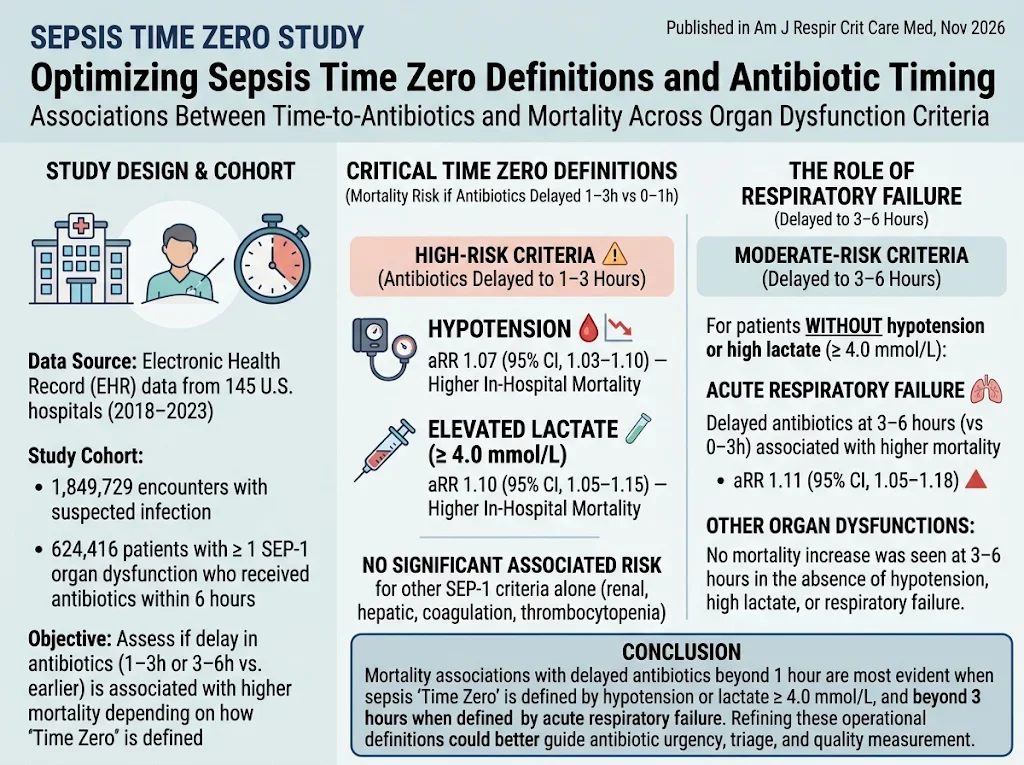
This retrospective observational cohort study analyzed electronic health record data from 145 U.S. hospitals over five years (2018-2023). The population included 1,849,729 adult hospital encounters with suspected infection. Among these, 624,416 patients had at least one SEP-1 organ dysfunction criterion and received antibiotics within six hours of sepsis time zero.
SEP-1 organ dysfunction criteria evaluated included hypotension, elevated lactate (≥4.0 mmol/L), respiratory failure, renal dysfunction, hyperbilirubinemia, thrombocytopenia, and coagulopathy, assessed both individually and in combination.
Using inverse probability weighting to control for baseline and time-varying confounders, the investigators estimated adjusted risk ratios (aRR) for in-hospital mortality associated with delays in antibiotic initiation comparing intervals of 1-3 hours vs. 0-1 hour, and 3-6 hours vs. 0-3 hours after sepsis time zero for each organ dysfunction criterion.
Key Findings
Antibiotic administration delays of 1-3 hours relative to the first hour after time zero were significantly associated with increased mortality when time zero was defined by hypotension (adjusted risk ratio [aRR] 1.07; 95% CI, 1.03–1.10) or lactate ≥4.0 mmol/L (aRR 1.10; 95% CI, 1.05–1.15).
No significant mortality associations were observed for other organ dysfunctions (renal, hepatic, hematologic, or coagulopathy) alone or in combinations during this early delay window.
In patients without hypotension or elevated lactate, antibiotic delays of 3-6 hours compared to 0-3 hours were linked to mortality increases only in those with acute respiratory failure (aRR 1.11; 95% CI, 1.05–1.18), suggesting a more extended critical window in this subgroup.
Collectively, these data identify hypotension and significant hyperlactatemia as organ dysfunction markers defining patient subgroups with the most immediate risk from delayed antibiotic therapy. Acute respiratory failure also defines a time-sensitive group but with a longer delay threshold.
Expert Commentary
This extensive multicenter cohort study addresses a clinically pertinent question: how to operationalize sepsis time zero in a manner that accurately reflects risk associated with delays in antibiotics. Prior SEP-1 criteria aggregate various organ dysfunctions without differentiating their differential impact on outcomes related to timing. By stratifying mortality risk associations by organ dysfunction, this work provides mechanistic and practical insights.
Hypotension and severe lactate elevation are well-recognized markers of septic shock and tissue hypoperfusion, physiologically consistent with rapid deterioration and heightened sensitivity to treatment delays. Respiratory failure’s association at a longer delay interval may relate to more gradual progression or response to supportive care measures.
However, as an observational study, potential residual confounding exists despite advanced adjustment methods. Additionally, the findings rely on electronic health record-derived criteria, which may be variable in accuracy and timing across institutions.
These results advocate for targeted refinement of sepsis quality metrics whereby time zero definitions incorporate organ dysfunction phenotypes most indicative of imminent risk from antibiotic delay—potentially enabling more precise clinical prioritization and policy frameworks.
Conclusion
Defining sepsis time zero using hypotension or lactate ≥4.0 mmol/L captures those patients at greatest risk of mortality associated with antibiotic delays beyond the first hour. In patients without these defining features, acute respiratory failure identifies a subgroup vulnerable to mortality increases with antibiotic delays beyond three hours. Other SEP-1 organ dysfunction criteria were not significantly associated with mortality risk from delayed antibiotics.
These findings provide a strong evidence base to refine sepsis time zero operationalization, enhancing clinical efficiency and guiding quality improvement programs to focus urgently on patients with hypotension or high lactate. Future research should validate these observations prospectively and explore integration with rapid diagnostics and sepsis phenotyping.
Funding and ClinicalTrials.gov
The original study was published in the American Journal of Respiratory and Critical Care Medicine. Specific funding sources and clinical trial registration information were not provided in the abstract.
References
1. Rhee C, Pak TR, Young J, Jin R, DelloStritto L, Guy J, Sands KE, Poland RE, McKenna CS, Agan A, Shappell CN, Filbin MR, Dutta S, Septimus EJ, Kadri SS, Masur H, Klompas M. Optimizing Sepsis Time Zero Definitions Through Associations between Antibiotic Timing and Mortality. Am J Respir Crit Care Med. 2026 Nov 12. PMID: 43016314.
2. Rhodes A, Evans LE, Alhazzani W, et al. Surviving Sepsis Campaign: International Guidelines for Management of Sepsis and Septic Shock: 2016. Intensive Care Med. 2017;43(3):304-377.
3. Seymour CW, Gesten F, Prescott HC, et al. Time to Treatment and Mortality during Mandated Emergency Care for Sepsis. N Engl J Med. 2017;376(23):2235-2244.