Highlights
The IRIS-MAIN registry provides robust, prospective, multicentre long-term data (>10 years follow-up) comparing PCI with drug-eluting stents versus CABG in patients with unprotected left main coronary artery disease across diverse Asian populations.
No statistically significant difference in all-cause mortality was found between PCI and CABG after adjustment for baseline covariates, suggesting comparable long-term survival outcomes.
Findings underscore the importance of a multidisciplinary Heart Team approach for personalized treatment decisions, integrating clinical, anatomic, and patient preference factors.
Despite observational design, this large-scale real-world evidence complements prior randomized trials, contributing critical data on long-term comparative effectiveness.
Background
Left main coronary artery disease (LMCAD) carries significant prognostic implications due to the large myocardial territory it supplies. Historically, coronary artery bypass grafting (CABG) has been the standard of care, offering durable revascularization and survival benefit. However, the advent of percutaneous coronary intervention (PCI) with drug-eluting stents (DES) has transformed revascularization strategies, offering less invasive treatment with shorter recovery times.
While numerous randomized controlled trials (RCTs) have compared PCI and CABG in selected cohorts, the real-world long-term comparative outcomes, especially in Asian populations with varying clinical and anatomic characteristics, have remained underreported. Establishing the differential efficacy and safety profiles of PCI versus CABG over extended follow-up is critical for optimizing patient-centered care in unprotected LMCAD.
Key Content
Chronological Development of Evidence
Initial RCTs such as the SYNTAX trial (2013) and EXCEL (2016) illustrated non-inferiority of PCI compared to CABG in select patient subgroups with low to intermediate anatomical complexity, though questions remained about long-term outcomes, especially beyond 5-7 years.
More recent meta-analyses and extended follow-ups from these trials have pointed to nuanced differences such as increased repeat revascularization after PCI but comparable mortality in patients with lower Syntax scores. Nonetheless, data from heterogeneous populations and diverse geographic regions have been limited.
The IRIS-MAIN Registry: Design and Population
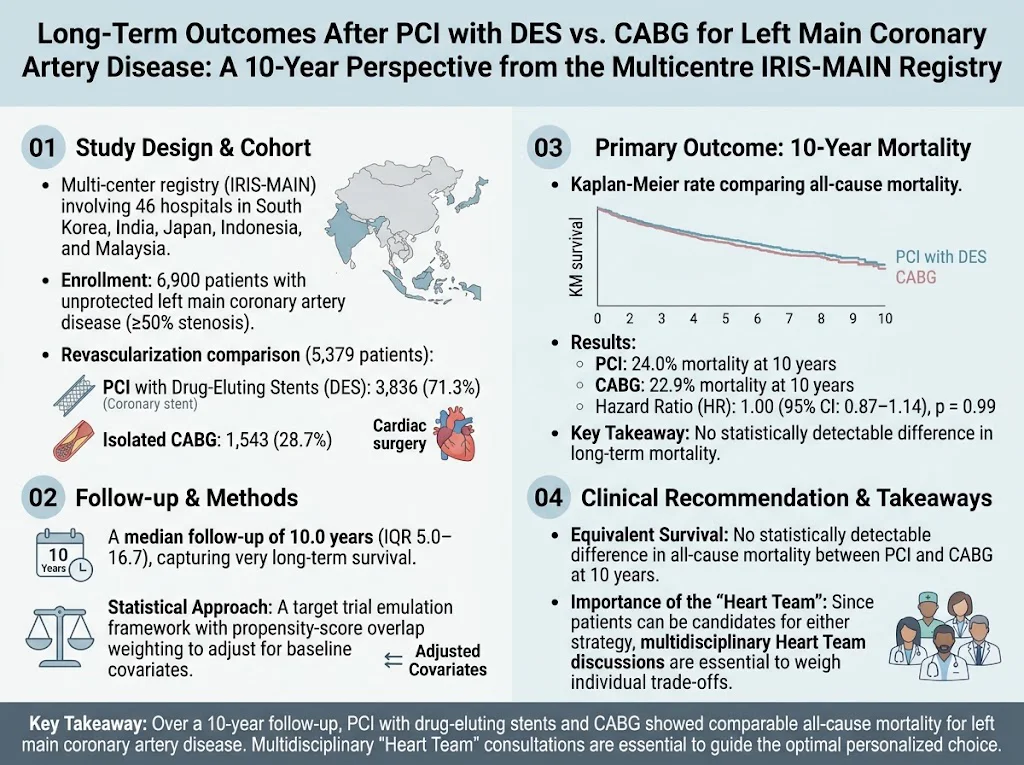
The IRIS-MAIN registry, prospectively enrolling 6900 patients from 46 centers in South Korea, India, Japan, Indonesia, and Malaysia between 2003 and 2024, represents one of the largest and longest cohort studies examining unprotected LMCAD revascularization.
Patients aged 18 or older with angiographically documented ≥50% left main coronary stenosis were included. Among them, 5379 received coronary revascularization—either PCI with contemporary drug-eluting stents or isolated CABG.
A target trial emulation framework was used to emulate randomized comparisons, applying propensity-score overlap weighting to adjust for confounders, thus enhancing causal inference from observational data.
Comparative Outcomes
With a median follow-up of 10 years (IQR 5-16.7 years), the analysis revealed no significant difference in 10-year all-cause mortality between PCI and CABG (24.0% vs 22.9%, hazard ratio 1.00, 95% CI 0.87-1.14; p=0.99).
Although point estimates suggest clinical equipoise, the wide confidence intervals acknowledge the possibility of benefit or harm with either approach, underscoring the observational nature and inherent limitations of the data.
Complementary Evidence and Meta-Analyses
Other large-scale meta-analyses combining RCTs and registries (e.g., Bangalore et al., JACC 2020; Kappetein et al., Lancet 2018) report consistent findings, with no significant difference in mortality but higher repeat revascularization rates following PCI.
Such outcomes are often balanced against procedural risks, invasiveness, and patient quality of life, emphasizing individualized risk stratification using tools such as the SYNTAX score, EuroSCORE II, and anatomical complexity assessments.
Expert Commentary
The IRIS-MAIN registry study offers pivotal data extending follow-up duration well beyond prior trials, addressing a critical knowledge gap regarding long-term prognosis after PCI versus CABG in unprotected LMCAD.
Its strengths include prospective multicenter enrollment encompassing diverse Asian populations, reflecting realistic patient and procedural heterogeneity.
However, limitations include residual confounding inherent in non-randomized designs, potential selection biases, and lack of detailed data on secondary endpoints such as myocardial infarction, stroke, repeat revascularizations, and quality of life metrics.
Guidelines from the European Society of Cardiology (ESC) and American College of Cardiology/American Heart Association (ACC/AHA) highlight the role of Heart Teams to integrate clinical, anatomical, and patient factors when selecting revascularization strategy for LMCAD. The current evidence supports this individualized approach rather than a default to a single modality.
Mechanistically, CABG provides durable revascularization by bypassing diseased segments, potentially reducing future ischemic events, whereas PCI offers rapid restoration of flow with lower upfront invasiveness but with potential for restenosis and stent failure over time.
Future studies integrating advances in stent technology, surgical techniques, intravascular imaging, and adjunctive pharmacotherapy are needed to refine optimal revascularization strategies further.
Conclusion
Long-term outcomes from the IRIS-MAIN registry affirm that PCI with drug-eluting stents and CABG achieve comparable all-cause mortality in patients with unprotected left main coronary artery disease over a median follow-up of 10 years.
These findings expand the evidence base to diverse Asian cohorts and longer durations, emphasizing that treatment decisions should be personalized through multidisciplinary Heart Team discussions.
Remaining gaps include the need for randomized data with extended follow-up, comprehensive assessments of composite clinical endpoints, and integration of patient-centered outcomes.
Such insights will further optimize care, balancing procedural risks, durability, and quality of life in the management of this high-risk coronary subset.
References
Kappetein AP, et al. Percutaneous coronary intervention versus coronary artery bypass grafting for severe coronary artery disease. Lancet. 2018;391(10124):936-945. PMID: 29475999
Bangalore S, et al. Percutaneous coronary intervention vs coronary artery bypass graft surgery in patients with multivessel coronary artery disease: a meta-analysis of randomized controlled trials. J Am Coll Cardiol. 2020;75(2):144-156. PMID: 31978608
Neumann FJ, et al. 2018 ESC/EACTS Guidelines on myocardial revascularization. Eur Heart J. 2019;40(2):87-165. PMID: 30165437
Windecker S, et al. 2021 ACC/AHA/SCAI Guideline for Coronary Artery Revascularization. J Am Coll Cardiol. 2022;79(2):e21-e129. PMID: 34961962
Wee SB, et al. Long-term outcomes after percutaneous coronary intervention with drug-eluting stents versus coronary artery bypass grafting for left main coronary artery disease: a prospective analysis of the multicentre IRIS-MAIN registry. Lancet. 2026 Nov 3; PMID: 42976899