Highlight
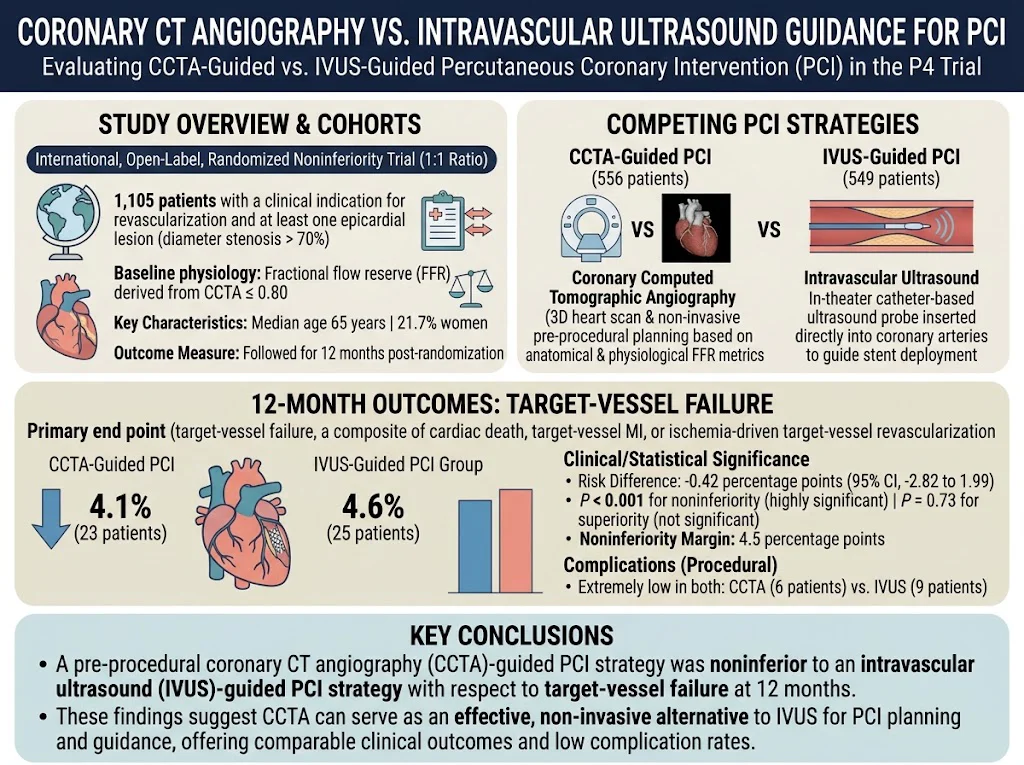
A randomized, international trial comparing coronary CT angiography (CCTA)-guided PCI with intravascular ultrasound (IVUS)-guided PCI demonstrated noninferiority of CCTA guidance in terms of target-vessel failure at 12 months.
The primary endpoint, a composite of cardiac death, target-vessel myocardial infarction, or ischemia-driven target-vessel revascularization, occurred at similar low rates in both groups.
Clinical procedural complications were rare and comparable between the two imaging guidance strategies.
This study potentially broadens PCI guidance approaches, leveraging noninvasive pre-procedural anatomical and physiological assessment with CCTA.
Study Background
Percutaneous coronary intervention (PCI) is a cornerstone therapy for patients with significant coronary artery disease, aimed at restoring vessel patency and alleviating ischemia. Optimization of PCI relies on accurate lesion assessment and stent deployment strategies. Intravascular ultrasound (IVUS) guidance has been shown to improve procedural outcomes by allowing real-time, detailed vessel wall imaging during PCI. Despite IVUS’s benefits, it requires an invasive catheter-based approach during cardiac catheterization.
Coronary computed tomographic angiography (CCTA) is a non-invasive imaging modality that provides comprehensive anatomical as well as physiological data on coronary lesions prior to catheterization. With technological advances, CCTA now allows assessment of fractional flow reserve (FFR) noninvasively, facilitating precise lesion identification and treatment planning. However, whether CCTA-guided PCI achieves clinical outcomes comparable to the gold-standard IVUS-guided PCI has lacked robust evidence.
Study Design
This was an investigator-initiated, international, open-label, randomized controlled trial enrolling 1,105 patients with an indication for coronary revascularization. Inclusion criteria included having at least one epicardial coronary lesion with >70% diameter stenosis identified by CCTA and a CCTA-derived fractional flow reserve (FFR) of 0.80 or less, indicating hemodynamic significance.
Participants were randomized in a 1:1 ratio to either a CCTA-guided PCI strategy or an IVUS-guided PCI strategy. The primary endpoint was target-vessel failure at 12 months, defined as a composite of cardiac death, target-vessel myocardial infarction (MI), or ischemia-driven target-vessel revascularization. The trial was designed as a noninferiority study with a noninferiority margin set at 4.5 percentage points for absolute risk difference. Blinded endpoint adjudication was performed.
Key Findings
Among the 1,105 randomized patients (median age 65 years; 21.7% women), 556 underwent CCTA-guided PCI and 549 underwent IVUS-guided PCI. At 12-month follow-up, target-vessel failure occurred in 4.1% (23 patients) of the CCTA group compared with 4.6% (25 patients) in the IVUS group. The absolute risk difference was -0.42 percentage points (95% CI -2.82 to 1.99), satisfying the noninferiority criterion (P < 0.001). There was no statistical superiority in either direction (P = 0.73).
The composite endpoint rates reflect low event incidence, highlighting that both imaging strategies were effective in guiding PCI procedures. Clinical procedural complications were infrequent, reported in six patients in the CCTA group versus nine patients in the IVUS group, consistent with comparable safety profiles.
Secondary endpoints and procedural characteristics were not detailed in the abstract but presumably aligned with the primary outcomes given the hierarchical testing framework.
Expert Commentary
This trial is significant in that it positions CCTA-guided PCI as a viable alternative to IVUS-guided PCI. The noninvasive, pre-procedural nature of CCTA offers practical advantages, including less procedural complexity and exposure associated with intracoronary imaging. Moreover, incorporating physiological assessment via CCTA-derived FFR enhances lesion selection and procedural planning without the need for pressure wires or hyperemic agents during catheterization.
The comparable low rates of target-vessel failure underscore the clinical robustness of CCTA guidance for coronary revascularization. However, limitations inherent to an open-label study design, and potential selection biases, must be acknowledged. Further subgroup analyses and longer-term follow-up can elucidate if certain patient populations benefit preferentially from one imaging modality over the other.
In current clinical practice, IVUS remains widely adopted as the intraprocedural gold standard for precise stent optimization. This study suggests that CCTA, widely available and noninvasive, could complement or in select cases substitute IVUS, particularly when access to intravascular imaging is limited or patient risk stratification favors noninvasive assessment.
Conclusion
This landmark international randomized trial demonstrates that a CCTA-guided PCI strategy is noninferior to IVUS-guided PCI in terms of target-vessel failure within one-year follow-up. Both strategies yielded similarly low event rates and low procedure-related complications. These findings support incorporating CCTA not only as a diagnostic modality but also as a robust tool for guiding coronary intervention, potentially impacting PCI planning paradigms globally.
Future investigations should explore long-term outcomes, cost-effectiveness, and integration of novel quantitative CCTA metrics for precision PCI guidance to further refine individualized coronary artery disease management.
Funding and Clinical Trial Registration
This trial was funded by GE Healthcare and Heartflow, with the ClinicalTrials.gov identifier NCT05253677.
References
Collet C, Mizukami T, Bouisset F, et al; P4 Trial Investigators. Coronary CT Angiography versus Intravascular Ultrasound Guidance for PCI. N Engl J Med. 2026 Nov 1; (epub ahead of print). PMID: 42969897.