Highlight
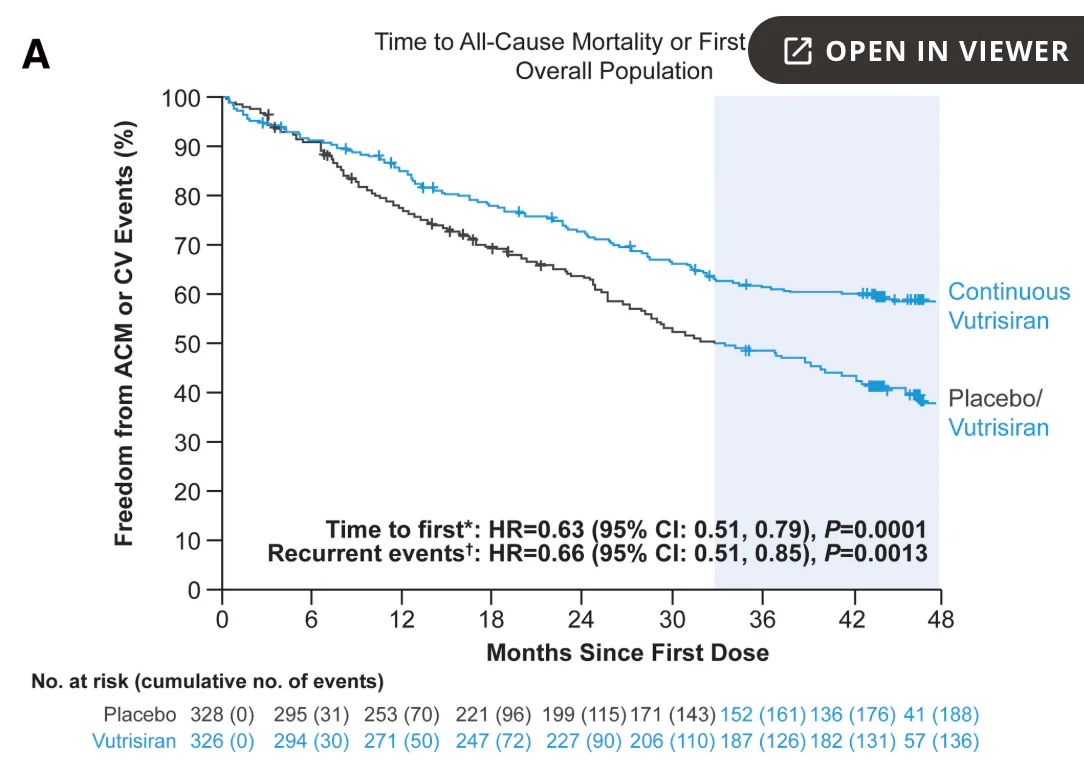
Vutrisiran showed a 37% reduction in all-cause mortality and cardiovascular events through 48 months in patients with TTR amyloidosis with cardiomyopathy.
Continuous vutrisiran treatment preserved functional status and quality of life as assessed by Kansas City Cardiomyopathy Questionnaire and NYHA class.
Cardiac biomarkers NT-proBNP and troponin I remained stable or improved with long-term vutrisiran treatment compared to delayed initiation.
The safety profile remains consistent without new signals, supporting vutrisiran’s long-term use in this patient population.
Study Background
Transthyretin (TTR) amyloidosis is a progressive, life-threatening systemic disease caused by the deposition of misfolded transthyretin protein fibrils in tissues, notably the myocardium, leading to cardiomyopathy. This infiltrative cardiomyopathy results in restrictive heart failure, arrhythmias, and increased mortality. Historically, treatment options have been limited and primarily palliative. Vutrisiran, a small interfering RNA (siRNA), targets hepatic TTR synthesis, reducing both wild-type and variant TTR, thus mitigating amyloid deposition and disease progression. Prior randomized controlled trials demonstrated vutrisiran’s efficacy over approximately three years. The HELIOS-B study evaluated the effects of vutrisiran versus placebo in patients with TTR amyloidosis cardiomyopathy, and this report details the 1-year open-label extension results, reflecting long-term efficacy and safety profiles up to 48 months.
Study Design
HELIOS-B was a multicenter, randomized, double-blind, placebo-controlled study enrolling 654 patients with transthyretin amyloidosis cardiomyopathy (vutrisiran n=326, placebo n=328). After 33-36 months of blinded treatment assessing mortality, cardiovascular outcomes, functional status, quality of life, and cardiac biomarkers, 478 patients completed the double-blind phase. Of these, 466 patients enrolled in an ongoing open-label extension to continue vutrisiran 25 mg subcutaneously every three months. Participants were divided into two cohorts for this phase: continuous vutrisiran (initially on vutrisiran) and placebo/vutrisiran (initially on placebo who subsequently initiated vutrisiran). Prespecified endpoints included a composite of all-cause mortality (ACM) and cardiovascular events, ACM alone, Kansas City Cardiomyopathy Questionnaire Overall Summary (KCCQ-OS) score, New York Heart Association (NYHA) functional class, and cardiac biomarkers NT-proBNP and troponin I. Efficacy and safety were assessed through month 48 from initial randomization.
Key Findings
The extended follow-up yielded continued and consistent benefits with vutrisiran treatment:
Mortality and Cardiovascular Events: The continuous vutrisiran group exhibited a 37% relative risk reduction in the composite endpoint of first cardiovascular event or ACM compared to the placebo/vutrisiran group (Hazard Ratio [HR] 0.63; 95% Confidence Interval [CI], 0.51 to 0.79; P=0.0001). Similarly, ACM alone was reduced by 37% (HR 0.63; 95% CI, 0.46 to 0.84; P=0.0023). These findings emphasize the durable survival advantage of early and sustained vutrisiran therapy.
Functional Status and Quality of Life: At month 48, patients continuously treated with vutrisiran demonstrated significant preservation of health status measured by the KCCQ-OS score with a least squares mean difference of +9.0 points (95% CI, 5.3 to 12.6; P<0.0001) versus those who started vutrisiran after placebo. Moreover, NYHA functional class was improved or stabilized in a higher proportion of patients receiving continuous treatment (Odds Ratio 1.6; 95% CI, 1.1 to 2.2; P=0.0084), indicating sustained clinical functional benefits.
Cardiac Biomarkers: NT-proBNP and troponin I, established biomarkers of cardiac stress and injury, declined or were maintained at lower levels in the continuous vutrisiran cohort compared to delayed treatment. Adjusted geometric mean ratios were 0.66 (95% CI, 0.58 to 0.74; P<0.0001) for NT-proBNP and 0.71 (95% CI, 0.64 to 0.79; P<0.0001) for troponin I, correlating with better myocardial status.
Safety: Over the 48-month period, vutrisiran’s safety profile remained consistent with no new safety concerns. The tolerability was favorable, supporting long-term administration. Common adverse events were consistent with previous experience and manageable.
Expert Commentary
The HELIOS-B open-label extension underscores the clinical value of vutrisiran in modifying the natural history of transthyretin amyloid cardiomyopathy. The substantial reduction in mortality and adverse cardiovascular events highlights the importance of early diagnosis and initiation of targeted therapy. Unlike supportive care alone, vutrisiran addresses the pathogenic substrate by decreasing circulating TTR protein, thereby slowing amyloid fibril formation and myocardial infiltration. The sustained improvements in functional status and patient-reported quality of life reinforce the translational relevance of biomarker changes.
While the open-label phase has inherent limitations such as absence of a placebo control, the consistency of benefits and biomarker data strongly advocates for continued use. Future studies could elucidate long-term organ-specific outcomes and economic considerations in broader populations. The inclusion of both variant and wild-type TTR amyloidosis patients supports generalizability. Clinicians should prioritize early evaluation of patients with cardiomyopathy compatible with amyloid infiltration to optimize outcomes with vutrisiran.
Conclusion
Long-term vutrisiran therapy confers enduring clinical benefits in patients with transthyretin amyloidosis cardiomyopathy. This includes significant reductions in all-cause mortality and cardiovascular events, stabilization or improvement in cardiac biomarkers, functional capacity, and quality of life measures. The data reinforce the paradigm that early intervention in TTR amyloidosis is critical to maximize patient outcomes. With an established favorable safety profile, vutrisiran represents a promising disease-modifying option for this challenging, progressive cardiomyopathy.
Funding and ClinicalTrials.gov
The HELIOS-B trial and its extension were funded by Alnylam Pharmaceuticals, the manufacturer of vutrisiran. The study is registered at ClinicalTrials.gov under NCT04153149.
References
1. Garcia-Pavia P, Witteles R, Morbach C, et al. Long-Term Impact of Vutrisiran in Patients With TTR Amyloidosis With Cardiomyopathy: 1-Year Efficacy and Safety Outcomes From the HELIOS-B Open-Label Extension. Circulation. 2026 Nov 3; PMID: 42974684.
2. Maurer MS, Elliott P, Merlini G, et al. Design and rationale of the HELIOS-B study: a randomized, double-blind, placebo-controlled, multicenter study evaluating vutrisiran in patients with transthyretin amyloidosis with cardiomyopathy. Am Heart J. 2023; DOI: 10.1016/j.ahj.2023.03.001.
3. Ruberg FL, Maurer MS. Transthyretin Amyloid Cardiomyopathy: A Treatable Cause of Heart Failure With Preserved Ejection Fraction. Circulation. 2019;140:1760-1762.