Long-Term Benefits of Quantitative Flow Ratio-Guided PCI: Insights from the 5-Year FAVOR III China Trial
Highlight
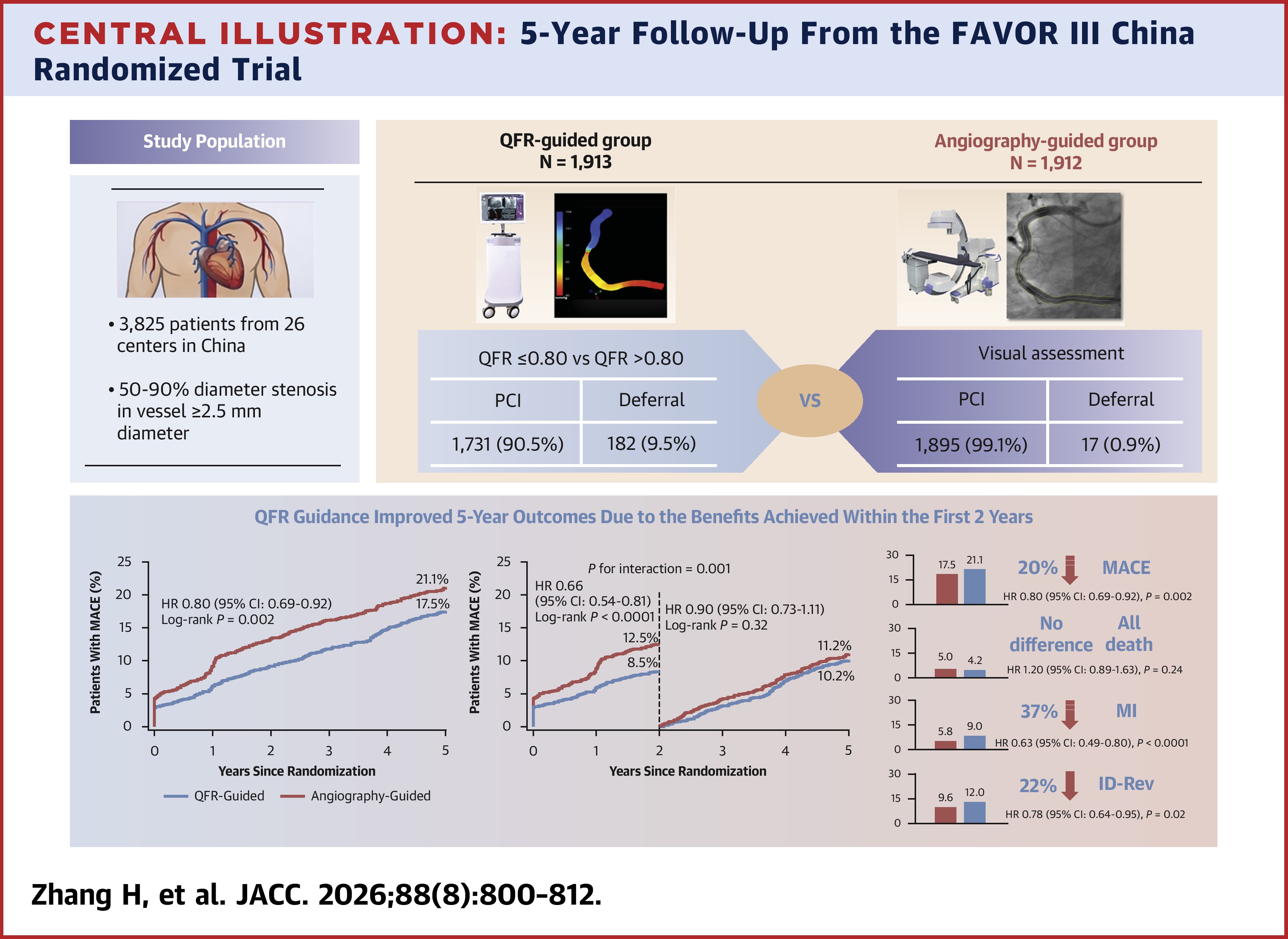
The FAVOR III China randomized trial reveals that angiographic Quantitative Flow Ratio (QFR)-guided PCI provides sustained clinical benefits over 5 years compared with angiography-guided strategies, notably lowering myocardial infarction and ischemia-driven revascularization with no increase in mortality.
Study Background
Coronary artery disease (CAD) remains a leading cause of morbidity and mortality worldwide, and the optimization of revascularization strategies is critical to improving clinical outcomes. Percutaneous coronary intervention (PCI) guided by angiography alone is limited in its ability to predict functional significance of coronary lesions, potentially leading to unnecessary interventions or missed ischemic lesions. The Quantitative Flow Ratio (QFR) is an emerging tool that utilizes angiographic images to non-invasively assess the physiological impact of coronary stenosis without the need for pressure wires or hyperemic agents. Prior studies, including the FAVOR III China trial, have demonstrated that QFR-guided PCI can improve short-term outcomes at 1 and 2 years. However, the durability and long-term clinical effectiveness of this strategy required further evaluation.
Study Design
The FAVOR III China study was a multicenter, randomized, sham-controlled clinical trial enrolling patients with at least one angiographically intermediate lesion (50% to 90% stenosis) in vessels ≥2.5 mm. Participants were randomized to undergo PCI guided either by QFR (with PCI performed only if QFR ≤ 0.80, indicating physiologically significant stenosis) or conventional angiography alone. The primary composite endpoint was major adverse cardiac events (MACE), defined as all-cause death, myocardial infarction (MI), or ischemia-driven revascularization, initially reported at 1 year. The current analysis reports 5-year outcomes to address the longevity of clinical benefits following QFR-guided PCI.
Key Findings
At 5 years, patients randomized to the QFR-guided strategy experienced significantly lower rates of MACE compared to those guided by angiography alone (17.5% vs 21.1%; hazard ratio [HR] 0.80; 95% confidence interval [CI] 0.69–0.92; P = 0.002). This reduction was primarily driven by a markedly lower incidence of myocardial infarction (5.8% vs 9.0%; HR 0.63; 95% CI 0.49–0.80; P < 0.0001) and ischemia-driven revascularization (9.6% vs 12.0%; HR 0.78; 95% CI 0.64–0.95; P = 0.02) among the QFR-guided group. Notably, all-cause mortality did not differ significantly between groups (P > 0.05).
A landmark analysis separating early and late events revealed that the majority of the benefit occurred within the first 2 years post-randomization (MACE: 8.5% vs 12.5%; HR 0.66; 95% CI 0.54–0.81; P < 0.0001). Beyond 2 years, the difference in outcome between groups was not statistically significant (MACE: 10.2% vs 11.2%; HR 0.90; 95% CI 0.73–1.11; P = 0.32), indicating that early intervention guided by QFR confers an upfront reduction in ischemic events that is sustained over longer-term follow-up.
Expert Commentary
The FAVOR III China trial confirms that physiological rather than purely anatomical assessment of coronary stenosis better informs PCI decision-making and leads to improved clinical outcomes. QFR, as a non-invasive and wire-free alternative to fractional flow reserve (FFR), simplifies implementation in routine practice while preserving prognostic benefits. These findings align with existing evidence suggesting that functional guidance reduces unnecessary stenting and procedural complications.
However, it is important to consider study limitations including the exclusive inclusion of Chinese patients, which may affect generalizability to wider populations. The angiography-guided group reflects current standard care but may vary internationally depending on institutional protocols. Reassuringly, QFR guidance did not increase all-cause mortality, alleviating concerns about undertreatment of borderline lesions.
Mechanistically, QFR likely improves outcomes by accurately identifying lesions causing ischemia and thereby targeting PCI to patients most likely to benefit, which reduces recurrent ischemic events and the need for repeat procedures. Given the plateau of benefit after 2 years, future research might explore complementary strategies for late event prevention.
Conclusion
The 5-year data from the FAVOR III China trial demonstrates that QFR-guided PCI is superior to angiography-guided PCI in reducing major adverse cardiac events, especially myocardial infarction and ischemia-driven revascularization, with benefits evident mainly in the first two years after intervention. This evidence supports wider adoption of QFR-based physiological assessment in CAD management to optimize patient outcomes and resource utilization. Further studies may expand on long-term mechanisms and applicability across diverse populations.
Funding and ClinicalTrials.gov
The FAVOR III China trial was supported by multiple academic and governmental research grants in China. The study is registered under ClinicalTrials.gov identifier NCT03656848.
References
1. Zhang H, Guan C, Jin Z, et al. Angiographic Quantitative Flow Ratio-Guided Coronary Intervention: 5-Year Follow-Up From the FAVOR III China Randomized Trial. J Am Coll Cardiol. 2026;88(8):800-812. PMID: 42268156.
2. Tonino PA, De Bruyne B, Pijls NH, et al. Fractional flow reserve versus angiography for guiding percutaneous coronary intervention. N Engl J Med. 2009;360(3):213-224.
3. Xu B, Tu S, Qiao S, et al. Diagnostic Accuracy of Fast Computational Approaches to Derive Fractional Flow Reserve From Coronary Angiography. JACC Cardiovasc Interv. 2017;10(10):1041-1051.
4. Pijls NH, Fearon WF. Fractional flow reserve: a review. Heart. 2011;97(22):187-190.
5. Kirtane AJ, Orlov NV, Ben-Yehuda O, et al. Physiologic Assessment of Coronary Artery Disease in the Catheterization Laboratory. Circulation. 2020;141(14):1150-1162.
This article was created using several editorial tools, including AI, as part of the process. Human editors reviewed this content before publication.