We use cookies

Our website uses essential cookies and, with your consent, additional cookies to measure performance and improve our services. Cookie Policy.

You can change your choice at any time.

MMedXYNews
HomeVideos
MedXY AI/MedXY News/Section: Cardiology

Stent Retriever Thrombectomy Reduces Infarct Size in High-Thrombus Myocardial Infarction: Insights from the NATURE Trial
MedXY Editorial Team•Sep 6, 2026•Cardiology
Infarct SizeStent Retriever ThrombectomyPercutaneous Coronary Interventionmyocardial infarction

Highlight

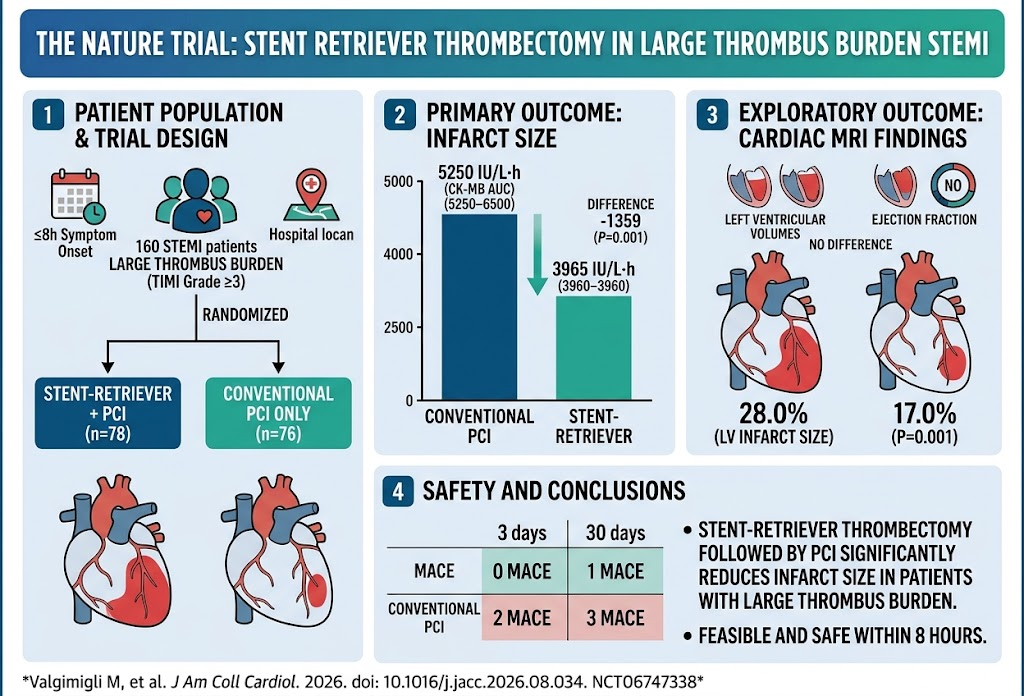
  • Stent retriever thrombectomy adjunctive to PCI significantly lowers infarct size in STEMI patients with large thrombus burden compared to conventional PCI alone.
  • The trial showed a meaningful reduction in creatine kinase-MB area under the curve (CK-MB AUC), a biochemical marker of myocardial injury.
  • Exploratory cardiac MRI corroborated reduced infarct size with thrombectomy, with no significant differences in left ventricular volumes or ejection fraction at early follow-up.
  • Major adverse cardiovascular events (MACE) were low and comparable between groups, affirming the safety of the thrombectomy approach.

Study Background

MedXY registered readers

Sign in free to continue reading

Create or use your MedXY account to unlock the complete article.

This article was created using several editorial tools, including AI, as part of the process. Human editors reviewed this content before publication.

Related articles

Open language-specific specialty feeds and department pages.

Intracoronary Imaging-Guided PCI: Updated Meta-Analysis Validates Cardiovascular Outcome BenefitsThis updated meta-analysis of 28 RCTs reveals significant reductions in cardiovascular events and mortality with intracoronary imaging-guided PCI versus angiography-guided PCI, highlighting the importance of lesion and geographic factors inSep 19, 2026Targeting the CCND1-PDK4 Axis to Promote Reparative Macrophage Phenotype and Mitigate Post-Myocardial Infarction Cardiac RemodelingThis article discusses the role of cyclin D1 (CCND1) in promoting reparative macrophage transition post-myocardial infarction, highlighting its therapeutic potential in reducing adverse cardiac remodeling through metabolic reprogramming.Sep 19, 2026Geographic Variability in Outcomes of IVUS-Guided Versus Angiography-Guided PCI: Insights from a Meta-Analysis of Randomized TrialsThis meta-analysis reveals significant geographic differences in the benefits of intravascular ultrasound (IVUS)-guided percutaneous coronary intervention (PCI), with East Asian populations showing marked reductions in cardiac death and advSep 15, 2026
Loading comments...
MedXY briefing

Get the free newsletter

Evidence-led clinical news, trends, and analysis—delivered to your inbox.

Ask MedXY AI

Most popular

Intimate Health
Five Benefits for Women Continuing Sexual Activity After Menopause
Intimate Health
Why Some Women Have a Strong Sex Drive—And Why Men Shouldn't Worry About It
Nursing & care
How often should a couple have sex?
Intimate Health
Classic Intimacy Recommendations: How to Help Women Reach Orgasm and Enjoy Mutual Pleasure
Intimate Health
What Makes a Woman "Physiologically Addicted" Is Never Money, But These Two Relationship Qualities
© 2026 MedXY
Contact usAbout usPrivacy PolicyMedXY story
Evaluating Targeted Vitamin D Supplementation Post-Myocardial Infarction: Insights from the TARGET-D Trial
The TARGET-D trial investigated whether vitamin D supplementation, titrated to achieve serum levels >40-80 ng/mL, reduces major adverse cardiovascular events after myocardial infarction but found no significant benefit in the primary com
Sep 17, 2026
Comparing 0/1-Hour vs 0/3-Hour High-Sensitivity Troponin Pathways for Suspected Acute Coronary Syndrome in Real-World PracticeThis randomized trial evaluates the safety and efficiency of the ESC 0/1-hour versus 0/3-hour high-sensitivity troponin pathways in suspected acute coronary syndrome, showing noninferior safety but no significant improvement in rapid dischaSep 17, 2026
Long-Term Benefits of Quantitative Flow Ratio-Guided PCI: Insights from the 5-Year FAVOR III China TrialThe FAVOR III China trial demonstrates that QFR-guided percutaneous coronary intervention significantly reduces major adverse cardiac events over 5 years, mainly by decreasing myocardial infarction and ischemia-driven revascularization compSep 11, 2026