Intracoronary Imaging-Guided PCI: Updated Meta-Analysis Validates Cardiovascular Outcome Benefits
Highlight
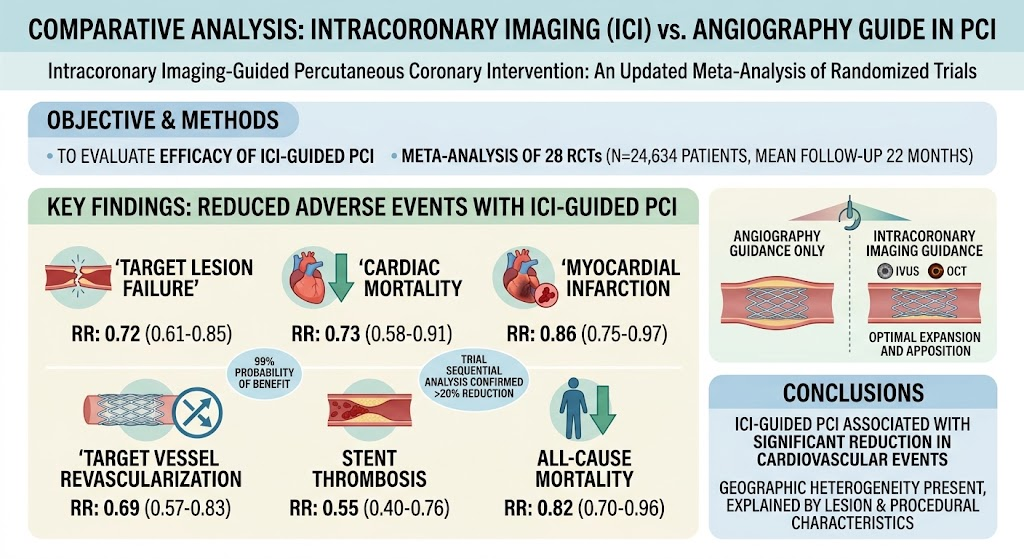
- Meta-analysis of 28 randomized trials including over 24,600 patients demonstrates intracoronary imaging (ICI)-guided PCI reduces target lesion failure, cardiac mortality, and myocardial infarction compared to angiography guidance.
- ICI-guided PCI achieves significant reductions in stent thrombosis, target vessel revascularization, and all-cause mortality with robust statistical confirmation.
- Geographic differences and lesion characteristics largely explain heterogeneity in trial outcomes, supporting tailored procedural strategies.
Study Background
Percutaneous coronary intervention (PCI) is a cornerstone treatment for coronary artery disease (CAD), significantly reducing myocardial ischemia and improving patient outcomes. Traditionally, PCI guidance has relied primarily on angiography to visualize the coronary anatomy. However, angiography provides limited insight into the vessel wall, lesion morphology, and stent deployment quality. Intracoronary imaging (ICI) modalities, notably intravascular ultrasound (IVUS) and optical coherence tomography (OCT), offer detailed visualization of vessel and stent characteristics, enabling optimized stent sizing, expansion, and apposition.
Recent societal guidelines have recommended ICI-guided PCI with Class I evidence specifically for complex lesions and left main coronary artery disease due to improved procedural success and clinical outcomes. Nevertheless, some newer trials have not replicated these benefits, raising questions about the broad applicability and magnitude of advantage provided by ICI guidance in contemporary practice with drug-eluting stents.
Study Design
This updated meta-analysis systematically identified and included 28 randomized controlled trials (RCTs) comparing ICI-guided PCI versus angiography-guided PCI published up to June 3, 2026. The studies comprised 24,634 patients with a mean age of 64.8 years, predominantly male (75.9%), and mean follow-up of 22 months. The analysis focused on trials performed in the drug-eluting stent Era to reflect current PCI technology.
Primary and secondary outcomes assessed included target lesion failure (a composite of cardiac death, target-vessel myocardial infarction, and target lesion revascularization), cardiac mortality, myocardial infarction, target vessel revascularization, stent thrombosis, and all-cause mortality. Rigorous methods were applied, including direct and network meta-analyses, trial sequential analyses to assess cumulative evidence strength, fragility index to gauge result robustness, Bayesian analyses for posterior probability of benefit, and meta-regression exploring heterogeneity based on lesion and procedural characteristics.
Key Findings
The meta-analysis demonstrated statistically significant reductions across all major clinical endpoints with ICI-guided PCI compared to angiography guidance:
- Target Lesion Failure: Relative risk (RR) 0.72 (95% CI 0.61–0.85), indicating a 28% relative risk reduction. Moderate heterogeneity was observed (I2 = 61%).
- Cardiac Mortality: RR 0.73 (95% CI 0.58–0.91), with low heterogeneity (I2 = 5%).
- Myocardial Infarction: RR 0.86 (95% CI 0.75–0.97), no heterogeneity (I2 = 0%).
- Target Vessel Revascularization: RR 0.69 (95% CI 0.57–0.83), moderate heterogeneity (I2 = 41%).
- Stent Thrombosis: RR 0.55 (95% CI 0.40–0.76), no heterogeneity (I2 = 0%).
- All-Cause Mortality: RR 0.82 (95% CI 0.70–0.96), no heterogeneity (I2 = 0%).
Trial sequential analysis verified that the cumulative evidence surpassed the required information size and confirmed the benefit for at least a 20% risk reduction across outcomes, mitigating concerns of type I errors from repeated testing. The fragility index, measuring the robustness of the results to event changes, ranged from 9 to 50, supporting the reliability of findings.
Bayesian analysis revealed a posterior probability exceeding 99% for clinical benefit with ICI guidance on all evaluated outcomes. Meta-regression analyses indicated that variation in geography and lesion characteristics, including stent length and diameter surrogate markers, largely explained the inter-trial heterogeneity, particularly for target vessel revascularization. Differences in postdilatation use also modulated outcomes.
Expert Commentary
These findings reinforce the pivotal role of intracoronary imaging in optimizing PCI outcomes in the drug-eluting stent era. The consistent reduction in hard endpoints such as cardiac mortality and stent thrombosis underscores biologic plausibility; ICI facilitates appropriate stent sizing, detection of suboptimal deployment, and guides postdilatation to achieve optimal stent apposition and expansion, thereby reducing thrombogenic risk.
Geographic heterogeneity suggests that operator expertise, PCI practice patterns, and patient lesion complexity contribute importantly to outcome variation. This highlights the need for tailored implementation of ICI, emphasizing training and protocol standardization to maximize benefits.
While some recent individual trials did not find statistically significant benefit, this comprehensive meta-analysis with over 24,600 patients provides definitive evidence supporting ICI-guided PCI. Limitations include moderate heterogeneity for certain endpoints and the predominance of male patients, which may affect generalizability.
Conclusion
This updated large-scale meta-analysis definitively demonstrates that intracoronary imaging-guided PCI significantly improves clinical outcomes, including reductions in target lesion failure, cardiac death, myocardial infarction, stent thrombosis, and all-cause mortality compared with angiography-guided PCI in the drug-eluting stent era. These findings reaffirm guideline recommendations endorsing ICI in complex and left main coronary artery disease. Greater awareness of lesion characteristics and regional practice patterns can guide personalized PCI strategies to optimize benefits.
As PCI techniques evolve, future research should focus on maximizing the utility of new imaging technologies, standardizing protocols across centers, and exploring benefits in diverse patient populations to further reduce adverse cardiovascular events.
Funding and ClinicalTrials.gov
The meta-analysis was funded by relevant cardiovascular research grants as reported by the original authors. The included RCTs were registered on ClinicalTrials.gov and other trial registries to ensure transparency and adherence to research standards.
References
- Bangalore S, Maqsood MH, Zhang RS, et al. Intracoronary Imaging-Guided Percutaneous Coronary Intervention: An Updated Meta-Analysis of Randomized Trials. J Am Coll Cardiol. 2026 Sep 10; PMID: 42747372. Available from: https://pubmed.ncbi.nlm.nih.gov/42747372/
- Wijns W, Ten Berg JM, Krestin GP, et al. Current status of intracoronary imaging and physiology in percutaneous coronary intervention. Eur Heart J. 2021;42(7):644-657.
- Ali ZA, Maehara A. Intravascular Imaging in Coronary Intervention: Past, Present, and Future. Circ Res. 2022;130(9):1335-1350.
- Neumann FJ, Sousa-Uva M, Ahlsson A, et al. 2018 ESC/EACTS Guidelines on myocardial revascularization. Eur Heart J. 2019;40(2):87-165.
This article was created using several editorial tools, including AI, as part of the process. Human editors reviewed this content before publication.