Levothyroxine in Pregnancy for Subclinical Hypothyroidism or Hypothyroxinemia: No Benefit on Child IQ
Levothyroxine treatment for subclinical hypothyroidism or hypothyroxinemia during pregnancy did not significantly improve child IQ at 5 years of age compared with placebo.
The median IQ was 97 vs. 94 in the subclinical hypothyroidism trial and 94 vs. 91 in the hypothyroxinemia trial, both non-significant.
No differences were seen in other neurocognitive or pregnancy outcomes, and adverse events were low in both groups.
These findings indicate that routine screening and treatment for these conditions may not be warranted.
Study Snapshot
Design: Two parallel, randomized, double-blind, placebo-controlled trials nested in a screening study.
Population: 677 women with subclinical hypothyroidism and 526 with hypothyroxinemia, singleton pregnancy before 20 weeks.
Intervention: Levothyroxine (dose adjusted to normalize thyroid tests) or placebo, with sham adjustments.
Primary Outcome: Child IQ score at 5 years (or 3 years if missing) or death before age 3.
Key Result: No significant difference in IQ; median IQ 97 vs 94 (P=0.71) for subclinical hypothyroidism; 94 vs 91 (P=0.30) for hypothyroxinemia.
Funding: Eunice Kennedy Shriver National Institute of Child Health and Human Development and National Institute of Neurological Disorders and Stroke.
Registration: ClinicalTrials.gov NCT00388297.
Clinical context
Subclinical thyroid disease is relatively common during pregnancy, affecting 2–5% of women. Observational studies have linked both subclinical hypothyroidism (elevated thyrotropin with normal free thyroxine) and hypothyroxinemia (normal thyrotropin with low free thyroxine) to adverse neurodevelopmental outcomes in children, including lower IQ. However, whether treatment with levothyroxine can improve these outcomes has been uncertain. The National Institute of Child Health and Human Development Maternal–Fetal Medicine Units Network conducted two parallel randomized trials to answer this question.
Trial design
The trials were conducted at 15 U.S. centers. Women with a singleton pregnancy were screened before 20 weeks’ gestation. Subclinical hypothyroidism was defined as a thyrotropin level ≥4.00 mU/L and normal free T4 (0.86–1.90 ng/dL). Hypothyroxinemia was defined as normal thyrotropin (0.08–3.99 mU/L) and free T4 <0.86 ng/dL. Eligible participants were randomly assigned to receive levothyroxine or placebo. Thyroid function was monitored monthly, and doses were adjusted (or sham-adjusted) to achieve normal thyrotropin or free T4 levels. Children underwent annual developmental testing for 5 years.
Primary outcome
The primary outcome was the child’s full-scale IQ score at 5 years of age (or at 3 years if the 5-year test was missing) or death before age 3. In the subclinical hypothyroidism trial, the median IQ was 97 (95% CI, 94–99) in the levothyroxine group and 94 (95% CI, 92–96) in the placebo group (P=0.71). In the hypothyroxinemia trial, the median IQ was 94 (95% CI, 91–95) in the levothyroxine group and 91 (95% CI, 89–93) in the placebo group (P=0.30). The differences were neither statistically significant nor clinically meaningful. IQ scores were missing for 4% of children in each trial, primarily due to withdrawal or loss to follow-up.
Secondary outcomes and safety
No significant between-group differences emerged in any prespecified secondary neurocognitive outcomes, including language, memory, attention, and behavioral scores. Pregnancy outcomes, such as preterm birth, preeclampsia, and cesarean delivery, were also similar between groups. Adverse events were uncommon and did not differ. No safety signal from levothyroxine was identified.
Maternal thyroid function
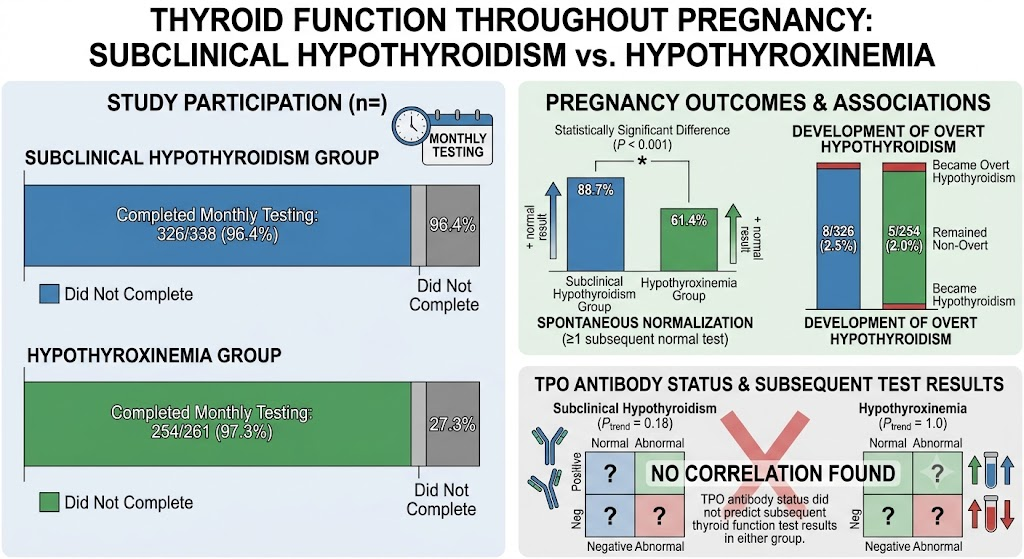
As expected, levothyroxine normalized thyroid hormone levels in treated women. A secondary analysis (Theilen et al., 2026) examined longitudinal thyroid function throughout pregnancy in the same cohort, confirming that the treatment protocol achieved biochemical correction, yet this did not translate into child cognitive benefit.
Interpretation and limitations
These results strongly suggest that routine screening and treatment for subclinical hypothyroidism or hypothyroxinemia in pregnancy, as defined in this study, does not improve child cognitive outcomes. The trials were well-powered, masked, and controlled, with high follow-up rates. Limitations include the initiation of treatment at a mean of 16–18 weeks, which may miss a critical earlier window; the use of a single IQ measure as primary outcome; and a generally healthy, iodine-replete population, which may not reflect settings with endemic iodine deficiency. The findings do not support universal thyroid screening in pregnancy but do not rule out potential benefit for women with more severe or earlier thyroid dysfunction.
Funding and references
The study was funded by the Eunice Kennedy Shriver National Institute of Child Health and Human Development and the National Institute of Neurological Disorders and Stroke. ClinicalTrials.gov registration: NCT00388297.
References
Casey BM, Thom EA, Peaceman AM, et al. Treatment of Subclinical Hypothyroidism or Hypothyroxinemia in Pregnancy. N Engl J Med. 2017;376(9):815-825. doi:10.1056/NEJMoa1606205. PMID: 28249134.
Theilen LH, Mele L, Peaceman AM, et al. Thyroid Function Throughout Pregnancy in Women With Subclinical Hypothyroidism or Hypothyroxinemia. Obstet Gynecol. 2026 Jul 27. doi:10.1097/AOG.0000000000006373. PMID: 42492995.
This article was created using several editorial tools, including AI, as part of the process. Human editors reviewed this content before publication.