We use cookies

Our website uses essential cookies and, with your consent, additional cookies to measure performance and improve our services. Cookie Policy.

You can change your choice at any time.

MMedXYNews
HomeVideos
MedXY AI/MedXY News/Section: Clinical Updates

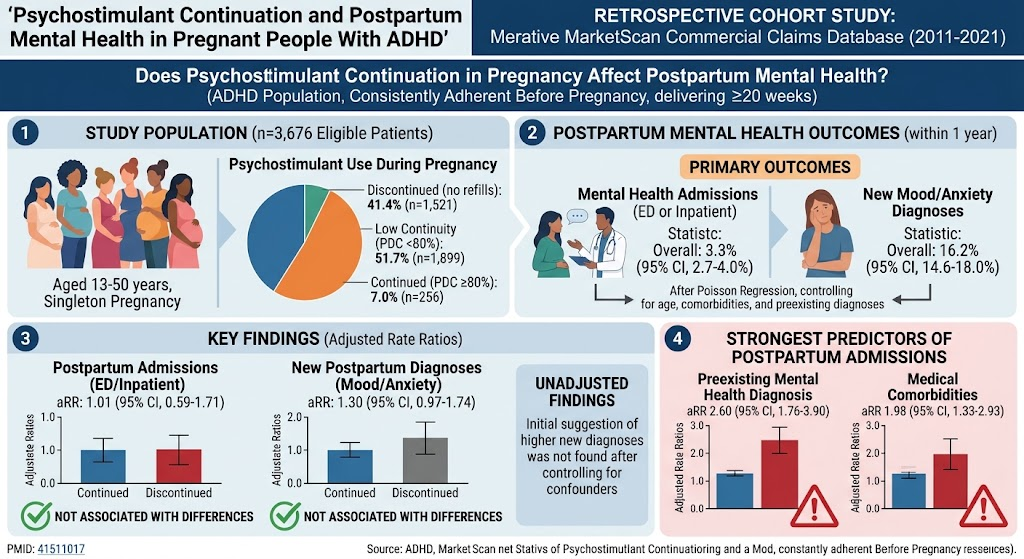
Psychostimulant Continuation and Postpartum Mental Health in Pregnant People With Attention-Deficit/Hyperactivity Disorder: A Clinical Evidence Review
MedXY Editorial Team•Sep 9, 2026•Clinical Updates
postpartum mental healthPregnancyADHD

Highlights

  • Continuation of psychostimulant medication during pregnancy in patients with ADHD does not increase risk of postpartum mental health admissions or new mood/anxiety disorders after adjusting for confounders.
  • Preexisting mental health diagnoses and medical comorbidities strongly predict adverse postpartum mental health outcomes, overshadowing psychostimulant use impacts.
  • This evidence alleviates concerns about psychostimulant discontinuation-associated postpartum mental health deteriorations in adherent pregnant people with ADHD.

Background

MedXY registered readers

Sign in free to continue reading

Create or use your MedXY account to unlock the complete article.

This article was created using several editorial tools, including AI, as part of the process. Human editors reviewed this content before publication.

Related articles

Open language-specific specialty feeds and department pages.

Understanding HPA-1a Alloimmunisation in Pregnancy: Insights from a Multi-Ethnic Prospective StudyThis study reveals the population prevalence and incident risk of HPA-1a alloimmunisation in pregnancy across diverse ethnic groups, highlighting its rarity and establishing a framework for risk assessment in foetal-neonatal alloimmune throSep 17, 2026Antiseizure Medication Use During Pregnancy: Implications for Fetal Growth from the EURAP RegistryA comprehensive cohort study from the EURAP registry reveals that antiseizure medication, especially polytherapy and certain monotherapies, increases the risk of poor fetal growth, underscoring the need for optimized treatment strategies duSep 5, 2026Balancing Maternal Mental Health and Fetal Safety: Insights on Depression and SSRI Use During PregnancyThis article reviews the complex interplay between major depressive disorder during pregnancy and selective serotonin reuptake inhibitor treatment, highlighting the importance of prioritizing maternal mental health to optimize outcomes forAug 18, 2026
Loading comments...
MedXY briefing

Get the free newsletter

Evidence-led clinical news, trends, and analysis—delivered to your inbox.

Ask MedXY AI

Most popular

Intimate Health
Five Benefits for Women Continuing Sexual Activity After Menopause
Intimate Health
Why Some Women Have a Strong Sex Drive—And Why Men Shouldn't Worry About It
Nursing & care
How often should a couple have sex?
Intimate Health
Classic Intimacy Recommendations: How to Help Women Reach Orgasm and Enjoy Mutual Pleasure
Intimate Health
What Makes a Woman "Physiologically Addicted" Is Never Money, But These Two Relationship Qualities
© 2026 MedXY
Contact usAbout usPrivacy PolicyMedXY story
Impact of Texas Abortion Ban on Critical Illness in Hospitalized Pregnant Women: A Retrospective Cohort Analysis
The Texas Senate Bill 8 abortion ban is linked to an increased rate of critical illness, sepsis, and infections among hospitalized pregnant women with high-risk features, highlighting significant implications for maternal healthcare in rest
Aug 18, 2026
Exploring the Impact of Multiple Pregnancies on Subclinical Left Ventricular Function in Healthy WomenThis study reveals that higher parity is associated with subtle reductions in myocardial strain during pregnancy, suggesting cumulative cardiovascular effects despite normal ejection fraction.Aug 18, 2026
Antidepressant Continuation During Pregnancy and Its Impact on Postpartum Depression Risk Across Diverse PopulationsContinuing antidepressants in pregnancy lowers postpartum depression risk irrespective of race or ethnicity; prenatal depressive symptoms severity is critical for personalized treatment.Aug 4, 2026