MMedXYNews
HomeVideos
MedXY AI/MedXY News/Section: Dermatology

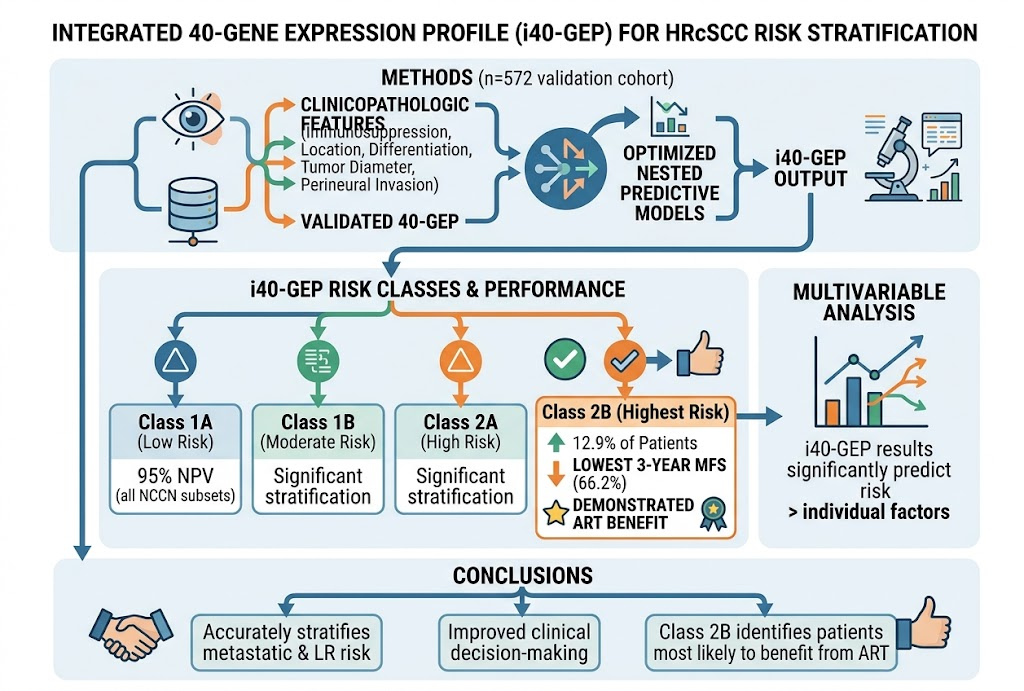
Integrated 40-Gene Expression Profile Enhances Prognostic Precision and Guides Adjuvant Radiation in High-Risk Cutaneous Squamous Cell Carcinoma

MedXY Editorial Team•Aug 26, 2026•Dermatology
risk stratificationadjuvant radiation therapygene expression profilecutaneous squamous-cell carcinoma
Highlight

  • The integrated 40-gene expression profile (i40-GEP) combines tumor biology with clinicopathologic features to improve prognostic accuracy in high-risk cutaneous squamous cell carcinoma (HRcSCC).
  • i40-GEP categorizes patients into four risk classes, identifying those at highest risk (Class 2B) with significantly poorer 3-year metastasis-free survival.
  • Class 2B patients demonstrate a clear benefit from adjuvant radiation therapy (ART), supporting more personalized treatment approaches.
  • i40-GEP outperforms individual clinicopathologic factors in predicting metastasis and local recurrence, enabling improved clinical decision-making.

Study Background

MedXY registered readers

Sign in free to continue reading

Create or use your MedXY account to unlock the complete article.

This article was created using several editorial tools, including AI, as part of the process. Human editors reviewed this content before publication.

Related articles

Open language-specific specialty feeds and department pages.

Genotype and Arrhythmic Risk in Dilated Cardiomyopathy: An Integrative Review of Genetic Stratification and Clinical ImplicationsGenetic variants in dilated cardiomyopathy confer differential arrhythmic risks, independent of traditional clinical parameters. Integrating recent registry data and molecular studies enhances risk stratification and informs tailored manageOct 22, 2026Neutrophil-to-Lymphocyte Ratio as a Prognostic Biomarker in High-Risk Cutaneous Squamous Cell CarcinomaPreoperative neutrophil-to-lymphocyte ratio (NLR) predicts poor outcomes in high-risk cutaneous squamous cell carcinoma, offering a cost-effective tool to enhance risk stratification.Oct 21, 2026Adoption of Outpatient Management of Acute Low-Risk Pulmonary Embolism: Evidence, Implementation, and Future DirectionsThis review synthesizes evidence supporting outpatient management of acute low-risk pulmonary embolism (PE), highlighting risk stratification tools, safety outcomes, and implementation strategies to enhance adoption in clinical practice.Oct 20, 2026
Loading comments...
MedXY briefing

Get the free newsletter

Evidence-led clinical news, trends, and analysis—delivered to your inbox.

Ask MedXY AI

Most popular

Intimate Health
Five Benefits for Women Continuing Sexual Activity After Menopause
Intimate Health
Why Some Women Have a Strong Sex Drive—And Why Men Shouldn't Worry About It
Nursing & care
How often should a couple have sex?
Cardiology
Precision Medicine for Long QT Syndrome Type 2: Lumacaftor Corrects Trafficking Defects and Shortens QT Interval
General Surgery
Optimizing Postoperative Opioid Prescriptions After Intra-Abdominal Cancer Surgery: Comparing the 5x-Multiplier and 3-Tier Models
© 2026 MedXY
Contact usAbout usPrivacy PolicyMedXY story
COMPASS-SCC: A Novel Prognostic and Staging System Enhancing Risk Stratification in Cutaneous Squamous Cell Carcinoma
The COMPASS-SCC, developed from a large international cohort, offers improved prognostic accuracy for cutaneous squamous cell carcinoma compared to existing AJCC8 and BWH staging systems, aiding clinical decision-making for metastasis and m
Oct 17, 2026
Refining Prognostication in Advanced Mycosis Fungoides and Sézary Syndrome: The Role of the Cutaneous Lymphoma International Prognostic Index (CLIPI)The Cutaneous Lymphoma International Prognostic Index (CLIPI) enhances risk stratification and predicts progression and treatment response beyond conventional staging in advanced mycosis fungoides and Sézary syndrome.Oct 14, 2026
Enhanced Risk Stratification for Pediatric Tracheostomy Hospitalizations: Evaluating a Novel Tracheostomy-Specific Tier SystemA new tracheostomy-specific risk-tier system improves outcome prediction in pediatric tracheostomy hospitalizations compared with traditional severity metrics, offering better benchmarking for clinical care across institutions.Sep 29, 2026