We use cookies

Our website uses essential cookies and, with your consent, additional cookies to measure performance and improve our services. Cookie Policy.

You can change your choice at any time.

MMedXYNews
HomeVideos
MedXY AI/MedXY News/Section: Dermatology

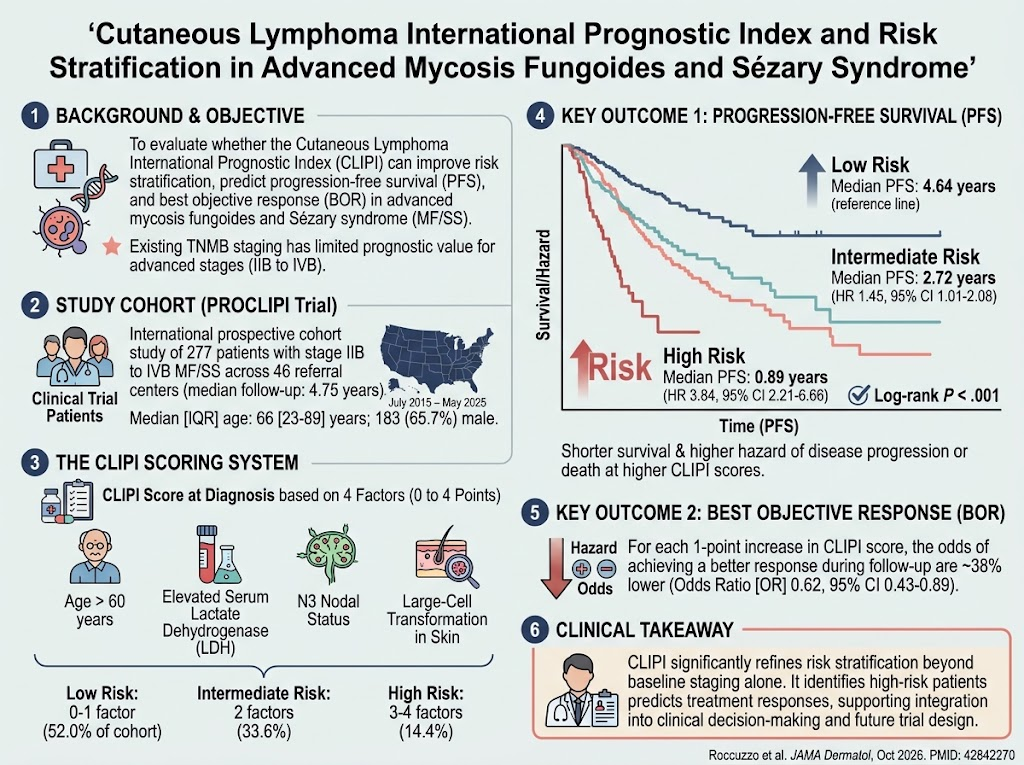
Refining Prognostication in Advanced Mycosis Fungoides and Sézary Syndrome: The Role of the Cutaneous Lymphoma International Prognostic Index (CLIPI)
MedXY Editorial Team•Oct 14, 2026•Dermatology
Cutaneous lymphomaMycosis fungoidesPrognostic indexrisk stratificationSézary syndrome

Highlight

  • The Cutaneous Lymphoma International Prognostic Index (CLIPI) incorporates clinical and laboratory parameters to improve risk stratification in advanced mycosis fungoides (MF) and Sézary syndrome (SS).
  • CLIPI effectively predicts progression-free survival (PFS) and the best objective response (BOR) during follow-up, surpassing the prognostic value of traditional TNMB staging.
  • Higher CLIPI scores are correlated with increased risks of disease progression and death, and lower odds of favorable treatment response.
  • Integrating CLIPI into routine clinical practice may optimize treatment decisions and inform clinical trial designs for MF/SS.

Study Background

MedXY registered readers

Sign in free to continue reading

Create or use your MedXY account to unlock the complete article.

This article was created using several editorial tools, including AI, as part of the process. Human editors reviewed this content before publication.

Related articles

Open language-specific specialty feeds and department pages.

Enhanced Risk Stratification for Pediatric Tracheostomy Hospitalizations: Evaluating a Novel Tracheostomy-Specific Tier SystemA new tracheostomy-specific risk-tier system improves outcome prediction in pediatric tracheostomy hospitalizations compared with traditional severity metrics, offering better benchmarking for clinical care across institutions.Sep 29, 2026Soluble BCMA as a Key Biomarker Defining Tumor Phenotypes and Prognosis in Newly Diagnosed Multiple MyelomaSoluble BCMA levels in newly diagnosed multiple myeloma patients reveal distinct tumor phenotypes and predict prognosis more strongly than tumor volume, enabling improved risk stratification and clinical decision-making.Sep 26, 2026MTMR4 Gene Variants: Divergent Impact on Arrhythmic Risk in Type 1 and 2 Long QT SyndromeMTMR4 minor allele homozygosity influences arrhythmic risk oppositely in LQT1 and LQT2, providing critical insights for personalized risk stratification in long QT syndrome patients.Sep 25, 2026
Loading comments...
MedXY briefing

Get the free newsletter

Evidence-led clinical news, trends, and analysis—delivered to your inbox.

Ask MedXY AI

Most popular

Intimate Health
Five Benefits for Women Continuing Sexual Activity After Menopause
Intimate Health
Why Some Women Have a Strong Sex Drive—And Why Men Shouldn't Worry About It
Nursing & care
How often should a couple have sex?
Cardiology
Precision Medicine for Long QT Syndrome Type 2: Lumacaftor Corrects Trafficking Defects and Shortens QT Interval
General Surgery
Optimizing Postoperative Opioid Prescriptions After Intra-Abdominal Cancer Surgery: Comparing the 5x-Multiplier and 3-Tier Models
© 2026 MedXY
Contact usAbout usPrivacy PolicyMedXY story
Tailored Screening Intervals for Relatives Carrying TTN Truncations: Enhancing Dilated Cardiomyopathy Management
A gene-specific, risk-based screening algorithm for relatives with titin-truncating variants optimizes monitoring intervals from 1 to 5 years, improving safety and resource use in dilated cardiomyopathy surveillance.
Sep 23, 2026
Standalone Salpingectomy for Primary Ovarian Cancer Prevention: A Cost-Effectiveness AnalysisThis review synthesizes evidence on the cost-effectiveness of standalone salpingectomy for ovarian cancer prevention, highlighting its benefits primarily in women at moderately elevated risk, especially between ages 45-50, supporting tailorSep 23, 2026
Stratifying Risk for Further Retinal Intervention After Laser Retinopexy: The Impact of Cumulative Clinical FactorsA novel, cumulative risk factor approach identifies patients at increased risk for additional retinal intervention after laser retinopexy for retinal tears, improving surveillance and management strategies.Sep 15, 2026