We use cookies

Our website uses essential cookies and, with your consent, additional cookies to measure performance and improve our services. Cookie Policy.

You can change your choice at any time.

MMedXYNews
HomeVideos
MedXY AI/MedXY News/Section: news

Impact of Antifibrotic Dose Modifications on Idiopathic Pulmonary Fibrosis Outcomes: Insights from Real-World Data
MedXY Editorial Team•Oct 9, 2026•news
Antifibrotic Therapyclinical outcomesdose reductionIdiopathic Pulmonary Fibrosisreal-world data

Highlight

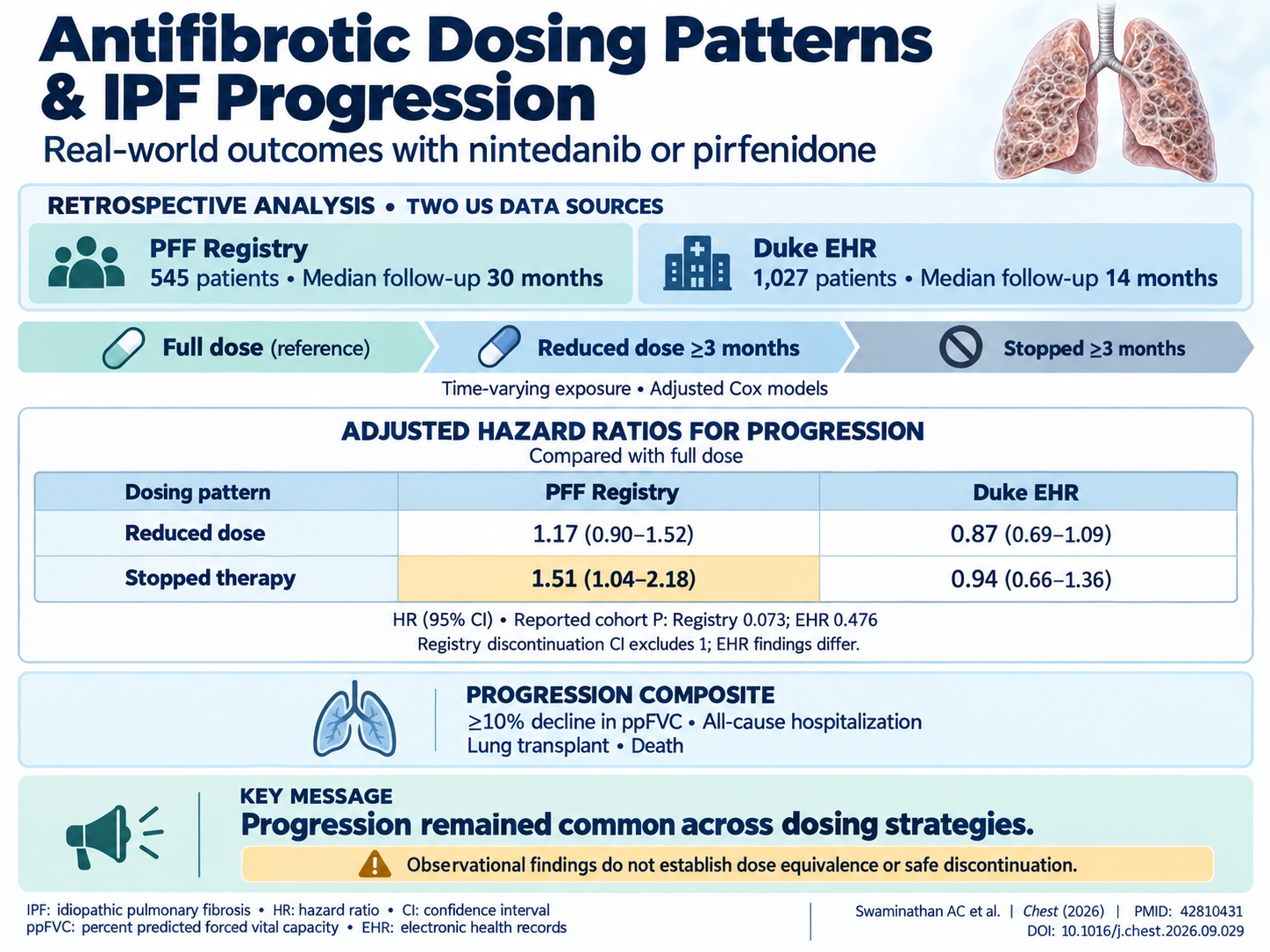
1. Dose reductions and discontinuations of antifibrotic medications nintedanib and pirfenidone are common in clinical practice due to poor tolerability in patients with IPF.
2. Real-world data from the Pulmonary Fibrosis Foundation Registry and Duke University Health System show no significant difference in disease progression risk between patients on full dose antifibrotics and those who reduce or stop therapy.
3. Disease progression rates remain high despite antifibrotic use, emphasizing the urgent need for more effective and better-tolerated treatment options.

Study Background

MedXY registered readers

Sign in free to continue reading

Create or use your MedXY account to unlock the complete article.

This article was created using several editorial tools, including AI, as part of the process. Human editors reviewed this content before publication.

Related articles

Open language-specific specialty feeds and department pages.

Pulse versus Nonpulse Corticosteroid Therapy in Acute Exacerbation of Idiopathic Pulmonary Fibrosis: Evidence Synthesis and Clinical Implications from the SAFER TrialThis review synthesizes current evidence on pulse versus nonpulse corticosteroid therapy in AE-IPF, contextualizing the SAFER trial findings within prior studies and clinical guidelines to guide management and future research.Oct 18, 2026Quality indicators for lupus nephritis care: implementing the 2025 EULAR recommendations — development, adherence, and impact on outcomesA validated set of 17 quality indicators (QIs) for lupus nephritis, derived from the 2025 EULAR recommendations, shows variable adherence in practice and an association between higher adherence and lower damage accrual in a tertiary-care coOct 16, 2026Hematoma Location as a Key Modifier of Intensive Blood Pressure Lowering Outcomes in Acute Intracerebral HemorrhageThis pooled analysis of INTERACT and ATACH-II trials reveals that intensive blood pressure lowering significantly improves outcomes only in patients with deep intracerebral hemorrhage, highlighting hematoma location as crucial for personaliOct 16, 2026
Loading comments...
MedXY briefing

Get the free newsletter

Evidence-led clinical news, trends, and analysis—delivered to your inbox.

Ask MedXY AI

Most popular

Intimate Health
Five Benefits for Women Continuing Sexual Activity After Menopause
Intimate Health
Why Some Women Have a Strong Sex Drive—And Why Men Shouldn't Worry About It
Nursing & care
How often should a couple have sex?
Cardiology
Precision Medicine for Long QT Syndrome Type 2: Lumacaftor Corrects Trafficking Defects and Shortens QT Interval
General Surgery
Optimizing Postoperative Opioid Prescriptions After Intra-Abdominal Cancer Surgery: Comparing the 5x-Multiplier and 3-Tier Models
© 2026 MedXY
Contact usAbout usPrivacy PolicyMedXY story
Gut Microbiota and Idiopathic Pulmonary Fibrosis: Associations with Disease Severity and Survival Outcomes
Emerging evidence reveals gut microbiota profiles correlate with disease severity and survival in idiopathic pulmonary fibrosis, highlighting potential microbial biomarkers and treatment modifiers.
Oct 11, 2026
Age-Adjusted Whole Genome Sequencing Telomere Length in Idiopathic Pulmonary Fibrosis: Enhancing Diagnostic and Prognostic PrecisionAge-adjusted WGS-estimated telomere length improves identification of pathologically short telomeres and detection of telomere-related variants in IPF, associating with survival outcomes but offering limited survival prediction beyond cliniOct 11, 2026
Polygenic Risk Score Enhances Diagnosis and Prognostic Stratification in Idiopathic Pulmonary FibrosisA polygenic risk score (PRS) significantly associates with IPF diagnosis and mortality, demonstrating potential for improving clinical risk stratification using real-world biobank data.Oct 8, 2026