We use cookies

Our website uses essential cookies and, with your consent, additional cookies to measure performance and improve our services. Cookie Policy.

You can change your choice at any time.

MMedXYNews
HomeVideos
MedXY AI/MedXY News/Section: news

Polygenic Risk Score Enhances Diagnosis and Prognostic Stratification in Idiopathic Pulmonary Fibrosis
MedXY Editorial Team•Oct 6, 2026•news
geneticsIdiopathic Pulmonary Fibrosispolygenic risk scoreprognosis

Highlight

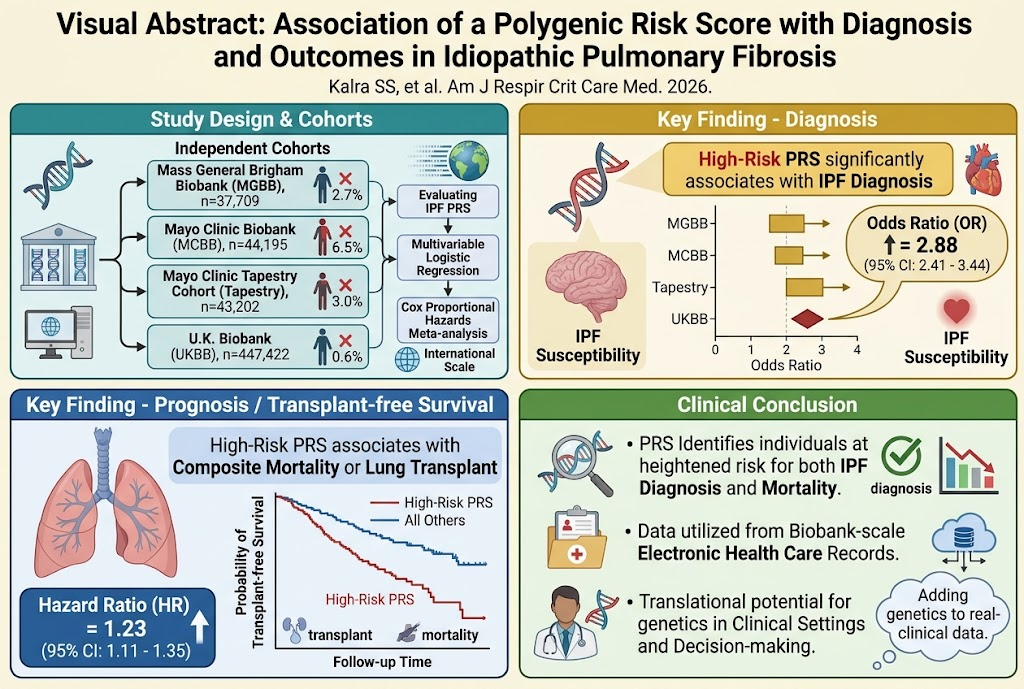
– A polygenic risk score (PRS) strongly associates with idiopathic pulmonary fibrosis (IPF) diagnosis across multiple large biobank cohorts.
– High-risk PRS predicts increased mortality or lung transplant risk in individuals diagnosed with IPF.
– The study leverages routinely collected electronic health records (EHR) and genetic data to evaluate PRS utility in real-world settings.
– Incorporation of PRS into clinical practice could enhance early identification and prognostication in IPF, pending further validation.

Study Background

MedXY registered readers

Sign in free to continue reading

Create or use your MedXY account to unlock the complete article.

This article was created using several editorial tools, including AI, as part of the process. Human editors reviewed this content before publication.

Related articles

Open language-specific specialty feeds and department pages.

Harnessing Circulating Tumour DNA for Minimal Residual Disease Detection in Colorectal Cancer: Insights from the INTERCEPT ProgrammeThe INTERCEPT study demonstrates that longitudinal ctDNA testing effectively detects minimal residual disease post-curative treatment in colorectal cancer, enhancing recurrence prediction and refining risk stratification to guide future intOct 3, 2026Cardiovascular-Kidney-Metabolic Multimorbidity in Heart Failure: Prevalence, Prognostic Impact, and Clinical Implications Across Ejection Fraction PhenotypesMost heart failure patients harbor multiple cardiovascular-kidney-metabolic conditions, which independently escalate mortality and readmission risk, especially in HFrEF, underscoring the need for integrated management strategies tailored byOct 3, 2026Inhaled Treprostinil in Idiopathic Pulmonary Fibrosis: Robust Evidence from the Combined TETON-1 and TETON-2 Phase 3 TrialsCombined analysis of the TETON-1 and TETON-2 trials confirms inhaled treprostinil significantly slows lung function decline, reduces clinical worsening and exacerbations, and improves quality of life in idiopathic pulmonary fibrosis over onSep 28, 2026
Loading comments...
MedXY briefing

Get the free newsletter

Evidence-led clinical news, trends, and analysis—delivered to your inbox.

Ask MedXY AI

Most popular

Intimate Health
Five Benefits for Women Continuing Sexual Activity After Menopause
Intimate Health
Why Some Women Have a Strong Sex Drive—And Why Men Shouldn't Worry About It
Nursing & care
How often should a couple have sex?
Cardiology
Precision Medicine for Long QT Syndrome Type 2: Lumacaftor Corrects Trafficking Defects and Shortens QT Interval
General Surgery
Optimizing Postoperative Opioid Prescriptions After Intra-Abdominal Cancer Surgery: Comparing the 5x-Multiplier and 3-Tier Models
© 2026 MedXY
Contact usAbout usPrivacy PolicyMedXY story
Soluble BCMA as a Key Biomarker Defining Tumor Phenotypes and Prognosis in Newly Diagnosed Multiple MyelomaSoluble BCMA levels in newly diagnosed multiple myeloma patients reveal distinct tumor phenotypes and predict prognosis more strongly than tumor volume, enabling improved risk stratification and clinical decision-making.Sep 27, 2026
Genetically Mediated LDL Cholesterol Variations and Their Limited Impact on Venous Thromboembolism RiskThis study reveals that lifelong genetic differences in LDL cholesterol levels do not significantly affect the risk of venous thromboembolism (VTE), suggesting LDL-C may not be a major causal factor in VTE development.Sep 25, 2026
Enhancing Prognosis in Stable Coronary Artery Disease: Insights from a Nationwide Cohort on FFR-CTThis large nationwide study demonstrates that coronary CTA-derived FFR-CT strongly predicts future myocardial infarction, cardiovascular death, and revascularization, independent of traditional risk factors and stenosis severity, with a thrSep 25, 2026