Impact of Acid Type on the Efficacy of Experimental Fluoride Gels in Protecting Enamel from Erosion
Highlight
• Experimental fluoride gels containing Carbopol 980 and stannous ions significantly reduce enamel mineral loss caused by citric acid erosion.
• The protective effects of these gels are not observed against enamel erosion induced by hydrochloric acid.
• Acid origin critically modulates the efficacy of anti-erosive dental formulations.
• Clinical preventive strategies for erosive tooth wear should consider the chemical nature of the erosive challenge.
Study Background
Erosive tooth wear has emerged as a prevalent clinical concern characterized by the irreversible loss of dental hard tissue due to acid exposure, independent of bacterial action. The widespread consumption of acidic foods and beverages and the occurrence of gastric acid reflux contribute to this pathology. Protective dental formulations, especially those containing fluoride, play a pivotal role in mitigating enamel erosion. However, the chemical nature of the erosive acid, such as intrinsic (gastric hydrochloric acid) versus extrinsic (dietary citric acid) sources, may influence the effectiveness of such interventions. This study addresses a vital knowledge gap by investigating how these different acid types modulate the protective efficacy of experimental anti-erosive fluoride gels combined with Carbopol 980 polymer and stannous ions.
Study Design
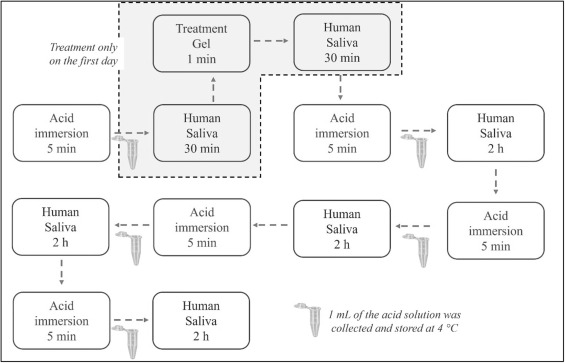
The investigation employed an in vitro experimental design using bovine enamel specimens to model human dental enamel erosion. Two erosive acid challenges were simulated: 0.03% hydrochloric acid and 1% citric acid, both adjusted to pH 2.3 to ensure comparable acidity levels. After an initial erosive episode, enamel samples were treated with one of four gels: 1) acidulated phosphate fluoride (APF) gel (12,300 ppm fluoride, pH 5.2); 2) Carbopol 980 gel (C980, 2 g/100 mL, pH 5.0) as a placebo; 3) sodium fluoride plus Carbopol 980 (NaF + C980, 7,500 ppm fluoride, pH 5.5); and 4) sodium fluoride plus stannous chloride plus Carbopol 980 (NaF + Sn + C980, 7,500 ppm fluoride, 15,000 ppm tin, pH 5.5). Mineral release—calcium and phosphate—was quantified throughout a 5-day erosive cycling protocol to assess enamel demineralization. Surface morphology and elemental composition of samples were examined by scanning electron microscopy (SEM) and energy-dispersive spectroscopy (EDS). Data analysis utilized nonparametric statistics (Kruskal-Wallis and Dwass-Steel-Critchlow-Fligner tests) with significance set at α=0.05.
Key Findings
Baseline measurements demonstrated that citric acid induced significantly greater enamel mineral release compared to hydrochloric acid, with calcium and phosphate losses markedly elevated (calcium p=0.003, phosphate p<0.001). This underscores the differential demineralizing potential even at identical pH values.
Following treatment, analysis revealed significant differences in calcium loss between gels only under citric acid challenge (p<0.001). Specifically, NaF + C980 and NaF + Sn + C980 gels substantially reduced calcium and phosphate release compared to the Carbopol placebo, with efficacy comparable to the APF gel. These findings indicate that the presence of fluoride, with or without stannous ions, effectively mitigated mineral dissolution in the context of citric acid erosion.
Conversely, under hydrochloric acid challenge, no statistically significant differences were observed among the treatment groups, suggesting that the experimental gels did not confer protective benefits against enamel erosion mediated by hydrochloric acid.
SEM and EDS analyses supported quantitative findings: enamel surfaces treated with fluoride-containing gels exhibited protective surface deposits and retained detectable levels of fluoride and tin elements, indicative of mineral stabilization and precipitate formation. These surface modifications likely contributed to the observed erosion resistance under citric acid conditions but were insufficient to counteract the erosive effects of hydrochloric acid.
Expert Commentary
The study importantly highlights that enamel erosion prevention by anti-erosive gels is not universally effective across all acid challenges. The molecular complexity and chelating capacity of citric acid may facilitate formation of metal-fluoride precipitates on enamel surfaces, enhancing protective effects of fluoride and stannous ions integrated formulations. In contrast, hydrochloric acid’s simple monovalent nature with strong proton activity and lack of chelation likely undermines such protective mechanisms.
While the in vitro bovine enamel model is widely accepted for erosion studies, extrapolation to in vivo clinical contexts requires cautious interpretation, as saliva, pellicle, and dietary dynamics also influence erosive processes. Additional clinical trials are warranted to validate these findings and optimize formulations tailored to patients’ specific erosive risk profiles.
This research aligns with emerging consensus that personalized preventive strategies considering acidogenic challenge characteristics improve management of erosive tooth wear. The demonstrated importance of acid chemistry supports further exploration of tailored anti-erosive agents combining polymeric bioadhesives and metal ions to enhance enamel resistance.
Conclusion
The protective efficacy of experimental anti-erosive fluoride gels containing Carbopol 980 and stannous ions is modulated by the origin and chemical nature of erosive acid. These gels significantly reduced enamel mineral loss induced by citric acid but failed to do so against hydrochloric acid erosion. Practitioners should recognize that anti-erosive formulations may not provide uniform protection against enamel erosion arising from diverse acidic insults. Acid chemistry should be an integral consideration in the development and clinical application of preventive treatments for erosive tooth wear. These findings pave the way for differentiating therapeutic approaches and optimizing preventive care in dentistry based on acid challenge profiles.
Funding and Clinical Trials
The original study did not specify funding sources or clinical trial registration. Future studies could benefit from transparency regarding sponsorship and registration in clinical trial databases.
References
1. Da Silva Silveira Cardoso TB, Estenico MR, Torres CRG, Borges AB, Mailart MC, da Silva Ávila DM. Acid origin modulates the protective effect of an experimental anti-erosive gel against enamel erosion. J Dent. 2026 Oct 14:107105. doi: 10.1016/j.jdent.2026.107105. PMID: 42874983.
2. Lussi A, Carvalho TS. Erosive tooth wear: a multifactorial condition of growing concern and increasing knowledge. Monogr Oral Sci. 2014;25:1-15.
3. Zero DT. Etiology of dental erosion–extrinsic factors. Eur J Oral Sci. 1996;104(2 ( Pt 2)):162-77.
This article was created using several editorial tools, including AI, as part of the process. Human editors reviewed this content before publication.