Identifying Preclinical Crohn’s Disease in High-Risk Individuals Using Faecal Calprotectin: A New Framework for Prevention Trials
Highlight
Approximately 20% of asymptomatic first-degree relatives of Crohn’s disease patients exhibit persistently elevated faecal calprotectin (FC), indicating mucosal inflammation.
Persistently high FC (>70 µg/g) effectively distinguishes individuals with presymptomatic Crohn’s disease from those without overt disease.
Higher FC thresholds (>225 µg/g) predict presymptomatic Crohn’s disease with excellent sensitivity and specificity, enabling targeted enrollment in prevention trials.
A novel preclinical classification framework stratifies asymptomatic at-risk subjects into presymptomatic and potential pre-Crohn’s disease, facilitating precision prevention strategies.
Study Background
Crohn’s disease (CD) is a chronic, relapsing inflammatory bowel disease with a rising global incidence and significant morbidity. Despite advances in treatment, CD remains largely incurable, motivating strategies centered on disease prevention. First-degree relatives (FDRs) of CD patients have a substantially elevated risk, often harboring subclinical mucosal inflammation before symptom onset. Identifying these individuals during the preclinical phase offers a critical window to intervene and potentially arrest disease progression. However, optimal biomarkers and screening algorithms to define this preclinical stage remain elusive.
Faecal calprotectin, a neutrophil-derived protein elevated in intestinal inflammation, is a non-invasive biomarker widely used in clinical practice to detect active inflammatory bowel disease. Its utility in asymptomatic at-risk populations to stratify risk and guide prevention trial enrolment has not been rigorously established. The PIONIR trial (Preventing IBD ONset in Individuals at Risk) aims to evaluate a dietary intervention in FDRs, but defining the ideal preclinical target population is imperative for trial success.
Study Design
This prospective screening study recruited 950 asymptomatic FDRs of CD patients aged 6 to 38 years. Participants underwent faecal calprotectin testing as an initial screening tool. Persistent elevation was defined stringently as FC levels exceeding 70 µg/g on at least two separate stool tests, ensuring reproducibility and reducing false positives due to transient inflammation.
Subjects meeting this criterion were offered detailed diagnostic evaluation by panenteric video capsule endoscopy or ileocolonoscopy to identify mucosal abnormalities characteristic of CD or other inflammatory changes. This design allowed stratification of asymptomatic individuals into distinct preclinical phenotypes based on endoscopic and biochemical profiles.
Key Findings
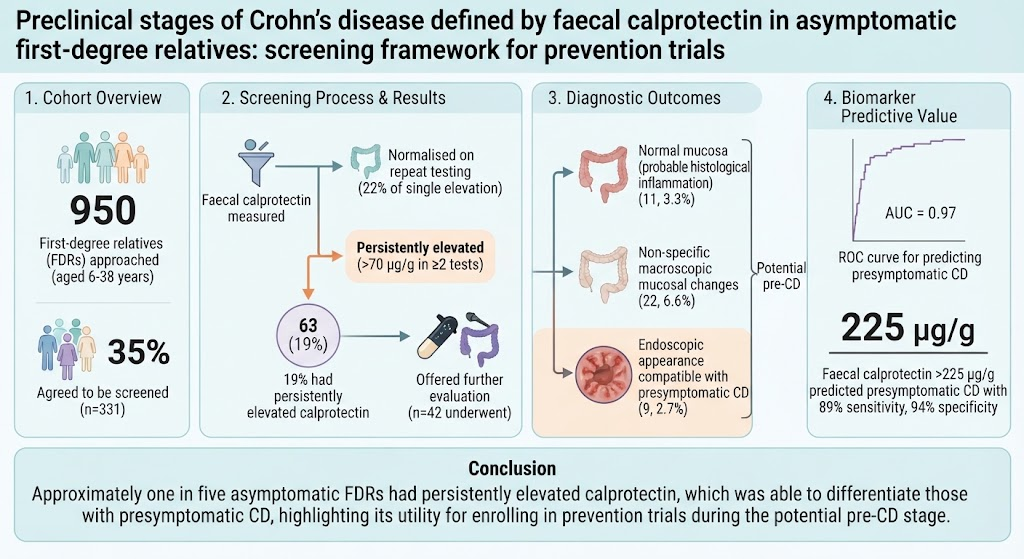
Among 331 screened FDRs (35% of those approached), 63 (19%) exhibited persistently elevated FC. Of these, 42 underwent endoscopic evaluation, revealing three principal groups:
1. Presymptomatic CD (n=9, 2.7% of all screened): Endoscopic findings compatible with CD despite absence of symptoms.
2. Potential pre-CD (n=33, 17.9% adjusted for missing data): Included 22 participants with nonspecific mucosal abnormalities and 11 with normal endoscopy despite elevated FC, suggesting microscopic inflammation.
3. Participants with normal FC on repeat testing despite initial elevation, highlighting intra-individual variability.
Diagnostic performance analyses demonstrated that FC levels >225 µg/g predicted presymptomatic CD with an area under the receiver operating characteristic (AUROC) curve of 0.97 (95% CI 0.94–1.0, p<0.001), sensitivity 89%, and specificity 94%. This strong discriminative ability supports FC as an effective biomarker to enrich prevention trial cohorts.
Additionally, a single elevated FC measurement was less reliable, with 22% normalizing on repeat testing, and an intraclass correlation coefficient of 0.72 confirmed moderate longitudinal variability, underscoring the necessity of repeated testing for screening accuracy.
Expert Commentary
This study represents a pivotal advance in conceptualizing the preclinical stages of Crohn’s disease in high-risk asymptomatic individuals. By coupling serial FC measurements with targeted endoscopic evaluation, researchers have delineated a gradient of subclinical inflammation ranging from microscopic to overt endoscopic disease.
The identification of a ‘potential pre-CD’ stage is particularly novel, suggesting a biologically meaningful window for intervention prior to macroscopic disease. Such stratification enhances the precision of prevention trials by selecting individuals most likely to benefit while avoiding missed early disease.
However, limitations include incomplete endoscopic evaluation in some subjects with elevated FC, potentially biasing phenotype distribution. The modest participation rate (35%) may raise concerns about screening feasibility and generalizability. Longitudinal follow-up is needed to ascertain the natural history and validate the clinical impact of these preclinical stages.
From a mechanistic perspective, elevated FC reflects neutrophil influx into the intestinal mucosa, an early event in inflammation. The strong predictive value of FC >225 µg/g aligns with this pathophysiology and offers a quantitative threshold for risk stratification.
Current guidelines do not specify optimal biomarkers for identifying at-risk asymptomatic individuals, and this study provides empirical evidence to incorporate FC into clinical algorithms for preventive medicine in CD.
Conclusion
The PIONIR preclinical screening framework leverages faecal calprotectin to identify asymptomatic first-degree relatives at high risk for Crohn’s disease. Persistent FC elevation effectively delineates presymptomatic CD and defines a broader potential pre-CD population, setting the stage for precision prevention trials.
Implementation of serial FC testing with confirmatory endoscopy enables targeted enrollment of individuals with early mucosal inflammation. This approach could transform care by enabling interventions before irreversible intestinal damage and symptomatic disease develop.
Future work should focus on validating these findings in diverse populations, exploring additional non-invasive biomarkers, and assessing the impact of early intervention in randomized controlled prevention trials.
Funding and ClinicalTrials.gov
The study was supported as part of the PIONIR trial initiative. Details of funding sources and trial registration can be accessed via ClinicalTrials.gov and the original publication.
References
Turner D, Kenigsberg S, Focht G, et al. Preclinical stages of Crohn’s disease defined by faecal calprotectin in asymptomatic first-degree relatives: screening framework for prevention trials. Gut. 2026;75(11):2225-2231. doi:10.1136/gutjnl-2025-XXX
Additional literature supporting faecal calprotectin use in inflammatory bowel disease and preclinical detection strategies is available upon request.
This article was created using several editorial tools, including AI, as part of the process. Human editors reviewed this content before publication.